JEE Main 2026 Highlights: The National Testing Agency (NTA) conducted the JEE Main 2026 Session 1 examinations for the fourth consecutive day on Friday. The exam body stated that 10,36,211 candidates have appeared in the ongoing examination since it began on January 21. According to cumulative data released on January 24, overall attendance stood at 96.26%, while Aadhaar verification was completed for 96.19% of candidates. A total of 3,453 PwD candidates appeared for the examination.
Experts said the Shift 1 exam on JEE Main Day 4 was of moderate difficulty. Physics, Chemistry, and Mathematics were largely of equal level, although Mathematics was slightly more challenging due to lengthy calculations, while Physics and Chemistry were relatively moderate. The paper was well-balanced in terms of question distribution and chapter coverage.
The second shift exam was also of moderate difficulty, according to Ajay Sharma, National Academic Director (Engineering) at Aakash Educational Services Limited. Physics and Chemistry were of nearly similar moderate difficulty, while Mathematics was comparatively more challenging. He noted that the paper featured a balanced mix of questions with comprehensive syllabus coverage.
The Session 1 exams for BE/BTech were scheduled for January 21, 22, 23, 24, and 28, while the BArch/BPlanning exam will be conducted on January 29, 2026. The exam is being held in Computer-Based Test (CBT) mode across two sessions: the first session in January and the second in April.
JEE Main 2026 Jan 24: Track all latest updates on the Session 1 exam for Day Four here
JEE Main 2026 Jan 24 Live: How The Second Shift Fared Subject-Wise
Physics
The Physics section was moderate in difficulty, with questions drawn from nearly all major chapters. Mechanics, Electrostatics, and Magnetism received higher weightage, while Optics and Waves had relatively fewer questions. Topics such as Fluids, Mechanical Properties, Oscillations, Electromagnetic Waves, Thermodynamics, Thermal Properties, and Modern Physics were adequately covered. About half of the questions were basic, while the remainder were calculation-based. Although conceptually straightforward, some questions were time-consuming. Notably, no questions were asked from Electromagnetic Induction (EMI) or Alternating Current (AC).
Chemistry
The Chemistry section ranged from easy to moderate. Questions were distributed across Organic, Inorganic, and Physical Chemistry, with fewer from Inorganic Chemistry. Organic and Physical Chemistry had nearly equal representation, though Physical Chemistry included slightly more numerical problems. Some integer-type questions involved lengthy calculations, making the section time-consuming. Several statement-based questions were directly derived from NCERT.
Mathematics
The Mathematics section was moderate to difficult and emerged as the most challenging. Questions were evenly distributed across the syllabus, with stronger focus on Algebra, Calculus, and Conic Sections. Topics such as 2D and 3D Geometry, Matrices, Vectors, and Complex Numbers had average representation, while Probability and Permutation & Combination carried relatively higher weightage. Lengthy, multi-step calculations made this section particularly time-consuming.
Overall Difficulty
Based on student feedback, the overall difficulty ranking of the paper was: Mathematics > Physics > Chemistry
JEE Main 2026 Jan 24 Live: Maths Tougher Than Physics, Chemistry In Second Shift
The Joint Entrance Examination (JEE) Main paper conducted on January 24, 2026, in the second shift was of moderate overall difficulty, according to Ajay Sharma, National Academic Director (Engineering) at Aakash Educational Services Limited.
He said that Physics and Chemistry were of similar moderate difficulty, while Mathematics was comparatively more challenging. He noted that the paper featured a balanced mix of questions with comprehensive syllabus coverage.
JEE (Main) 2026 Session 1 Jan 24: Over 10.36 Lakh Candidates Appear So Far
The National Testing Agency (NTA) said the JEE (Main) 2026 Session 1 examinations held between January 21 and 24 were conducted smoothly, with 10,36,211 candidates appearing across shifts. According to cumulative data released on January 24, the overall attendance stood at 96.26%, while Aadhaar verification was completed for 96.19% of candidates. A total of 3,453 PwD candidates appeared for the exam.
📢 JEE (Main) 2026 | Session 1 – Day Update (24 Jan 2026)
— National Testing Agency (@NTA_Exams) January 24, 2026
📊 Cumulative data for 21–24 January 2026 reflects smooth and successful conduct of the examination:
👨🎓 Candidates Appeared: 10,36,211
📈 Attendance: 96.26%
🆔 Aadhaar Verified: 96.19%
♿ PwD Candidates: 3,453
🤝… pic.twitter.com/O9btED1FN0
JEE Main 2026 Jan 24 (Live Updates): Shift 2 Exam Ends, Paper Analysis Soon
The National Testing Agency (NTA) conducted the JEE Main 2026 Session 1 examinations for the fourth consecutive day. According to experts, the Shift 1 paper was of moderate difficulty. The subject-wise paper analysis will be released soon.
JEE Mains 2026 LIVE: Exam Analysis For Mathematics Paper
The Mathematics section was moderate to difficult. Questions were well-distributed across the syllabus, with greater emphasis on Algebra, Calculus, and Conic Sections. Topics like 2D Geometry, Sets, Determinants, Matrices, 3D Geometry, Vectors, and Complex Numbers had an average presence, while Probability and Permutation & Combination had relatively fewer questions. The lengthy calculations made this section the most challenging and time-consuming.
JEE Main 2026: Exam Analysis For Chemistry Paper
Chemistry
The Chemistry section was easy to moderate. Questions were distributed across Organic, Inorganic, and Physical Chemistry. Among these, Inorganic Chemistry had relatively fewer questions, while Organic and Physical Chemistry were almost equally represented, with Physical Chemistry having slightly more numerical questions. Some of these were calculation-intensive, making the section somewhat time-consuming. Several statement-based questions were directly inspired by NCERT.
JEE Main 2026: Exam Analysis For Physics Paper
Physics
The Physics section was easy to moderate in difficulty. Questions were asked from almost all major chapters, with a greater focus on Mechanics, Electrostatics, and Magnetism, while Optics, Waves, and EMI had comparatively fewer questions. A fair number of questions were also seen from Gravitation.
Some statement-based theoretical questions appeared ambiguous, making them slightly tricky to answer, though several were straightforward and direct. A few questions were time-consuming. Topics like Fluids, Oscillations, Electromagnetic Waves, Thermodynamics, Thermal Properties, and Modern Physics were adequately represented. Overall, the section comprised roughly 50% basic and 50% calculation-based questions.
JEE Mains 2026 LIVE Updates: Physics And Chemistry Papers Were Relatively Moderate, Says Expert
All three subjects Physics, Chemistry, and Mathematics were nearly of equal level, though Mathematics was slightly more challenging due to lengthy calculations, says Ajay Sharma
National Academic Director, Engineering, Aakash Educational Services Limited. Physics and Chemistry papers were relatively moderate. The paper was well-balanced in terms of question distribution and chapter coverage.
JEE Main 2026 News Updates: Experts Feel Paper Showed Growing Trend In Numerical Ability
"The 24th of January Shift 1 paper clearly highlighted a growing trend in JEE Main strong numerical ability and NCERT-based conceptual clarity are becoming decisive. With practical Organic Chemistry questions being repeated across shifts, students who observe patterns, revise consistently and focus on fundamentals are better positioned for upcoming exams," says Ujjwal Singh. founding CEO, Infinity Learn by Sri Chaitanya.
JEE Mains 2026 LIVE: Paper Analysis For Chemistry
Chemistry
Easy and Balanced
Questions were spread across Physical, Organic and Inorganic Chemistry. Numerical questions dominated, especially from Physical Chemistry, with a few statement-based conceptual questions. NCERT-based preparation proved effective.
JEE Mains 2026: Physics Paper Analysis
Physics
Easy to Moderate
Aligned with previous shifts. Questions were predictable with no major surprises, making it manageable for prepared students.
JEE Mains 2026 Updates: Paper Analysis For Mathematics
Mathematics
Moderate to Difficult
Similar to earlier papers. A few questions were lengthy and time-consuming, requiring careful time management and strong problem-solving skills.
JEE Mains 2026 LIVE: What Is The Expected Cutoff For 2026 JEE Mains?
The National Testing Agency (NTA) is conducting the Joint Entrance Examination (JEE Mains) session 1 in Computer Based Test (CBT) mode. The results for the Session 1 exam will be announced on January 12, 2026.
The NTA scores for each of the candidates in total in Paper-1 for Session 1 as well as for Session 2 of JEE (Main) - 2026 will be merged for the compilation of results and preparation of the overall merit list/ranking. The best of the two NTA scores in total (and not in individual subject) will be considered for further processing for those candidates who appeared in both sessions.
Candidates are required to achieve a minimum qualifying percentile in order to be eligible for appearing in the JEE Advanced exam. Applicants are required to achieve the admission cutoff for taking admission in NITs, IIITs, and other participating institutes.
The cutoff for General category candidates in 2025 and 2024 was 93. in 2023, the cutoff was 90 while in 2022 it was 88.
Based on the previous years' cutoff, the tentative cutoff percentile for JEE Mains 2026 is expected to be 93-95 for General category students.
For General EWS, the cutoff may lie between 80-82. Candidates from the OBC-NCL category may require score between 79-81.
Those belonging to the SC category may require 60-63 while candidates from the ST category may require 47-50.
JEE Main 2026 LIVE: First Shift Concludes, Exam Analysis To Follow Soon
NTA has conducted the Joint Entrance Examination (JEE) Main 2026 on its fourth day today, January 24, 2026. The first shift began at 9 am and concluded 12 noon. The second shift will start at 3 pm and will continue until 6 pm.
JEE Main 2026 Live: Nanded Candidates Advised To Reach Exam Centres Early Amid Traffic Advisory
The NTA has issued an advisory for
candidates appearing for JEE (Main) 2026 Session-1 in Nanded. On 24 January
2026, the "Hind Di Chadar" Samagam, organised by the Maharashtra
government in tribute to Guru Tej Bahadur Ji, may affect traffic in the city.
Candidates are advised to plan their commute carefully, report to exam centres
well in advance, and carry their admit card along with a valid
government-issued photo ID, as these may be checked during security or traffic
inspections.
JEE Mains 2026 Updates: First Shift Underway, To End At 12 PM
The National Testing Agency (NTA) is conducting the Joint Entrance Examination (JEE) Main 2026 on its fourth day today, January 24, 2026. The first shift began at 9 am and ended around 12 noon, while the second shift will start at 3 pm and will continue until 6 pm.
JEE Mains 2026 LIVE: When Will NTA Release Admit Cards For January 28, 29 Exam
The agency has not yet released the admit cards for the JEE Mains exam scheduled for January 28 and 29, 2026. The exam on these days will be conducted for Paper 1 (BE/BTech), Paper 2A (Barch), Paper 2B (BPlanning) and Paper 2A and 2B (BArch and BPlanning both).
JEE Mains 2026: When Will NTA Release Results For The Exam?
The NTA will display the provisional answer key of the questions along with the recorded response of the candidate on the NTA website: https://jeemain.nta.nic.in/
Candidates will be provided with an opportunity to challenge the provisional answer keys with a non-refundable online payment of Rs 200 per question challenged as processing charges.
Challenges made along with payment during the stipulated time will only be considered.
Challenges without justification/evidence and those filed on any other medium other than the prescribed link will not be considered.
The subject experts will examine all the challenges received. Post this, NTA will release a final answer. The result will be compiled based on the final answer key declared on NTA website.
JEE Mains 2026: Admission Process Post Result Declaration
Candidates will be offered admission based on their choices and All India Ranks of JEE (Main) 2026 through a Seat Allocation Process. The same will be announced later by CSAB/ JoSAA. The authentication/ verification of relevant documents would be done at the time of the seat allocation/admission process.
On failing to produce any of the authentic documents, the candidate may not be considered for admission.
Gen-EWS, SC, ST, OBC and PwD/PwBD candidates will be required to produce the original
certificate as per prescribed formats issued by the competent authority at the time of the seat allocation/admission process failing which they will not be considered for admission.
JEE Mains 2026: Normalisation Procedure Based On Percentile Score
Percentile scores are based on the shift-wise relative performance of all candidates who appear for the examination. The marks obtained are transformed into a scale ranging from 100 to 0 for each shift of examinees. The percentile score indicates the percentage of candidates that have scored equal to or below (same or lower raw scores) that particular candidate in that shift.
Therefore, the topper (highest score) of each shift will get
the same percentile of 100 which is desirable. The marks obtained in between
the highest and lowest scores are also converted to appropriate percentiles.
JEE Mains 2026: How Is Score Calculated In Case Of A Tie
In case of a tie, when two or more candidates obtain equal total NTA score in JEE Main, the agency follows the 'Method of resolving ties'.
JEE Mains 2026: Display Of Results For Overall Merit List/Ranking of Paper 1
The NTA scores for each of the candidates in total in Paper-1 for Session 1 as well as for Session 2 of JEE (Main) - 2026 will be merged for the compilation of results and preparation of the overall Merit List/Ranking.
The best of the two NTA scores in total (and not in individual subject) will be considered for further processing for those candidates who appeared in both sessions.
JEE Mains 2026: Compilation And Display Of Result Of Paper 1 of JEE Main 2026
The Session 1 of JEE (Main) - 2026 Paper-1 will be conducted in multi-shifts, and the NTA scores will be calculated corresponding to the raw (actual) marks obtained by a candidate. The calculated NTA scores for all the registered candidates will be declared on the website. This will
comprise the NTA scores for each of the three subjects (Mathematics, Physics and Chemistry) and the total in BE / BTech of Session 1 of Paper 1 of JEE (Main) - 2026.
JEE Main 2026: Paper 1 BE/BTech Exam Begins For First Shift
The JEE Main Session 1 exam for the morning shift has started at multiple centres in Computer Based Test (CBT) mode.
JEE Main 2026: "Thorough preparation through NCERT," Says AIR 1
Rajit Gupta, AIR 1 in JEE Main 2026, says, "I scored 96.4 per cent in Class 12 and 332 in JEE Advanced. My strategy for preparing for the exam has been straight and simple. I clearly followed the instructions of my teachers and prepared for the entrance exams throughout the year. I also enrolled at Allen coaching institute for guidance. I discontinued with my JEE preparation during the board exams and focused only on boards. During the final stage of preparation I thoroughly revised NCERT and solved previous year question papers."
JEE Main 2026: Preparation Strategy By AIR 1
Saksham Jindal, AIR 1 in JEE Main 2025, who scored 332 in JEE Advanced shares his success mantra for aspirants to follow during the final stage of preparation. Currently pursuing BTech from IIT Bombay, Jindal suggests focusing on chapters with high weightage. "In Mathematics, Calculus and Vectors carry high marks and should be given more preparation time. Certain chapters in Physics such as Rotation, Fluid Mechanics, EMI and in Chemistry Salt Analysis and Coordination Chemistry may take good amount of time," he told NDTV.
Talking about his preparation strategy for board exams, he said, "I started sincere preparation for board exams nearly 15 days before the boards and made sure to write more of subjective answers in order to match the board pattern. I solved enough problems to develop confidence over the topic."
Jindal scored 96.4 per cent in Class 12 board exams.
Highlighting the importance of previous years question papers, he added, "Solving previous years question papers is crucial as it helps in understanding and getting used to the paper pattern. Students must try to solve all the easy and medium questions in the first go, keeping the difficult questions for the end."
Jindal stressed on the importance of staying calm and composed during the exam time. He said keeping in touch with teachers and parents helps students to remain calm and motivated. "Consistent revision is important and students must keep revising the topics through short notes."
JEE Main 2026 Session 1: Marking Scheme For Exam
Marking scheme for Physics/ Chemistry/ Mathematics
Section A
- This section contains 20 questions for each subject.
- Each question has four options. Only one of these four options is the correct answer.
- Candidates are advised to do the calculations with the constants given (if any) in the questions.
- The answer to each question will be evaluated according to the following marking scheme.
- For every correct answer candidates will be awarded 4 marks. No marks will be given/deducted for unanswered/ marked for review (without selecting any option).
- There is a negative marking of 1 mark for every incorrect answer.
Section B
- This section contains five questions for each subject, all must be attempted.
- The answers for this section should be filled as a numerical value.
- Candidates are advised to do the calculations with the constants given (if any) in the questions. The answer should be rounded off to the nearest integer.
- For each question, enter the correct integer value of the answer using the mouse and the onscreen virtual numeric keypad in the place designated to enter the answer.
- The answer to each question will be evaluated according to the following marking scheme.
- For every correct answer candidates will be awarded 4 marks. No marks will be given/deducted for unanswered/ marked for review (without selecting any option).
- There is a negative marking of 1 mark for every incorrect answer.
JEE Mains 2026: Unfair Practices That May Invite Punishment
Unfair Practices that can result in cancellation of the candidate's exam:
- Using or attempting to use any other undesirable method or means in connection with the exam
- Manipulation, Locking and fabrication of online or physical documents/certificates viz. Admit Card, Self- Declaration, score card, Aadhaar Card or any certificates/documents issued by any Government authority etc
- Forceful entry in /exit from examination centre/hall beyond the specified time Use or attempted use of any electronic device after entering the examination centre
- Affixing/uploading of wrong/morphed photographs/signatures on the Application Form/Admit Card/ ProformaPassing on the rough paper with scribbling
- Trying to hack the system, possession/use of USBs, hacking tools, cheating through Screen recording, taking photos/screenshots, Bluetooth devices,
- Logging in with another person's credentials or fake ID, trying to hack the test software, tampering, pausing or altering test timer, sharing or leaking digital copies of questions
- Creating obstacles in the smooth and fair conduct of the examination Fidgeting and looking here and there
- In possession of bits of written/ printed paper
- Any candidate with more than one application number (more than one SCORE CARDS) will be treated as UFM, even if found at a later stage, and strict action will be taken against that candidate
- Candidate Producing/uploading manipulated Disability Certificate/ Medical Certificate or Documents
- Breaching examination rules or any direction issued by NTA in connection with various examination from time to time
- Any other malpractices declared as Unfair Means by the NTA
- An offence punishable under the Public Examinations (Prevention of Unfair Means) Act, 2024
JEE Mains 2026: NTA Advises Candidates To Avoid Unfair Practices
NTA had also advised candidates not to involve in unfair activities as these may result in cancellation of the candidate's exam. Such candidate may also be debarred up to three years in the future and may also be liable for criminal action.
The following are some of the activities that may result in cancellation of the candidate's exam:
- Being in possession/use of any item or article in the exam hall which has been prohibited including any stationery item, communication device, mobile phone, bluetooth device, smartwatch, calculator, electronic device, accessories, any items restricted by the examination agency
- Engaging someone to write an examination (impersonation) or preparing material for copying.
- Contacting or communicating or trying to do so with any person, other than the examination staff, during the exam time in the centre.
- Peaking and interacting, talking, whispering, cheating, writing on hands/desks, assisting others during the exam
- Passing answers or communicating through hand signals or gestures, looking at another student's screen
- Threatening any of the officials connected with the conduct of the examination or threatening any of the candidates
JEE Main 2026: NTA Issues Warning To Students
The National Testing Agency (NTA) had issued a strong advisory for candidates appearing in the JEE (Main) 2026 Session 1, cautioning them against misleading claims of leaked question papers circulating on social media platforms.
The testing agency warned students about fraudulent advertisements that mislead students, demand money or collect personal data, which could result in financial loss and misinformation. It categorically stated that question papers are not provided, sold, shared, or leaked through any social media platform.
"Claims of 'paper leaks' on social media are fake and misleading. Avoid sharing personal details or making payments," NTA said in the advisory.
JEE Mains 2026: Qualified Candidates To Appear In JEE Advanced
Candidates who qualify JEE Main will be eligible to appear in JEE Advanced which is scheduled to be conducted on May 17 in two shifts - from 9 am to 12 pm (paper 1) and 2:30 pm to 5:30 pm (paper 2). The registration process for the same will begin on April 23, 2026.
JEE Main 2026: Exam Being Held At Multiple Centres
The JEE (Main) 2026 Session 1 began on January 21 at multiple centres across several cities in India and 15 cities abroad. More than 14 lakh students have registered for the exam, which will continue till January 29.
JEE Main 2026 Session 1 : JEE Main Session 1 Results To Be Out In February
The exam is being conducted in Computer Based Test (CBT) mode in two sessions. The first session has been scheduled for January, while the second session will be held in April.
The results for the January session will be out on February 12, 2026.
JEE Main session 2 is scheduled for April 1-10, 2026. The results for session 2 will be announced by April 20, 2025.
JEE Mains 2026: Entrance Exam Being Held In Two Sessions
The session 1 exams for JEE Mains 2026 for BE/BTech had been scheduled for January 21, 22, 23, 24, 28, while that for BArch/BPlanning will be conducted on January 29, 2026.
The exam is being held in Computer Based Test (CBT) mode in two sessions. The first session has been scheduled for January, while the second session will be held in April.
JEE Main session 2 is scheduled for April 1-10, 2026.
JEE Mains 2026: Day 3 Paper Was Of Moderate Difficulty, Say Experts
According to experts, the JEE (Main) paper for the morning shift was of easy to moderate difficulty. All three subjects, Physics, Chemistry, and Mathematics, were nearly of equal difficulty. However, Mathematics was slightly more challenging, while Physics and Chemistry were comparatively easier to moderate. Overall, the paper was balanced in terms of question distribution and chapter coverage.
The JEE (Main) 2026 afternoon shift exam was of overall moderate difficulty, with all three subjects-Physics, Chemistry, and Mathematics-having nearly equal weight, though Mathematics emerged slightly tougher. The paper was well-balanced in terms of question distribution and chapter coverage, according to Ajay Sharma, National Academic Director (Engineering) at Aakash Educational Services Limited.
JEE Mains 2026: Day 3 Recorded 96.15% Attendance
NTA successfully conducted the JEE Main 2026 on its third day on Friday, January 23, 2026, with overall attendance recorded at 96.15 per cent so far. In an official update on JEE (Main) 2026 Session 1, the NTA confirmed that attendance stood at 96.15 per cent as of January 23, 2026. According to the agency, 8,01,326 candidates were registered to appear for the examination at centres across the country. Of these, 7,70,441 candidates have taken the test to date. Aadhaar-based verification was successfully completed for 7,40,412 candidates, accounting for 96.10 per cent of those who appeared.
The NTA also stated that 2,563 Persons with Disabilities (PwD) candidates have appeared for the examination during the ongoing session.
JEE Main 2026 Jan 23 Live Updates: Maths Most Difficult In Afternoon Shift
The JEE (Main) 2026 afternoon shift exam on January 23 was of overall moderate difficulty, with all three subjects-Physics, Chemistry, and Mathematics-having nearly equal weight, though Mathematics emerged slightly tougher. The paper was well-balanced in terms of question distribution and chapter coverage, according to Ajay Sharma, National Academic Director (Engineering) at Aakash Educational Services Limited.
Physics:
The Physics section was moderate in difficulty, with questions spanning most major chapters. Electrostatics and Magnetism featured prominently, while Optics had fewer questions. Mechanics had decent representation. The section included experiment-based questions and others requiring conceptual understanding and careful analysis. Topics like Electromagnetic Waves, Thermodynamics, Gravitation, Thermal Properties, and Modern Physics were also well-covered. Some questions were time-consuming, adding a layer of challenge.
Chemistry:
Chemistry was relatively easier. Questions were drawn from Organic, Inorganic, and Physical Chemistry, with Inorganic being slightly underrepresented. Many questions were statement-based and largely NCERT-aligned. While mostly straightforward, a few problems demanded careful reading and application of basic principles.
Mathematics:
The Mathematics section ranged from moderate to difficult. Questions were distributed across the syllabus, with Algebra, Calculus, and Conic Sections receiving more focus. Determinants, Matrices, 3D Geometry, Vectors, and Complex Numbers had average presence, while Probability had fewer questions. Algebra was slightly dominant, and Coordinate Geometry carried moderate weightage.
Overall Difficulty Ranking (Based on Student Feedback):
Mathematics > Physics > Chemistry
JEE Main 2026 Jan 23 Live Updates: Second Shift Concludes, Attendance Crosses 96%
The National Testing Agency (NTA successfully conducted the Joint Entrance Examination (JEE) Main 2026 on its third day today, January 23, 2026, with overall attendance recorded at 96.15 per cent so far. The examination is being held in two shifts daily, with the first shift conducted from 9 AM to around 12 noon and the second shift from 3 PM to 6 PM.
JEE Main 2026 Session 1 Live Update: Over 96% Attendance Recorded Till January 23
The National Testing Agency (NTA) has released an official update on the conduct of JEE (Main) 2026 Session 1 till January 23, 2026. A total of 8,01,326 candidates were scheduled to appear for the examination, of whom 7,70,441 candidates took the test, recording an overall attendance of 96.15%.
According to NTA, Aadhaar verification was completed for 7,40,412 candidates, accounting for 96.10%, while 2,563 PwD candidates appeared for the exam.
The agency said seamless coordination with state and district authorities, along with disciplined participation by candidates, ensured the smooth conduct of the examination.
For assistance, candidates may contact jeemain@nta.ac.in or the helpline number 011-40759000.
JEE Main 2026 Live: Nanded Candidates Advised To Reach Exam Centres Early Amid Traffic Advisory
The National Testing Agency (NTA) has issued an advisory for candidates appearing for JEE (Main) 2026 Session-1 in Nanded. On 24 January 2026, the "Hind Di Chadar" Samagam, organized by the Maharashtra government in tribute to Guru Tej Bahadur Ji, may affect traffic in the city. Candidates are advised to plan their commute carefully, report to exam centres well in advance, and carry their admit card along with a valid government-issued photo ID, as these may be checked during security or traffic inspections.
🚨 Important Advisory for Candidates (Nanded) 🚨
— National Testing Agency (@NTA_Exams) January 23, 2026
In view of the “ Hind Di Chadar” Samagam being organized by the Govt. of Maharashtra on 24 January 2026 in tribute to Guru Tej Bahadur Ji, traffic movement in Nanded city may be affected.
Candidates with exam centres for JEE…
JEE Main 2026 Jan 23 Live: Physics section Was Of Moderate Difficulty, Says Ajay Sharma, Academic Director
Ajay Sharma said the Physics section was of moderate difficulty, with questions covering almost all major chapters. "There was a higher number of questions from Magnetism, while Optics had comparatively fewer. Mechanics had average representation. Some questions were time-consuming, which made the section slightly challenging," he added.
JEE Main 2026 Jan 23: Second Shift Underway, To End At 6 PM
The National Testing Agency (NTA) is conducting the Joint Entrance Examination (JEE) Main 2026 on its third day today, January 23, 2026. The first shift began at 9 AM and ended around 12 noon, while the second shift started at 3 PM and will continue until 6 PM.
JEE Main Jan 23 Paper Analysis: Mathematics Tested Students' Ability, Says Expert
"This paper clearly reinforced an important shift in competitive exams success is moving beyond speed to depth of understanding. Mathematics tested students' ability to apply concepts under time pressure, while Physics and Chemistry rewarded those with strong fundamentals. Consistent revision and conceptual clarity, rather than last-minute preparation, made the real difference in this shift. Advised to students is to focus on building strong fundamentals rather than chasing shortcuts," says Ujjwal Singh, Founding CEO, infinity Learn by Sri Chaitanya.
JEE Mains 2026 Day 3 Shift 1 Paper Analysis For Physics
Physics
The Physics section was of moderate difficulty, says Ajay Sharma. Questions covered almost all major chapters, with a higher number from Magnetism, while Optics had comparatively fewer. Mechanics had an average representation. A few questions were time-consuming, making the section a bit challenging. Topics like Electromagnetic Waves, Thermodynamics, and Modern Physics were also adequately represented.
JEE Mains 2026 Day 3 Shift 1 Paper Analysis For Chemistry
Chemistry
The Chemistry section was easy to moderate, explains Ajay Sharma. Questions were evenly distributed among Organic, Inorganic, and Physical Chemistry, with a slightly higher weightage to Organic Chemistry. Physical and Inorganic Chemistry had nearly equal representation. Many questions were statement-based and closely aligned with NCERT concepts. While not difficult, some required careful reading and conceptual clarity.
JEE Mains 2026 Day 3 Shift 1 Paper Analysis For Mathematics
Mathematics
The Mathematics section was moderate to difficult, highlights Ajay Sharma, National Academic Director, Engineering, Aakash Educational Services Limited. He further explains, "Questions were well distributed across the syllabus with higher representation from Integral Calculus, Conic Sections, and Algebra (notably Binomial Theorem). Topics like 3D Geometry, Vectors, and Complex Numbers had an average presence. Algebra appeared slightly dominant, while Coordinate Geometry maintained moderate weightage."
JEE Mains 2026 Day 3 Shift 1: Mathematics Was Toughest Section
The JEE (Main) paper conducted on January 23, 2026 in the morning shift was of easy to moderate difficulty level. All three subjects-Physics, Chemistry, and Mathematics were nearly of equal difficulty. However, Mathematics was slightly more challenging, while Physics and Chemistry were comparatively easier to moderate. The paper was largely balanced in terms of question distribution and chapter coverage.
As per Ajay Sharma, National Academic Director, Engineering, Aakash Educational Services Limited, Mathematics was the most difficult section in the JEE Main Session 1 Paper 1. Physics and Chemistry was the relatively less difficult as compared to Mathematics.
JEE Mains 2026: When Will NTA Release Results For The Exam?
The NTA will display the provisional answer key of the questions along with the recorded response of the candidate on the NTA website: https://jeemain.nta.nic.in/
Candidates will be provided with an opportunity to challenge the provisional answer keys with a non-refundable online payment of Rs 200 per question challenged as processing charges.
Challenges made along with payment during the stipulated time will only be considered.
Challenges without justification/evidence and those filed on any other medium other than the prescribed link will not be considered.
The subject experts will examine all the challenges received. Post this, NTA will release a final answer. The result will be compiled based on the final answer key declared on NTA website.
JEE Mains 2026: Exam Analysis For Shift 1 To Follow Soon
The Paper 1 BE/BTech exam has concluded for the first shift of Day 3. The exam analysis and feedback by experts and students will be available soon.
JEE Mains 2026: Paper 1 BE/BTech Concludes For Shift 1
The National Testing Agency (NTA) concluded the first shift of the Paper 1 BE/BTech for JEE Mains 2026 Day 3. Candidates are now wrapping up from the first shift of the exam and planning to exit the centre.
JEE Mains 2026: Admission Process Post Result Declaration
Candidates will be offered admission based on their choices and All India Ranks of JEE (Main) 2026 through a Seat Allocation Process. The same will be announced later by CSAB/ JoSAA. The authentication/ verification of relevant documents would be done at the time of the Seat Allocation/admission process.
On failing to produce any of the authentic documents, the candidate may not be considered for admission.
Gen-EWS, SC, ST, OBC and PwD/PwBD candidates will be required to produce the original
certificate as per prescribed formats issued by the competent authority at the time of the seat allocation/admission process failing which they will not be considered for admission.
JEE Mains 2026: Normalisation Procedure Based On Percentile Score
Percentile scores are based on the shift-wise relative performance of all candidates who appear for the examination. The marks obtained are transformed into a scale ranging from 100 to 0 for each shift of examinees. The percentile score indicates the percentage of candidates that have scored equal to or below (same or lower raw scores) that particular candidate in that shift.
Therefore, the topper (highest score) of each shift will get the same percentile of 100 which is desirable. The marks obtained in between the highest and lowest scores are also converted to appropriate percentiles.
JEE Mains 2026: How Is Score Calculated In Case Of A Tie
In case of a tie, when two or more candidates obtain equal total NTA score in JEE Main, the agency follows the 'Method of resolving ties'.
JEE Mains 2026: Display Of Results For Overall Merit List/Ranking of Paper 1
The NTA scores for each of the candidates in total in Paper-1 for Session 1 as well as for Session 2 of JEE (Main) - 2026 will be merged for the compilation of results and preparation of the overall Merit List/Ranking.
The best of the two NTA scores in total (and not in individual subject) will be considered for further processing for those candidates who appeared in both sessions.
JEE Mains 2026: Compilation And Display Of Result Of Paper 1 of JEE Main 2026
Compilation and display of NTA Score for Session 1 of Paper-1
The Session 1 of JEE (Main) - 2026 Paper-1 will be conducted in multi-shifts, and the NTA scores will be calculated corresponding to the raw (actual) marks obtained by a candidate. The calculated NTA scores for all the registered candidates will be declared on the website. This will
comprise the NTA scores for each of the three subjects (Mathematics, Physics and Chemistry) and the total in BE / BTech of Session 1 of Paper 1 of JEE (Main) - 2026.
JEE Main Day 2 Analysis: Subject-Wise Highlights
Physics: Rated easy by most students; Class 12 topics such as Optics, Electromagnetism, and Modern Physics carried more weightage.
Chemistry: Moderate to difficult; Inorganic Chemistry dominated, with strong representation from the p-block.
Mathematics: Moderate to difficult; Calculus, Algebra, and Conic Sections featured prominently.
JEE Main 2026 Expert View: Overall Paper Assessment For Day 2 Exam
The National Academic Director (Engineering) at Aakash Educational Services Limited termed the paper moderate to difficult.
"The JEE Main paper conducted on January 22, 2026 (morning shift) was balanced and comparable to last year's papers. Physics was the easiest section, followed by Chemistry, while Mathematics was relatively more challenging," the expert said.
JEE Mains 2026 Session: How Difficult Was Mathematics Section in JEE Main Day 2 Exam
Mathematics: Easier Overall, Few Lengthy Questions
Ashish Agarwal, Faculty at PhysicsWallah (PW), described the Mathematics section as largely on the easier side and manageable for most candidates.
"Calculations were straightforward and not overly time-consuming. However, a few questions were lengthy and required careful execution, where minor errors could affect final answers," he said.
The paper included questions from Differential Equations, Probability, Vectors and 3D Geometry, Integrals, Area Under the Curve, and Inverse Trigonometric Functions.
"Out of 25 questions, nearly 17 to 20 were relatively easy. Overall, the Mathematics paper allowed well-prepared students to score confidently," Agarwal added.
JEE Mains 2026 Session: How Difficult Was Chemistry Section in JEE Main Day 2 Exam
Chemistry: Moderate Difficulty
Amitabh Sharma, Faculty at PhysicsWallah (PW), said the Chemistry section was of moderate difficulty and covered almost all major areas of the syllabus.
"The Chemistry section showed increased emphasis on reaction-based questions. Topics such as Coordination Compounds and Chemical Bonding featured prominently, along with questions from Hybridisation and Salt Analysis," Sharma said.
He further highlighted the continued importance of name reactions.
"In both Organic and Inorganic Chemistry, name reactions once again played a significant role. The paper maintained a good balance across Organic, Physical, and Inorganic Chemistry, underlining the need for comprehensive preparation rather than selective study."
JEE Mains 2026 Session: How Difficult Was Physics Section in JEE Main Day 2 Exam
Physics: Moderate and Manageable
According to Manish Singh Tak, Faculty at PhysicsWallah (PW), the Physics section was of moderate difficulty, primarily due to a few lengthy questions that required careful reading and precise calculations.
"Overall, the Physics section was of moderate difficulty. The paper included questions from both Class 11 and Class 12, offering a balanced mix of conceptual and numerical problems. While some numerical questions demanded additional focus, they were well within reach for adequately prepared students," Tak said.
He added that the section aligned closely with the prescribed syllabus and followed trends seen in previous JEE Main papers.
"The topic-wise distribution was fairly even, with no single chapter dominating the paper. With effective time management, students should have been able to complete the section comfortably," he noted.
JEE Main 2026: No Exam In West Bengal
NTA has rescheduled the Joint Entrance Examination (JEE) Main 2026 Session 1 for candidates in West Bengal who were scheduled to appear for the exam on January 23. The decision was taken following requests from students seeking a change in the examination date due to the celebration of Saraswati Puja.
Considering the requests from candidates, the NTA has taken a decision for allotting another examination date for the candidates scheduled to appear for JEE Main in West Bengal.
The new examination date will be from the advertised dates for the JEE Main 2026 Session 1 examination.
In a post on X, NTA wrote, "In view of the representations received from candidates in the state of West Bengal regarding the celebration of Saraswati Puja on 23rd January 2026, it has been decided that all candidates scheduled to appear for JEE (Main) in West Bengal on January 23 2026 shall be allotted another date of examination among the advertised dates for JEE (Main) 2026 Session 1 examination."
JEE Main 2026: "Thorough preparation through NCERT," Says AIR 1
Rajit Gupta, AIR 1 in JEE Main 2026, says, "I scored 96.4 per cent in Class 12 and 332 in JEE Advanced. My strategy for preparing for the exam has been straight and simple. I clearly followed the instructions of my teachers and prepared for the entrance exams throughout the year. I also enrolled at Allen coaching institute for guidance. I discontinued with my JEE preparation during the board exams and focused only on boards. During the final stage of preparation I thoroughly revised NCERT and solved previous year question papers."
JEE Main 2026: Preparation Strategy By AIR 1
Saksham Jindal, AIR 1 in JEE Main 2025, who scored 332 in JEE Advanced shares his success mantra for aspirants to follow during the final stage of preparation. Currently pursuing BTech from IIT Bombay, Jindal suggests focusing on chapters with high weightage. "In Mathematics, Calculus and Vectors carry high marks and should be given more preparation time. Certain chapters in Physics such as Rotation, Fluid Mechanics, EMI and in Chemistry Salt Analysis and Coordination Chemistry may take good amount of time," he told NDTV.
Talking about his preparation strategy for board exams, he said, "I started sincere preparation for board exams nearly 15 days before the boards and made sure to write more of subjective answers in order to match the board pattern. I solved enough problems to develop confidence over the topic."
Jindal scored 96.4 per cent in Class 12 board exams.
Highlighting the importance of previous years question papers, he added, "Solving previous years question papers is crucial as it helps in understanding and getting used to the paper pattern. Students must try to solve all the easy and medium questions in the first go, keeping the difficult questions for the end."
Jindal stressed on the importance of staying calm and composed during the exam time. He said keeping in touch with teachers and parents helps students to remain calm and motivated. "Consistent revision is important and students must keep revising the topics through short notes."
JEE Main 2026 Session 1: Marking Scheme For Exam
The following is the marking scheme for JEE Mains Exam.
Marking scheme for Physics/ Chemistry/ Mathematics
Section A
- This section contains 20 questions for each subject.
- Each question has four options. Only one of these four options is the correct answer.
- Candidates are advised to do the calculations with the constants given (if any) in the questions.
- The answer to each question will be evaluated according to the following marking scheme.
- For every correct answer candidates will be awarded 4 marks.
- No marks will be given/deducted for unanswered/ marked for review (without selecting any option).
- There is a negative marking of 1 mark for every incorrect answer.
Section B
- This section contains five questions for each subject, all must be attempted.
- The answers for this section should be filled as a numerical value.
- Candidates are advised to do the calculations with the constants given (if any) in the questions. The answer should be rounded off to the nearest integer.
- For each question, enter the correct integer value of the answer using the mouse and the onscreen virtual numeric keypad in the place designated to enter the answer.
- The answer to each question will be evaluated according to the following marking scheme.
- For every correct answer candidates will be awarded 4 marks.
- No marks will be given/deducted for unanswered/ marked for review (without selecting any option).
- There is a negative marking of 1 mark for every incorrect answer.
JEE Mains 2026: Unfair Practices That May Invite Punishment
Unfair Practices that can result in cancellation of the candidate's exam:
- Using or attempting to use any other undesirable method or means in connection with the exam
- Manipulation, Locking and fabrication of online or physical documents/certificates viz. Admit Card, Self- Declaration, score card, Aadhaar Card or any certificates/documents issued by any Government authority etc
- Forceful entry in /exit from examination centre/hall beyond the specified time
- Use or attempted use of any electronic device after entering the examination centre
- Affixing/uploading of wrong/morphed photographs/signatures on the Application Form/Admit Card/ Proforma
- Passing on the rough paper with scribbling
- Trying to hack the system, possession/use of USBs, hacking tools, cheating through Screen recording, taking photos/screenshots, Bluetooth devices, logging in with another person's credentials or fake ID, trying to hack the test software, tampering, pausing or altering test timer, sharing or leaking digital copies of questions
- Creating obstacles in the smooth and fair conduct of the examination
- Fidgeting and looking here and there
- In possession of bits of written/ printed paper
- Any candidate with more than one application number (more than one SCORE CARDS) will be treated as UFM, even if found at a later stage, and strict action will be taken against that
- Candidate Producing/uploading manipulated Disability Certificate/ Medical Certificate or Documents
- Breaching examination rules or any direction issued by NTA in connection with various examination from time to time
- Any other malpractices declared as Unfair Means by the NTA
- An offence punishable under the Public Examinations (Prevention of Unfair Means) Act, 2024
JEE Mains 2026: NTA Advises Candidates To Avoid Unfair Practices
NTA had also advised candidates not to involve in unfair activities as these may result in cancellation of the candidate's exam. Such candidate may also be debarred up to three years in the future and may also be liable for criminal action.
The following are some of the activities that may result in cancellation of the candidate's exam:
- Being in possession/use of any item or article in the exam hall which has been prohibited including any stationery item, communication device, mobile phone, bluetooth device, smartwatch, calculator, electronic device, accessories, any items restricted by the examination agency
- Engaging someone to write an examination (impersonation) or preparing material for copying.
- Contacting or communicating or trying to do so with any person, other than the examination staff, during the exam time in the centre.
- Peaking and interacting, talking, whispering, cheating, writing on hands/desks, assisting others during the exam
- Passing answers or communicating through hand signals or gestures, looking at another student's screen
- Threatening any of the officials connected with the conduct of the examination or threatening any of the candidates
JEE Main 2026: NTA Issues Warning To Students
The National Testing Agency (NTA) had issued a strong advisory for candidates appearing in the JEE (Main) 2026 Session 1, cautioning them against misleading claims of leaked question papers circulating on social media platforms.
The testing agency warned students about fraudulent advertisements that mislead students, demand money or collect personal data, which could result in financial loss and misinformation. It categorically stated that question papers are not provided, sold, shared, or leaked through any social media platform.
"Claims of 'paper leaks' on social media are fake and misleading. Avoid sharing personal details or making payments," NTA said in the advisory.
JEE Main 2026: Paper 1 BE/BTech Exam Begins For First Shift
The JEE Main Session 1 exam for the morning shift has started at multiple centres in Computer Based Test (CBT) mode.
JEE Main 2026: Exam Began On Multiple Centres
The JEE (Main) 2026 Session 1 began on January 21 at multiple centres across several cities in India and 15 cities abroad. More than 14 lakh students have registered for the exam, which will continue until January 29.
JEE Mains 2026: Qualified Candidates To Appear In JEE Advanced
Candidates who qualify JEE Main will be eligible to
appear in JEE Advanced which is scheduled to be conducted on May 17 in two
shifts - from 9 am to 12 pm (paper 1) and 2:30 pm to 5:30 pm (paper 2). The
registration process for the same will begin on April 23, 2026.
JEE Main 2026 Session 1 : JEE Main Session 1 Results To Be Out In February
The exam is being conducted in Computer Based Test (CBT)
mode in two sessions. The first session has been scheduled for January, while the
second session will be held in April.
The results for the January session will be out on February
12, 2026.
JEE Main session 2 is scheduled for April 1-10, 2026. The
results for session 2 will be announced by April 20, 2025.
JEE Mains 2026: Session 1 Day 3 Exam For BE/BTech Today
The National Testing Agency (NTA) is conducting the Joint
Entrance Examination (JEE) Mains 2026. The session 1 exams for BE/BTech had been
scheduled for January 21, 22, 23, 24, 28, while that for BArch/BPlanning will
be conducted on January 29, 2026.
JEE Main 2026: Complete Analysis For JEE Mains Day 2 Exam
Shift 2 Analysis
The JEE (Main) paper conducted on January 22, 2026 (Evening
Shift) was of moderate to difficult level. All three subjects-Physics,
Chemistry, and Mathematics-were almost of equal difficulty. However, Chemistry
was slightly easier, Mathematics a bit more challenging, and Physics moderately
difficult. The paper was largely balanced in terms of question distribution and
chapter coverage.
JEE Mains Exam Live: Evening Shift Complete Analysis
(Shift 2)
Physics Paper Shift 2 Review
The Physics section was of moderate difficulty. Questions
covered almost all chapters, with a significant number based on experiments.
Topics such as Optics and Electromagnetic Waves (EMW) featured several
experiment- and statement-based questions. While the questions were
conceptually straightforward, many required careful analysis and time to solve.
Units like Mechanics, Thermodynamics, and Waves had comparatively fewer
questions, whereas Optics and Electromagnetism were more prominent. Modern
Physics also had a fair presence.
Day 2 Shift 2 Chemistry Paper Analysis
The Chemistry section was of easy to moderate level.
Questions were asked from all three branches-Organic, Inorganic, and Physical
Chemistry. Among these, Inorganic Chemistry had a relatively lower
representation, while Organic and Physical Chemistry carried almost equal
weightage. Many questions were statement-based and directly inspired by NCERT.
Though not difficult, some required careful reading and application of basic
concepts.
Mathematics Evening Shift Analysis
The Mathematics section was rated moderate to difficult. The
questions were well distributed across the syllabus, with Calculus, Conic
Sections, and Algebra showing higher representation. Topics like 3D &
Vectors and Complex Numbers had fewer questions. Algebra appeared slightly
dominant, while Coordinate Geometry maintained moderate weightage. Chapters
from both Classes XI and XII were well covered.
(The Analysis is done by Ajay Sharma, National Academic
Director, Engineering, Aakash Educational Services Limited)
Candidates appearing for today's shifts are required to
strictly follow the National Testing Agency's (NTA) exam-day guidelines,
including reporting time and gate-closing instructions mentioned on the admit
card. Live updates on the question paper and subject-wise exam analysis will be
shared shortly.
The BE/BTech examinations are being conducted over five days
across 323 exam cities in India and abroad. This year, the NTA received 14.10
lakh applications and has set up more than 300 additional examination centres.
The BE/BTech exams are scheduled for January 21, 22, 23, 24 and 28, 2026.
Meanwhile, the BArch and BPlanning examinations will be held on January 28 and
29, 2026.
JEE Main Exam 2026 Live: Shift 2 Analysis Out
Mathematics was tougher than the earlier shifts, even though the questions were from familiar topics. This shift really showed how important regular revision is. If your concepts are clear, you can approach even lengthy questions with confidence and manage time better. For Chemistry, especially NCERT-based topics and reaction mechanisms, conceptual clarity helped a lot. Overall, consistent revision and strong fundamentals made a clear difference in this paper," said Ujjwal Singh, Founding CEO, Infinity Learn by Sri Chaitanya.
JEE Main Exam 2026 Live: Analysis Out Soon
The shift 2 analysis will be released soon here.
JEE Main Exam 2026 Live: Shift 2 Paper Analysis To Be Out Soon
The paper analysis for shift 2 examination will be released soon. Check Shift 1 analysis here.
JEE Mains 2026 Live: Shift 2 Concludes, Paper Review Soon
The Day 2's second shift JEE Main 2026 examination has been concluded. Paper 2 analysis will be released soon.
JEE Main Exam Live: West Bengal Exam Rescheduled
The NTA has rescheduled the JEE Mains examination in West Bengal scheduled for January 23, 2026
JEE Mains Exam 2026 Live: Shift 2 Underway, Shift 1 Paper Diffculty Moderate
The shift 2 examinaton is currently underway. Shift 1 paper difficulty was recorded as moderate to difficult.
JEE Main Exam Live: Mathematics Paper Analysis
Ashish Agarwal, Faculty, PhysicsWallah (PW) said around 17 to 20 questions out of 25 were relatively easier for students with moderate to strong preparation.
"The mathematics section of the JEE Main paper was generally on the easier side and manageable for most students. Calculations were largely straightforward and not overly time-consuming. However, a few questions were lengthy and demanded careful execution, where minor errors could impact the final answer, adding a slight level of challenge.
The exam featured multiple questions from topics including Differential Equations, Probability, Vectors and 3D Geometry, Definite and Indefinite Integrals, Area Under the Curve, and Inverse Trigonometric Functions. Students appearing in upcoming shifts are advised to prepare these areas thoroughly, as they continue to be important from a preparation perspective.
Out of the 25 questions, approximately 17 to 20 were relatively easy and could be attempted comfortably by students with moderate to strong preparation. Overall, the Mathematics paper leaned towards the easier end, enabling well-prepared candidates to score with confidence." he said.
JEE Mains Exam Live: Chemistry Paper Analysis By Physics Wallah
Amitabh Sharma, Faculty, PhysicsWallah (PW) mentioned that Day 2 shift 1 Chemistry exam had more reaction-based questions compared to previous years.
"The Chemistry section was of moderate difficulty, covering almost all major syllabus areas. A notable trend this year was the increased emphasis on reaction-based questions. As expected, topics such as Coordination Compounds and Chemical Bonding were covered prominently, along with questions from Hybridisation and Salt Analysis.
In both Organic and Inorganic Chemistry, name reactions once again held significant importance, focusing on the need for students to prioritise them during preparation. Questions based on general methods of preparation were also included, along with specific reaction-centric problems involving compounds such as chromides and fluorides, requiring a clear understanding of reaction behaviour.
Overall, the level of questions was well distributed across Organic, Physical, and Inorganic Chemistry when compared with previous years. The paper ensured a balance of questions from all key topics in each subsection, highlighting the importance of a thorough understanding of the syllabus rather than selective preparation." he said.
JEE Mains Exam Live: Physics Paper Analysis By Physics Wallah
Manish Singh Tak, Faculty, PhysicsWallah (PW) said the Day 2 shift 1 Physics paper remained closely aligned with the syllabus.
"Overall, the Physics section was of moderate difficulty, mainly because of a few lengthy questions that demanded careful reading and calculations. The paper had questions from both Class XI and XII, maintaining a mix of conceptual and numerical problems. While some numerical questions required additional focus, they were well within reach for adequately prepared students.
The section was in line with trends observed in previous JEE Main papers and remained closely aligned with the syllabus. Compared to the earlier shift, the topic-wise distribution was more even, with no single chapter carrying more weightage. Overall, the paper was quite manageable, and students with effective time management should have been able to complete it comfortably within the allotted duration." he said.
JEE Mains Exam Live: Complete Paper Analysis
Physics Paper Analysis Day 2 Shift 1
The Physics section was rated easy by most students. Almost all major chapters were represented, though Class XI topics such as Mechanics had relatively fewer questions, with Rotation missing entirely. Chapters like Waves and Thermodynamics were present but carried lesser weightage. In contrast, Class XII chapters were more prominent, with a good number of questions from Optics, Electromagnetism, and Modern Physics. A few questions also appeared from Waves and EMI.
Mathematics Paper Analysis Day 2 Shift 1
The Mathematics section was rated moderate to difficult. Questions were fairly distributed across the syllabus. Topics from Calculus, Conic Sections, and Algebra had higher representation, whereas 3D & Vectors and Complex Numbers were comparatively less frequent. Algebra appeared slightly dominant, and Coordinate Geometry maintained moderate weightage.
Chemistry Paper Analysis Day 2 Shift 1
The Chemistry section was of moderate to difficult level. Questions were asked from all three areas-Organic, Inorganic, and Physical Chemistry. Among these, Inorganic Chemistry had a stronger presence, with several questions from the p-block. Organic Chemistry focused on properties and name reactions, while Physical Chemistry included questions from Electrochemistry, Equilibrium, and Thermodynamics.
JEE Main 2026 Exam Live: Paper Analysis Shift 1 Day 2
According to Ajay Sharma, National Academic Director, Engineering, Aakash Educational Services Limited, the JEE (Main) paper conducted on January 22, 2026 (Morning Shift) was of moderate to difficult level. Among the three sections, Physics was the easiest, followed by Chemistry, while Mathematics was relatively more challenging. Overall, the paper was balanced and comparable to last year's papers in terms of both difficulty level and pattern. The distribution of questions across topics was largely uniform.
JEE Mains Exam Live: Day 1 Attendance
The attendance for Shift 1 exam for January 21 was 95.46 per cent, while that for Shift 2 was 95.77 per cent.
JEE Mains Exam Live: Chemistry Day 2 Shift 1 Paper Analysis
The Chemistry section was of moderate to difficult level. Questions were asked from all three areas-Organic, Inorganic, and Physical Chemistry. Among these, Inorganic Chemistry had a stronger presence, with several questions from the p-block. Organic Chemistry focused on properties and name reactions, while Physical Chemistry included questions from Electrochemistry, Equilibrium, and Thermodynamics.
JEE Main 2026 Jan 22 Live: Shift 2 Begins, To End At 6PM
The second shift of the JEE Main 2026 Session 1 Day 2 examination began at 3 PM after the first shift concluded at 12 noon. The Paper 1 examination for BE/BTech is being conducted in two shifts each day. The morning shift exam begins at 9 AM and ends at 12 noon, while the afternoon shift is scheduled from 3 PM to 6 PM.
JEE Mains Exam 2026 Live: Shift 2 Begins Soon, Shift 1 Paper Review Released
Shift 2 Exam to begin in 10 minutes. Shift 1 paper review has been published.
JEE Mains Exam Live: Mathematics Paper Analysis
The Mathematics section was rated moderate to difficult. Questions were fairly distributed across the syllabus. Topics from Calculus, Conic Sections, and Algebra had higher representation, whereas 3D & Vectors and Complex Numbers were comparatively less frequent. Algebra appeared slightly dominant, and Coordinate Geometry maintained moderate weightage.
JEE Mains 2026 Exam Live Complete Paper Analysis Out
The complete analysis of JEE Mains Day 2 has been released.
JEE Mains Exam 2026 Live: Physics Paper Analysis
The Physics section was rated easy by most students. Almost all major chapters were represented, though Class XI topics such as Mechanics had relatively fewer questions, with Rotation missing entirely. Chapters like Waves and Thermodynamics were present but carried lesser weightage. In contrast, Class XII chapters were more prominent, with a good number of questions from Optics, Electromagnetism, and Modern Physics. A few questions also appeared from Waves and EMI, according to Ajay Sharma, National Academic Director, Engineering, Aakash Educational Services Limited.
JEE Mains Exam Live: "Such papers reaffirm our belief" (JEE Main Shift 1 Exam)
Ujjwal Singh, Founding CEO, Infinity Learn by Sri Chaitanya on the shift 1 examination said, " the Day 2, Shift 1 paper of JEE Main 2026 was a clear validation of concept-focused and NCERT-driven preparation. Success largely depended on how well students balanced their time across subjects, prioritising easier and moderate questions over time-consuming onesWith an easy-to-moderate difficulty level and a strong emphasis on fundamentals especially in Chemistry the paper rewarded students who stayed consistent with the syllabus and avoided shortcuts. Such papers reaffirm our belief that when learning is done right, outcomes naturally follow."
JEE Mains 2026 Exam Live: Physics Easiest, Mathematics Hardest
According to Ajay Sharma, National Academic Director, Engineering, Aakash Educational Services Limited, the JEE (Main) paper conducted on January 22, 2026 (Morning Shift) was of moderate to difficult level. Among the three sections, Physics was the easiest, followed by Chemistry, while Mathematics was relatively more challenging. Overall, the paper was balanced and comparable to last year's papers in terms of both difficulty level and pattern. The distribution of questions across topics was largely uniform.
JEE Mains 2026 Exam Live: Day 2 Diffiulty Level
The Day 2, January 22 JEE Mains exam saw a moderate to difficult level, similary to Day 1 difficulty.
JEE Mains Exam 2026 Live: First Shift Paper Analysis Soon
The paper analysis of first shift JEE Mains examination will be shared here soon.
JEE Main LIVE: Over 95% Candidates Verified Aadhaar
Around 95.93 per cent candidates had appeared for Aadhaar verification in Shift 1 while 95.94 per cent appeared in Shift 2 on the Day 1 of JEE Main 2026. The number of candidates who appeared for verification in Shift 1 includes 1,22,367 and in shift 2 includes 1,23,703.
JEE Main LIVE: JEE Mains Session 1 Day 1 Records Over 95% Attendance
NTA has released details about the number of candidates that appeared in the first day of the JEE Main exam. As per the information shared by the NTA, the attendance for Shift 1 exam for January 21 was 95.46 per cent, while that for Shift 2 was 95.77 per cent.
Around 1,27,562 candidates appeared in the first shift of the exam, while 1,28, 938 appeared for the second shift.
The number of candidates from scheduled caste that appeared in shift 1 was 1,33,626 while in shift 2 was 1,34,631.
Around 417 PwD candidates appeared in shift 1 while 430 appeared in shift 2 .
JEE Main Session 1 LIVE: Day 2 Second Shift Exam To Begin At 3 PM
The examination for Paper 1 (BE/BTech) will be conducted in two shifts - from 9 am to 12 noon and from 3 pm to 6 pm. Students will appear for the second shift of the exam after a break.
More than 14 lakh students have registered for the exam, which will continue until January 29.
JEE Main Session 1 LIVE: Shift 1 Exam Concludes
The first shift of the JEE Mains Session 1 day 2 exam has
concluded now. Candidates have now wrapped up for the first shift and are exiting the examination centers.
JEE Main LIVE: First Shift Exam To Conclude At 12 PM
The exam is being held for Paper 1 BE/BTech. The first shift is conducted from 9 am to 12 noon, while the second shift is scheduled from 3 pm to 6 pm.
JEE Main Session 1 LIVE: Compilation Of NTA Score For Session 1 of Paper 1
Since the Session 1 of JEE (Main) - 2026 Paper 1 will be conducted in multiple shifts, the scores of NTA will be calculated corresponding to the raw (actual) marks obtained by a candidate.
The calculated NTA scores for all the registered candidates will be declared on the website. This will comprise the NTA scores for each of the three subjects (Mathematics, Physics and Chemistry) and the total in BE/ BTech of Session 1 of Paper 1 of JEE (Main) 2026.
JEE Main LIVE: Marking scheme for Physics/ Chemistry/ Mathematics
Section A
This section contains 20 questions for each subject.
Each question has four options. Only one of these four options is the correct answer.
Candidates are advised to do the calculations with the constants given (if any) in the questions.
The answer to each question will be evaluated according to the following marking scheme.
For every correct answer, candidates will be awarded four marks. No marks will be awarded or deducted for unanswered question or those marked for review. There is a negative marking of 1 mark for every incorrect answer.
Section B
This section contains five questions for each subject, all must be attempted.
The answers for this section should be filled as a numerical value.
Candidates are advised to do the calculations with the constants given (if any) in the questions. The answer should be rounded off to the nearest integer.
For each question, enter the correct integer value of the answer using the mouse and the onscreen virtual numeric keypad in the place designated to enter the answer.
The answer to each question will be evaluated according to the following marking scheme.
For every correct answer, candidates will be awarded four marks. No marks will be awarded or deducted for unanswered question or those marked for review. There is a negative marking of 1 mark for every incorrect answer.
JEE Main Session 1 LIVE: Paper 1 Exam To Conclude On January 28
The exams for Paper 1 BE/BTech will be held on January 21, 22, 23, 24 and January 28, 2026, while that for Paper 2 BArch/BPlanning is scheduled for January 28 and 29, 2026.
JEE Main Session 1 LIVE: Paper 1 BE/BTech Exam Underway
The exam is
being held for Paper 1 BE/BTech. The first shift will be conducted from 9 am to
12 noon, while the second shift will be held from 3 pm to 6 pm.
JEE Main Session 1 LIVE: How NTA Calculates JEE Main Scores
As the question papers of JEE Main are different in each session, the National Testing Agency (NTA) employs a percentile-based normalisation system to maintain the fairness of the exam.
The JEE Main scorecard displays NTA scores for each subject and an overall percentile. The percentile score indicates the candidate's performance in comparison to other candidates. For instance, if a candidate's percentile score is 70, it means that the candidate has scored better than or equal to 70 per cent of the total candidates whereas 30 per cent of the candidates have scored higher.
JEE Main 2026 LIVE: NTA Warns Against Claims Of Leaked Question Papers
The National Testing Agency (NTA) has issued a strong advisory for candidates appearing in the JEE (Main) 2026 Session 1, cautioning them against misleading claims of leaked question papers circulating on social media platforms.
In its official notice, the NTA said, "Claims of 'paper leaks' on social media are fake and misleading. Avoid sharing personal details or making payments."
The testing agency warned that these fraudulent advertisements are designed to mislead students, demand money or collect personal data, which could result in financial loss and misinformation. It categorically stated that question papers are not provided, sold, shared, or leaked through any social media platform.
JEE Main 2026 Exam Live: Session 1 Begins With BE/BTech Paper 1
The JEE Main 2026 Session 1 day 2 examination begins with the BE/BTech (Paper 1)
across multiple centres.
JEE Main 2026 Jan 22 Exam Live: Documents Required For Today’s Exam
1. A hard copy of the JEE Main 2026 Session 1 admit card
2. One original and valid government-issued photo ID
3. A passport-size photograph affixed to the admit card
4. Two extra passport-size photographs matching the one submitted in the application form
JEE Main 2026 Exam Live: Session 1 Continues Today With BE/BTech Paper 1 Exam From 9 AM
The JEE Main 2026 Session 1 examinations are underway, with the BE/BTech (Paper 1) exam being conducted today, January 22, by the National Testing Agency (NTA) across multiple centres. Candidates appearing in today’s shifts are required to strictly follow the exam-day guidelines mentioned on their admit cards, including reporting time and gate-closing instructions.
JEE Mains 2026 Exam Live: Mathematics Paper Shift 2 Analysis
Based on student feedback compiled by Physics Wallah, Mathematics was described as lengthy and time-consuming, making it the most challenging section. Major topics included Matrices and Vector Algebra, with two questions each, while Calculus carried relatively higher weightage. Some questions involved integer-type answers and rounding off, increasing calculation time. Although solvable, reaching the final answers required multiple steps.
JEE Mains 2026 Exam Live: Physics Paper Analysis
As per student feedback from Physics Wallah, Physics was considered simpler compared to Mathematics and manageable within the given time. The numerical questions were mostly direct and formula-based. Key topics included Modern Physics and Thermodynamics, with 2-3 questions each. Optics carried low weightage, with many students attempting only one question from this area.
JEE Mains Exam 2026 Live: Shift 2 Difficulty Level
The shift 2 JEE Mains overall difficulty level was termed as moderate by Physics Wallah. The Physics paper was between Easy and Moderate, while Chemistry was Moderate and Mathematics moderate to high.
JEE Mains Exam 2026 Live: Complete Paper Analysis
Assessing the Mathematics paper's difficulty level, Sachin Jakhar, Faculty at PhysicsWallah (PW), said that students found the section slightly more challenging than Physics and Chemistry.
JEE Mains Exam 2026 Live Updates: Shift 2 Exam Ends, Paper Analysis Soon
The shift 2 examination has concluded, running from 3 pm to 6 pm. The paper analysis will be shared soon.
JEE Mains 2026 Exam Live Updates: Overall Paper Difficulty Level
The Chemistry paper of shift 1 was considered tough, while Mathematics and Physics had Moderate-Easy level difficulty. The overall paper is considered to be moderate-hard level, according to Physics Wallah.
JEE Mains Exams 2026 Live: NTA Warns Of Fake Paper Leak Claims
The National Testing Agency (NTA) has said the claims regarding paper leak are "fake and misleading" and advised candidates to not trust any.
📢 Student Advisory
— National Testing Agency (@NTA_Exams) January 21, 2026
Claims of “paper leaks” on social media are fake and misleading.
Avoid sharing personal details or making payments.
Follow only official NTA website for authentic information.
🔗 https://t.co/Ki4jWbeNej pic.twitter.com/kY8C032i4H
JEE Mains Exam 2026 Live: Drawing Test Details
The drawing test contains two questions and both of them carry 50 marks. Candidates are allowed to carry required materials like pencil, color pencils, crayons, eraser and geometry etc. for the Drawing examination
JEE Mains 2026 Exam: Aptitude Test
The Aptitude test consists of 50 questions for 200 marks. This part of the examination follows the same marking scheme. Students are required to choose one correct option from the four available.
JEE Mains 2026 Exam: Section B Details
The Section B of the examination includes five questions for each subject and attempting all is mandatory.
JEE Mains Exam 2026 Live: Unfair Means Case For Malpractice During Exam
Candidates must note that if found doing any malpractice during the exam, they may get booked under Unfair Means case.
JEE Mains Exam Live: Prohibited Items
Students should not engage in any of the following or else their exam may be cancelled:
- Use or attempted use of any electronic device after entering the examination centre
- Affixing/uploading of wrong/morphed photographs/signatures on the Application Form/Admit Card/ Proforma
- Passing on the rough paper with scribbling
- Trying to hack the system, possession/use of USBs, hacking tools, cheating through Screen recording, taking photos/screenshots, Bluetooth devices, logging in with another person's credentials or fake ID, trying to hack the test software, tampering, pausing or altering test timer, sharing or leaking digital copies of questions
- Creating obstacles in the smooth and fair conduct of the examination
- Fidgeting and looking here and there
- In possession of bits of written/ printed paper
JEE Mains 2026 Exam: NTA's Strict Actions To Curb Impersonation
NTA is taking strict measures to curb impersonation and other malpractices by implementing real-time identity verification of candidates. (Shift 1 image)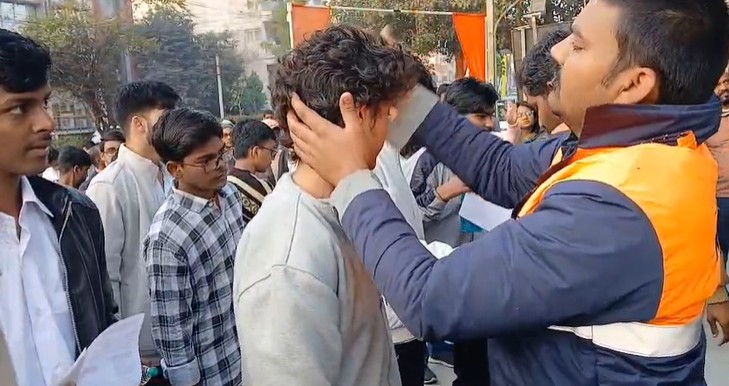
JEE Mains 2026 Exam Live: West Bengal JEE Mains Rescheduled
The NTA has rescheduled the JEE Mains examination in West Bengal scheduled for January 23, 2026. Here's Why.
JEE Mains Exam 2026 Live: Shift 2 Exam Started
The JEE Mains second shift examination has started at 3 pm.
JEE Main 2026 Session 1 Live: A4-Size Blank Sheets For Rough Work Provided In Exam Hall
A4-size blank paper sheets for rough work are provided in the examination hall/room. Candidates must write their name and roll number at the top of each sheet and drop the used sheet(s) in the designated drop box before leaving the examination hall/room. Failure to do so may result in non-evaluation of their answers.
JEE Main 2026 Live: Admit Card Must Be Dropped While Leaving Exam Hall
The National Testing Agency (NTA) has instructed students that the duly filled-in admit card must be dropped in the designated dropbox while leaving the examination hall or room. Failure to do so may result in non-evaluation of answers.
JEE Mains Exam Live: Marking Scheme
Students will be awarded four marks for each correct answer and one mark will be deducted for wrong answers.
JEE Mains Live 2026: Guidelines
Students caught trying to contact or communicate with someone during the exam will have their exam cancelled.
JEE Mains Session 1 Live Updates: Mathematics Shift 1 Review
According to Physics Wallah, Mathematics continued to be the most time-consuming section for students. The JEE Main 21 January 2026 topic-wise analysis indicates that a large number of questions were asked from Algebra and Coordinate Geometry, both of which required lengthy calculations and strong problem-solving skills.
JEE Mains 2026 Exam: Shift 1 Chemistry Question Paper Review
Traditionally, Chemistry has been considered as the highest-scoring section in the JEE Mains examination according to Physics Wallah. Most of the important questions in the JEE Mains shift 1 exam were directly based on concepts and content from NCERT textbooks. The paper followed the usual trend, featuring numerical problems from Physical Chemistry along with straightforward theory-based questions from Inorganice and Organic Chemistry.
JEE Mains 2026 Exam Live: Shift 1 Physics Paper Review
The review of the JEE Main January 21, 2026 question paper suggests that the Physics section largely featured formula-based questions. The paper pattern in this shift continued to emphasise fundamental concepts as per the paper analysic done by Physics Wallah.
JEE Mains Exam Live: Students Not Allowed To Peek During Exam
Students are not allowed to peek, interact, talk, whisper, cheat, write on hands/desks or assist others during the exam.
JEE Mains Exams 2026 (Live): Prohibited Items In Exam Centre
Candidates are not allowed to carry Instrument/ Geometry/ Pencil box, Handbag, Purse, any kind of Paper/ Stationery/ Textual material (printed or written material), Eatables and Water (loose or packed), Mobile Phone/ Ear Phone/ Microphone/ Pager, Calculator, DocuPen, Slide Rules, Log Tables, Camera, Tape Recorder, to wear/carry any type of watch including Electronic Watches with facilities of calculator, any metallic item or electronic gadgets/ devices in the Examination Hall/Room. There may not be any provision for safe keeping of valuables at the Centre.
JEE Mains Exam Live Updates: Lack Of Arrangements For Parents
Parents waiting outside examination centres have demanded seating and drinking facilities, citing a lack of basic arrangments.
JEE Mains Session 1 Live: Check Shift 1 Security Checks Video
Students are undergoing thorough checks to ensure they are not carrying notes or any other prohibited items into the exam centre. Watch Video Here.
JEE Mains Exam 2026 Live Updates: Biometric Verification Again If Candidate Goes For Breaks
If any candidate goes for a toilet-break or bio-break, they will be required to undergo the mandatory frisking and biometric verification again.
JEE Mains Session 1 Exam 2026: Stationary Not Allowed For Writing Exam
Candidates are not allowed to carry Geometry box set, pencils, erasers and colour pencils or crayons. They will not be allowed to use watercolours on drawing sheet.
JEE Mains 2026 Exam (Live): Exam Centre Guidelines
Candidates must reach the exam centre on time and should be prepared with the downloaded admit card, two passport size photographs and a valid photo ID proof.
JEE Mains 2026 Session 1 Live: These Practices May Lead To Cancellation Of Exam
There are several practices that will be recorded as Unfair Means and may lead to the cancellation of candidate's examination. Read in detail here.
JEE Mains Exams Live Updates: Evening Shift Exam Starts 3 PM
The first shift JEE examinations began today at 9 am and concluded at 12 pm, while the second shift exams are scheduled to be held from 3 pm to 6 pm.
