





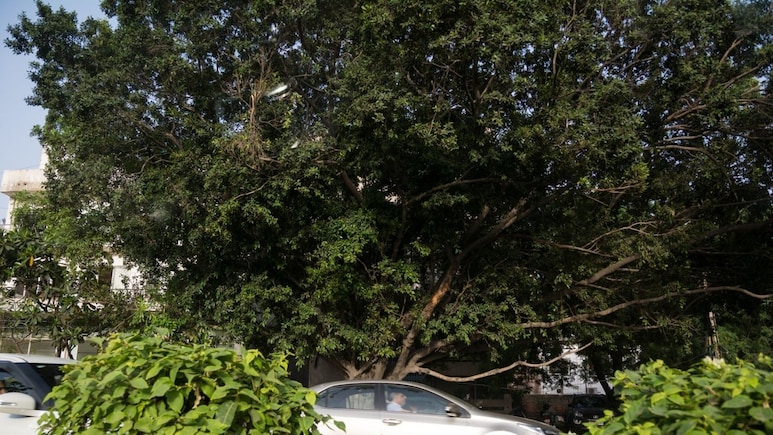
The death of an 11-year-old schoolboy after a tree collapsed in Mumbai this week has once again raised questions about the condition of urban trees across Indian cities. In Delhi too, every monsoon brings reports of uprooted trees and falling branches that disrupt traffic, damage vehicles and, at times, turn fatal.
In May last year, more than 100 trees were uprooted across Delhi on a single day after strong winds and thunderstorms battered the city, highlighting the vulnerability of ageing and weakened trees during extreme weather.
Yet, despite a Supreme Court order and a legal requirement that has existed for over three decades, Delhi's first scientific city-wide tree census is yet to begin. Sources said the exercise remains at the deliberation stage, with the Delhi Forest Department and the Forest Research Institute (FRI), Dehradun, yet to finalise the standard operating procedure (SOP).
Key aspects, including how tree health will be assessed, how hazardous trees will be identified and how the field survey will be carried out are still under discussion, sources said.
The Centre has sanctioned Rs 2.9 crore for the first phase of the four-year exercise, which will be conducted in three phases and cover Delhi's non-forest urban areas. The project aims to create the national capital's first scientific database of trees by recording details such as species, age, height, girth, geolocation and health.
Under the Delhi Preservation of Trees Act, 1994, the Tree Authority is legally required to conduct a census of existing trees and maintain updated records. Despite the law being in force for more than three decades, no city-wide scientific census has ever been carried out. The issue eventually reached the Supreme Court.
In December 2024, the Supreme Court directed the Delhi Tree Authority to immediately undertake the long-pending census under Section 7 of the law, observing that the exercise was necessary to determine Delhi's tree stock and strengthen protection against illegal felling.
The court appointed the Forest Research Institute (FRI), Dehradun, to oversee the exercise with expert assistance. In March 2025, the Supreme Court approved the FRI's proposal to conduct the census in three phases and accepted the Centre's proposal to fund it through the CAMPA fund.
However, more than a year after the court's directions, the survey is yet to begin on the ground.
Why The Census Matters
Delhi currently has no comprehensive database showing how many trees the city has, where they are located or how many are diseased, structurally weak, concretised or at risk of collapse.
Officials say the census will create a scientific baseline for Delhi's urban trees, helping authorities monitor tree health, detect illegal felling, plan plantation drives and improve conservation planning.
Environmentalists, however, say the exercise will be useful only if it goes beyond simply counting trees. Environmentalist Padmawati Dwivedi, who conducted Delhi's first citizen-led tree census in Sarvodaya Enclave over a decade ago, said the survey must become a tool for preventing accidents, not merely creating an inventory.
"Only if a proper tree census assesses tree health with the involvement of local residents and experts will it be meaningful. Otherwise, it cannot be reduced to a mere counting exercise."
She said governments often focus on numbering trees while overlooking their health. According to her, documenting species, maturity, root condition, soil availability and concrete encroachment around trees is just as important as recording their numbers.
"Simply saying a colony has 300 trees is basic information. But when you record the species, maturity and health of each tree, the data becomes useful for taking action."
Dwivedi said her own survey helped authorities remove concrete from around the roots of several trees. "After conducting our census, we were able to get the roots of many trees freed from concrete encroachments. Data must have a purpose."
She cautioned against assuming technology alone could solve the problem. "People are suggesting GPS tagging, but from experience I can tell you it is not that simple. If two trees are close to each other, they can end up with the same GPS tag."
Calling the exercise labour-intensive, she added, "A tree census is physically intensive and time-consuming. Somebody has to capture the data and somebody has to verify it. It is certainly not a one-day exercise."
Dwivedi also questioned whether the allocated budget would be sufficient. "I don't think Rs 2-3 crore is enough for an exercise of this scale."
Recalling her own neighbourhood survey, she said she spent nearly Rs 10,000 on paint alone to mark around 700-800 trees over 16 years ago, excluding labour costs. She believes Resident Welfare Associations (RWAs), schools and local communities should play a major role in the exercise while experts validate the collected data.
"The census has to be driven through RWAs because they can mobilise people. The horticulture department can do the painting and numbering, RWAs can collect the data, and experts can verify it through random sampling."
According to her, a tree census is not a one-time exercise but a long-term process that requires regular monitoring and verification.
Environmentalist Pradip Krishen, who is part of the Delhi government's expert panel on the tree census, said key technical issues remain unresolved. "I believe there are still some technical issues that need to be resolved before Delhi's first city-wide tree census can begin. While the Forest Research Institute (FRI) in Dehradun has been tasked with the census, Delhi's Forest Department has not agreed to conduct the exercise on the ground."
Krishen said the methodology itself is still under discussion. "Much of how the tree census will actually be conducted, including the methodology and technologies to be used, still needs to be resolved."
He expressed doubts about whether the exercise would generate meaningful information on hazardous trees. "I doubt the census will go beyond counting trees to assess their health or identify dead, diseased or structurally weak trees."
According to him, Delhi currently lacks reliable data on dangerous trees. "I don't think Delhi currently has data on hazardous trees, and I don't think the census will provide it either."
Summing up the project's status, he said, "How useful the census data will be depends on how the exercise moves ahead. At this moment, I believe it is at an impasse between the Forest Research Institute (FRI) and Delhi's Forest Department."
Delhi is entering another monsoon without knowing how many of its trees are healthy, diseased or structurally weak. The Supreme Court has ordered the city's first scientific tree census. Funding has been approved. Experts have been appointed.
But with the methodology still under discussion and fieldwork yet to begin, the larger question remains whether the long-delayed exercise will become a meaningful tool to identify hazardous trees and prevent future accidents, or simply create a long-awaited database.
Track Latest News Live on NDTV.com and get news updates from India and around the world

