





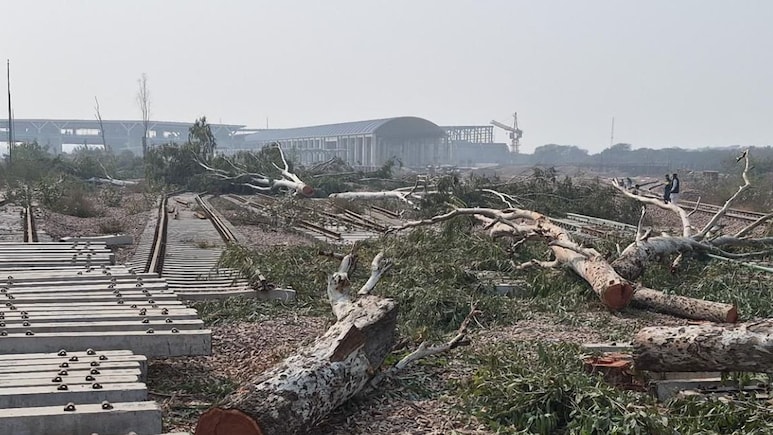
The Centre Empowered Committee (CEC) operating under Supreme Court oversight has granted final approval for the removal of 1,279 trees obstructing the much-anticipated Bijwasan Rail Terminal project in Delhi's Dwarka Sector 21, despite final NGT and Supreme Court judgment remaining pending.
This decision removes the last significant environmental barrier to the redevelopment, allowing the Rail Land Development Authority (RLDA) to proceed with critical external infrastructure works adjacent to Indira Gandhi International (IGI) Airport.
The RLDA had originally requested permission to fell 1,293 trees to make way for approach roads, footpaths, skywalks, metro connectivity, rotary ramps, and other essential facilities.
After detailed deliberations, the CEC reduced the figure to 1,279. Mitigation measures include transplanting 496 trees within the Bijwasan site itself to suitable locations, while the remaining 783 will be compensated through new plantations across Delhi. Additional compensatory afforestation will occur at an appropriate site between Narela and Badli railway stations in outer Delhi.
The approval comes despite ongoing legal and activist challenges framing the area as part of the contested "Dwarka Forest" - a roughly 110-120 acre urban green patch that has naturally regenerated over decades into a biodiverse ecosystem supporting over 65 bird species, Nilgai herds, wild rabbits, jungle cats, lizards, and migratory birds.
Activists Protest
Activist Naveen Solanki, who has spearheaded the fight since seeing initial clearances in 2022, told NDTV that the Supreme Court has made its stance clear that the giver of life, nature, isn't much important even in areas where it is alarmingly scarce.
"Such a stance gives a message that destroying nature is now easy for whoever is planning to do it for profits. It has come to us as a shock at a time when the Aravalis are facing threat, rural/farm tree cover is the lowest of all time and when AQI shouts 'gas chamber'," Solanki said.
"Construction plans can be altered for decades old trees to co-exist while the essential part of the railway project is also constructed. Right now, only the 1,200 decades- and century-old tall trees along the railway line have been chopped but the threat towards destruction of 25,000 trees and wildlife of Dwarka Forest is more imminent," he added.
Environmentalist Tannuja Chauhan said the forest serves as a critical "urban lung," absorbing airport emissions, mitigating heatwaves (Delhi frequently exceeds 45-50 degree Celsius), recharging groundwater, and buffering pollution in a city grappling with severe AQI levels.
"The cutting down of old-growth trees in Dwarka Forest happened despite the matter being sub-judice in both the NGT and the Supreme Court since 2024; it is truly heartbreaking and abominable at the same time. It is this environmental violence exactly which has rendered Delhi into a gas chamber like state that it is today," Chauhan said.
"With AQI hitting over 800 in the capital, how are permissions for felling trees still being granted? If we can't even give protection to a natural forest like the Dwarka Forest which is located right behind a tight security belt in the very capital of this country, then what hope remains for the other open ecosystems located in the obscure across India?"
Environmentalists said the site qualifies as a deemed forest due to a high tree density (over 25,000 trees estimated in surveys) and so have called for project redesign or relocation of non-core elements to preserve the ecosystem.
Project Significance And Features
The Bijwasan terminal aims to decongest overburdened stations like New Delhi Railway Station by serving as a gateway for trains to Western India (Rajasthan, Gujarat, etc.). It features: 11 tracks and 7-8 platforms; airport-themed main building with modern amenities; a first-floor waiting hall offering runway views through floor-to-ceiling glass; green building standards such as sewage treatment plant water reuse, rainwater harvesting, water conservation, and solar power.
Strategically located near the Airport Express Metro Line (Dwarka Sector 21 station), Dwarka ISBT (for western bus routes), and major roads linking to Gurugram and UER/Dwarka Expressway, it promises multi-modal integration
Timeline Of The Controversy
2008: Land transferred from Delhi Development Authority (DDA) to Ministry of Railways on perpetual lease for Bijwasan station redevelopment.
2021-2022: RLDA launches project to merge Bijwasan and Shahabad Mohammadpur stations into a modern terminal; early tree felling and burial incidents reported.
2022: Forest Department fines RLDA Rs 5.93 crore for illegally felling/burying around 990 trees without permission under the Delhi Preservation of Trees Act, 1994, following complaints by local activist Naveen Solanki.
2023-2024: "Save Dwarka Forest" campaign gains momentum with protests, petitions, and social media drives; National Green Tribunal (NGT) rules in February 2024 that the site is neither protected nor deemed forest.
September 2024: Supreme Court imposes interim stay on tree felling and construction in response to appeals by Solanki and others, citing potential "deemed forest" status under the 1996 Godavarman judgment (density criteria for forest recognition).
October 2024: Stay extended; next hearing noted around December 2024 in reports.
January 2026: CEC approves limited tree removal for external works, focusing on the 1,279 trees along the railway line periphery, while core project elements advance.
Track Latest News Live on NDTV.com and get news updates from India and around the world

