
Iran's currency is collapsing. Its economy is under crushing sanctions. Yet Tehran is still paying for machinery, fuel and military components abroad using a financial rail Donald Trump cannot control.
The workaround is simple: mine Bitcoin, then spend it.
"Iran can mine a single Bitcoin for roughly $1,300," says Jake Percy, a U.S.-based bitcoin strategist. With Bitcoin trading near $73,000, that creates a $71,700 margin per coin. That value can be deployed outside the global banking system.
The strategy quietly punches a hole through the sanctions architecture the United States spent two decades building. LIVE UPDATES HERE
When Tehran legalized Bitcoin mining in 2019, officials framed it as an economic experiment. Analysts now say it evolved into something far more strategic: a sanctions resistant payment network.

Bitcoin mining in Iran is state-controlled, generating billions in crypto for military and economic use
Mining operations produce Bitcoin that can be transferred directly to state controlled wallets and used to settle international transactions. Those payments allow Tehran to pay overseas suppliers for machinery, fuel and military components without touching the dollar system.
No SWIFT transfers.
No correspondent banks.
No U.S. Treasury enforcement.
A Clever Play
Blockchain analytics firm Chainalysis estimates Iran's crypto ecosystem reached $7.78 billion in 2025, expanding rapidly despite sanctions. Addresses linked to the Islamic Revolutionary Guard Corps accounted for more than half of Iran's crypto inflows in late 2025, moving over $3 billion in a single year.
"This is not civilian speculation," Percy said. "This is state military financial infrastructure."
What makes the system unusual is that it operates on a public ledger.
Every Bitcoin transaction is permanently recorded on the blockchain. The same technology enabling sanctions evasion is also creating a new intelligence layer.
When U.S. and Israeli airstrikes hit Tehran on February 28, analysts tracking blockchain activity noticed unusual movement before traditional intelligence channels confirmed the scale of the strikes.
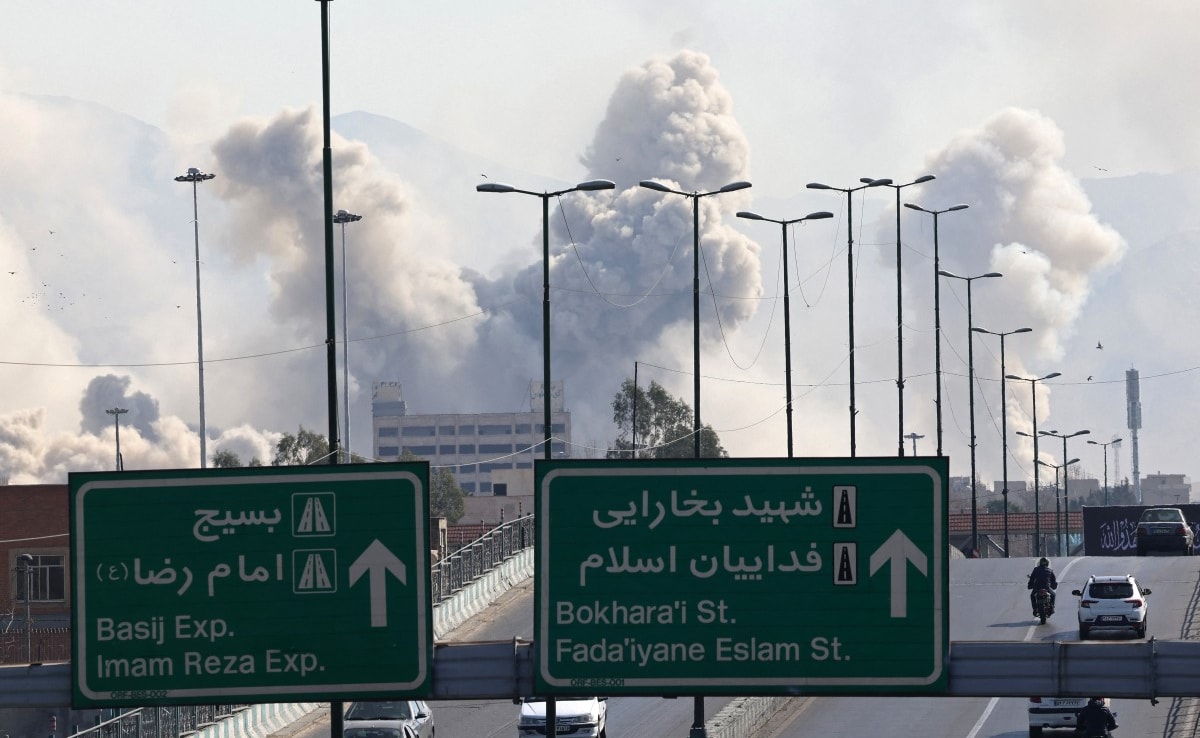
Vehicles drive along an expressway as smoke rises after a strike on Tehran. (AFP)
Crypto outflows from Iran's largest exchange, Nobitex, suddenly surged.
Between Feb. 28 and March 2, roughly $10.3 million left the exchange, with hourly volumes jumping 873% above the 2026 average, according to Chainalysis data.
The blockchain broadcast financial movement tied to the conflict in real time.
"That's real time financial signal intelligence," Percy said. "A public ledger anyone with the tools can analyze."
It is a capability intelligence agencies are only beginning to understand.
Chainalysis and Elliptic can map wallet clusters, track exchange flows and attribute transactions to sanctioned entities. What remains missing is a formal doctrine for integrating that data into national security and sanctions enforcement.
Iran is not the only country exploiting crypto's loopholes.
According to Chainalysis' 2026 Crypto Crime Report, illicit cryptocurrency addresses received $154 billion in 2025, driven largely by a 694% surge in funds flowing to sanctioned entities.
Russia processed $93 billion through a sanctioned stablecoin designed to move money outside the dollar system. North Korean hackers stole $1.5 billion in a single crypto exchange attack, funneling the funds directly into its weapons program.
Three adversaries. Three different methods.
But the same strategic conclusion remains. The global sanctions system built around the dollar has a blockchain shaped gap, and America's rivals are moving through it.
For those building the infrastructure behind the technology, the lesson is blunt. "Bitcoin doesn't care who the president is," said Makar Volcy, who runs the Ontario-based Bitcoin data center NRG Bloom. "It doesn't care about sanctions. It just moves."


