



Stock Market Highlights: Indian equity benchmarks opened in the red, and closed in deep red on Thursday. At the open, Sensex fell over 500 points while Nifty lost 200 points. At the close, Sensex fell 1,247 points while the Nifty was down 384 points.
Investors lost over Rs 3 lakh crore during the trading session on Thursday amid US bonds sell-off.
Stock Market, Sensex Today, Nifty, Share Market: Highlights
Stock Market Hits 3-Month Low: 5 Reasons Behind Sensex, Nifty Crash Today
Share Market Crash: Expectations of another US Fed rate increase have risen. At the same time, geopolitical uncertainty remains high. Read full report here
Stock Market LIVE: Investors' Lose Rs 3.54 Trillion In Thursday's Rout
The market-cap of all BSE-listed companies fell Rs 3.54 trillion to Rs 481.47 trillion from Rs 485.01 trillion at Wednesday's close.
India's Manufacturing PMI: Expert View
Chandragupt Prakash Mangal, Managing Director, Mangalam Worldwide Limited
"India's manufacturing PMI at 55.7 is indicative of sustained underlying demand, particularly from the domestic market, and the increase in new orders is translating into healthier production activity. For metal and engineering manufacturers, the easing of input-cost pressures is equally relevant as it offers greater visibility on margins and supports more confident planning around capacity utilisation and procurement. However, the moderation in export orders underlines the importance of market diversification and maintaining cost competitiveness as global trade conditions continue to evolve. The immediate priority for manufacturers will be to convert the current demand momentum into sustainable volume growth while continuing to invest in operational efficiency and export capabilities."
Stock Market Crash: Check Top Nifty50 Losers
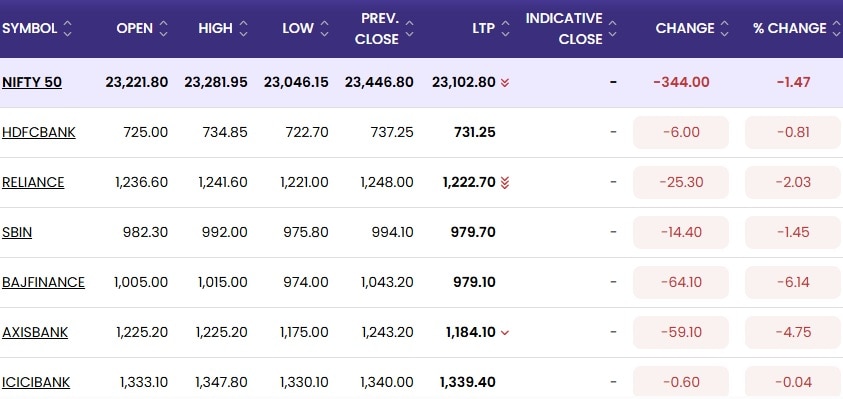
Sensex Nifty LIVE Updates: India VIX Above 13
The Nifty India Volatility gauge surged 27.44 per cent to 13.19 as expectation of near-term uncertainty increased.
Stock Market Crash: Check BSE Sensex Heatmap
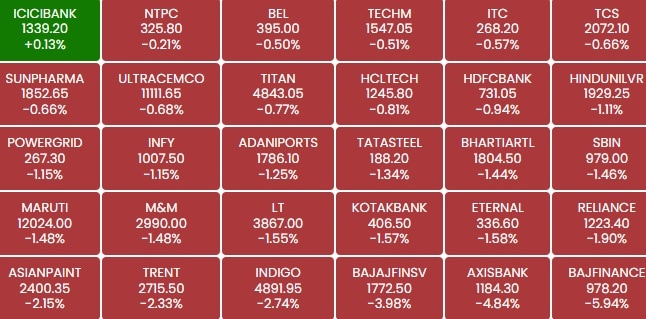
How Does A Global Bond Sell-Off Impact India
Here's how the chain reaction typically works:
1. Foreign Investors Pull Money Out Of Indian Markets
When US Treasury yields and other developed-market bond yields rise, investors can earn higher returns from relatively safer assets. As a result, some foreign institutional investors (FIIs) may move money out of emerging markets like India and into US bonds.
2. Rupee Comes Under Pressure
When foreign investors sell Indian assets and move dollars abroad, demand for the US dollar rises.
3. Government Borrowing Costs Rise
Indian government bond yields are influenced by global yields. If investors can get higher returns in US or Japanese bonds, they may demand higher yields from Indian government securities as well.
4. Home, Auto And Corporate Loans Can Get Costlier
Higher government bond yields often push up borrowing costs across the economy.
5. Pressure On High-Valuation Stocks
Technology and growth stocks are particularly sensitive to rising bond yields because future earnings become less valuable when interest rates are higher.
6. Oil Shock Makes Matters Worse
The current sell-off is partly linked to stronger US economic data and higher oil prices. For India, which imports over 80% of its crude oil needs, higher oil prices are a double blow:
Why Markets Are Reacting So Sharply Now
The benchmark US 10-year Treasury yield recently crossed 5%, raising fears that interest rates globally could stay "higher for longer." When the world's risk-free benchmark yield jumps this much, investors reassess valuations across equities, bonds, currencies and commodities.
Stock Market Today: Why Are Markets Crashing?
A sell-off in global bond markets intensified overnight as investors increasingly bet that the US Federal Reserve may continue raising interest rates in response to resilient economic data and elevated oil prices.
Japan's 10-year government bond yield climbed to 3.08%, its highest level since 1996, reflecting growing concerns that interest rates could stay higher for longer. Bond yields in Australia and New Zealand also rose sharply as investors reassessed the outlook for global monetary policy.
In Europe, the yield on France's 10-year government bond touched its highest level since 2008, while borrowing costs in the UK remained largely stable.
The latest move followed a sharp rise in US Treasury yields on Wednesday. The benchmark 10-year Treasury yield briefly jumped to 5.12% from 4.96%, marking its biggest single-day increase since the market turbulence triggered by tariff-related concerns in April last year. US Treasury yields are closely watched worldwide because they influence borrowing costs, investment flows, and asset prices across global markets.
Myntra Doubles Seasonal Workforce to 26,000+ Ahead of Big Fashion Festival
Myntra today announced the creation of over 26,000 seasonal employment opportunities ahead of its Big Fashion Festival, more than double the seasonal workforce from last year. Of these, 350 roles are designated for differently abled individuals, and women will account for 30% of the fulfilment centre workforce, making this Myntra's most inclusive seasonal hiring drive yet. The opportunities span fulfilment, last-mile delivery, and customer service, as Myntra scales its operations to serve millions of shoppers during one of India's most anticipated fashion and lifestyle events.
The seasonal workforce will come from across India, Odisha, Karnataka, Bihar, Uttar Pradesh, Madhya Pradesh, Jharkhand, and more, working across Myntra's five fulfilment centres in Bengaluru, Mumbai, Kolkata, Bilaspur, and Binola. Operations span sorting, grading, and packing, with 8,000 delivery partners and 2,700 customer service roles rounding out the seasonal team.
Growth, Jobs and Enterprise: Experts select Outstanding Grampreneurs for BYST JRD Tata Awards 2026
India's micro enterprises form the backbone of the MSME sector, with over 9.55 crore micro enterprises accounting for 99.3% of registered MSMEs and contributing to more than 41 crore jobs. The role of grassroots enterprises in driving jobs and local economic growth is reflected in the pan-India selection of 14 entrepreneurs assessed by the jury for the BYST JRD Tata Awards 2026, including five women entrepreneurs. Their businesses have collectively created nearly 425 direct jobs. The shortlisted Grampreneurs come from across India and operate across sectors including manufacturing, food processing, agri-business, farm technology, recycling and industrial solutions.
India-New Zealand FTA: Expert View
Vipin Prakash Mangal, Chairman, Mangalam Global Enterprise Limited (MGEL)
"When geopolitical tensions disrupt critical trade routes in West Asia, global agricultural supply chains face immediate pressure from freight volatility and shipping delays. In this environment, India's strategic trade agreements such as the operationalization of the New Zealand FTA and advancing talks with Canada offer vital balance by expanding bilateral agricultural trade, investment, and technical cooperation. At MGEL, our response to global instability is twofold: leveraging international trade agreements to broaden our export reach while accelerating our domestic value-addition through NEAT Everyday. By processing raw agricultural commodities into clean, branded consumer wellness products within India, we insulate our business model from global freight shocks while actively supporting national food security and economic self-reliance."
NSE IPO Listing: Expert View
Naresh Biyani, Founder & CEO of Capwise Financial Services
"NSE's listing is a landmark for Indian capital markets. The exchange at the heart of our market is now itself publicly accountable, and it closes a decade-long chapter in which the listing stalled over regulatory issues, including co-location. India now joins the US, UK, Hong Kong and Germany in having its dominant exchange listed, putting NSE squarely on global investors' radar. A flat debut after 12x institutional demand is disciplined pricing, not weak sentiment; this is a long-term compounder, not a listing-day trade. The one variable to watch is regulation on derivatives, still NSE's largest earnings engine. More importantly, India just absorbed one of its largest-ever IPOs, entirely secondary, without a wobble. That is the green light promoters, PE funds and growth companies, including MSMEs, have been waiting for. NSE is a toll road on India's financialisation, and today the market priced it like one."
New E-Commerce Rules: 7 Checks Every Shopper Must Make Before Buying Online
The new Consumer Protection (E-Commerce) (Amendment) Rules, 2026, effective January 2027, are aimed at making online marketplaces more transparent. Read full report here
Prozo expands its eastern India fulfilment network with a new 30,000 sq. ft. facility in Kolkata
Prozo, India's fastest-growing full-stack supply chain company, has strengthened its eastern India network with the launch of a new 30,000 sq. ft. fulfilment centre in Kolkata. The addition brings Prozo's network in the city to three fulfilment centres and supports its ongoing capacity expansion across one of the country's fastest-growing consumption markets.
Located at Prospace Logistics Park, Serampore, West Bengal, the facility benefits from strong connectivity to key freight and distribution corridors. With access to Kolkata Port, NH-16, NH-19 and the Dankuni logistics hub, the site is strategically positioned to support efficient movement of goods across eastern India. The location also enables brands to access major wholesale and retail markets while providing outbound reach to the north-eastern states.
Commodities Update: Expert View
Akshat Siddhant, Lead quant analyst, Mudrex
Gold extended its decline toward $4,280/oz, as a stronger dollar and higher Treasury yields pressured precious metals. Hawkish comments from Fed officials, following stronger-than-expected US business activity, pushed expectations for an October rate hike to around 70%. Silver also slipped to about $64/oz. Oil moved in the opposite direction, rebounding above $92/barrel after six straight sessions of losses, as rising US-Iran tensions at the UN offset reports of productive diplomatic talks. The rupee weakened to Rs 95.7-95.9/$, with dollar strength outweighing support from lower oil prices despite firm Indian PMI data.
Higher-ticket lending gains ground as loans over Rs 75,000 rise to 41% of disbursements: SIDBI-Equifax Microfinance Pulse Report
India's microfinance industry is entering a more measured phase of growth, with lenders prioritising portfolio quality and borrower discipline over aggressive credit expansion. According to the latest SIDBI-Equifax Microfinance Pulse Report, the industry's portfolio outstanding stood at Rs 2.69 lakh crore as of June 2026, down 12% year-on-year and 3% sequentially, while the number of active loans stood at 7.15 crore. Despite the contraction in portfolio size, disbursements during April-June 2026 (AMJ'26) grew 17% year-on-year to Rs 62,302 crore, indicating that lending activity is recovering steadily even as institutions adopt a more selective approach to credit.
Sonaselection India IPO: Expert View
Shivani Nyati, Head of Wealth at Swastika Investmart
Sonaselection India made a modest debut at Rs 102.31, around 3.3% above its Rs 99 issue price. Post-listing, the valuation at around 12.24x FY26 P/E is reasonable, but declining EBITDA margins, high leverage, single-facility dependence, customer concentration and governance concerns remain key risks. Our view is Neutral, and fresh entry can be considered only after monitoring margin stability and deleveraging. For risk management, Rs 96-98 can be considered as a stop-loss zone, while a sustained break below Rs 96 may indicate further weakness.
Advance Salaries, Banks To Open On Sunday: How Is Centre Preparing For 3-Day Strike
The Finance Ministry has advised ministries and departments to disburse September salaries, wages and pensions to employees ahead of schedule. Read full report here
Crypto Update By Vikram Subburaj
Vikram Subburaj, CEO, Giottus.com
Bitcoin is trading near $84,400 after retreating from an eight-month high of $87,359. The decline of about 2.5 per cent over 24 hours is largely a cooling-off move after a sharp weekly rally, rather than a clear reversal. Ethereum, XRP, and Solana have also given back some of their recent gains.
US spot Bitcoin ETFs provided much of the momentum. They received about $2.31 billion over four trading sessions through September 22. However, investors are now weighing that institutional demand against the prospect of further US interest-rate increases. The upcoming PCE inflation and employment data could influence the Federal Reserve's next move.
Bitcoin's immediate test is the $84,000-$85,000 region. A sustained hold could support another attempt at $87,400 and then $90,000. A break below $84,000 may bring the $81,000-$82,000 range back into focus.
Our advice: Investors should avoid reacting to a single day's movement after such a rapid rally. Fresh purchases can be staggered instead of being made at once. Traders should keep leverage low and define exits before entering a position, as macro data can produce sharp moves in either direction.
Stock Market News: Expert View By InvestorAi
The Thesis
Nifty 500 rebounded 0.62% Wednesday, led by a 2.4% surge in metals, but now faces a test: the US 10-year yield hit 5.10%, a 19-year high, after the hottest US PMI prints in five years, and Brent jumped 3.9% to $103 on Iran's defiant UN address. The five picks lean into domestic capex and export services that don't need the Fed's cooperation.
Where We're Concentrated
Engineers India and Chennai Petroleum sit inside India's refining and EPC capex cycle, more domestic than Fed-driven, though crude's overnight spike is the near-term risk. Prime Focus, Indegene and Jubilant Pharmova are export services and specialty pharma, a step from rate-sensitive largecaps: Nifty IT fell 0.86% Wednesday while metals and smallcaps led. The thesis breaks if Brent's jump outlasts the UN-speech reaction.
Conviction Picks
Highest Conviction
Prime Focus
Global VFX and content-services demand keeps this export play insulated from today's crude spike and Fed-driven rate jitters.
Indegene
Pharma commercialization outsourcing rides steady biotech spending, a demand line immune to Brent or Treasury-yield swings.
Jubilant Pharmova
Specialty pharma and CDMO exports stay defensive even as the Nifty IT pack drops 0.86% on rate-hike repricing.
Engineers India
EPC order flow tracks India's refining and petrochemical capex cycle, a domestic driver crude's overnight spike can't derail.
Chennai Petroleum
Refining margins face a near-term test from Brent's 3.9% jump, but product cracks and domestic demand still favor the name.
One Thing to Watch
US 10-year yield at 5.10% The 2007-era high followed the hottest US PMI prints in five years and lifted October Fed hike odds to 71% - a risk-off pulse GIFT Nifty is already pricing in.
Crypto Update: Expert Views
CoinSwitch: BTC fell to $84,400 as a sharp sell-off in U.S. bonds pushed Treasury yields significantly higher, pressuring risk assets. The Nasdaq declined 1.15% and the S&P 500 fell 0.7%, while crypto-linked stocks including Strategy, Coinbase and Circle also moved lower. The key macro concern is rising U.S. borrowing costs, higher yields increase government interest expenses and could worsen fiscal deficits, potentially forcing additional debt issuance. This could create a self-reinforcing cycle of higher yields, larger deficits and tighter financial conditions said CoinSwitch Markets Desk
Mudrex: Bitcoin slipped toward $84,000 after stronger-than-expected US business activity pushed the 10-year Treasury yield to its highest since 2007 and lifted October rate-hike expectations to around 70%. However, demand remains resilient, with US spot Bitcoin ETFs attracting $1.7 billion over just two days this week. On-chain signals are also constructive, as Bitcoin's MVRV ratio has moved above its 365-day average, a level that has historically coincided with the end of previous bear markets. With a large Bitcoin options expiry of $16 billion happening on Friday, markets are expected to be volatile in the near term. For now, resistance sits at $$86,500, while support has moved down to $82,500 said Prateek Gupta, Head of Business, Mudrex.
Stock Market News: Expert View
Gaurav Udani, Founder - Thincredblu
"Nifty is expected to open around 23,280, down by nearly 170 points, indicating a sharp gap-down and a weak start. With Sensex weekly expiry today, volatility is likely to remain elevated, and sharp intraday swings can be expected.
The immediate support is around 23,200-23,250, while 23,500-23,600 remains the key resistance zone. After such a sharp gap-down, I would avoid chasing shorts at the open and instead watch how Nifty behaves around 23,200-23,250. If this zone holds, some short-covering recovery can be expected. However, a decisive break below 23,200 can keep the selling pressure intact.
The broader bias remains cautious, with a sell-on-rise approach until Nifty shows sustained strength above the resistance zone. Given the expiry, price action and volatility will be more important than the opening gap."
Commodity Update: Expert View
Vikram Subburaj, CEO, Giottus.com
Indian bullion futures begin September 24 on a weaker footing, but gold and silver are not sending the same signal. MCX October gold ended the previous session at Rs 1,51,360 per 10 grams, down 0.89 per cent. December silver fell 1.59 per cent to Rs 2,36,085 a kg.
Gold's decline appears partly linked to contract rollover. Open interest in the October contract dropped 9.47 per cent as its October 5 expiry approached. December gold, which closed at Rs 1,53,590, recorded a 7.17 per cent increase in open interest. This suggests that traders are reducing near-month exposure and shifting towards the next contract.
Silver's positioning is less comfortable. Its price fell as open interest increased 9.62 per cent. That points to fresh bearish positions. Silver also moved through a range of nearly Rs 5,900 a kg during the session, confirming that it remains the more difficult metal to trade in the short term.
The pressure came mainly from global markets. Spot gold fell towards $4,300 an ounce as the dollar index strengthened to 100.87. Expectations of another US interest-rate increase have reduced the appeal of non-yielding assets. Elevated oil prices offer bullion some geopolitical support. However, it also increases inflation risk and strengthens the case for tighter monetary policy.
For Indian investors, the rupee and the 15 per cent import tariff will continue to cushion domestic prices from the full extent of an international decline. Gold buyers can stagger purchases rather than chase intraday reversals. Futures traders should watch Rs 1,51,050 in gold and Rs 2,35,500 in silver. A break below these levels would indicate that the correction has further to run.
Crypto Update: Expert View
Purvang Mashru, Lead Analyst, BitDelta India
Bitcoin fell 2.9% to about $84,214, while Ethereum dropped 3.1% to $2,682. Nine of the top ten large caps declined, and their equal-weight return was negative 4.8%.
The reversal was most pronounced in higher-beta assets. Dogecoin lost 8.7%, Avalanche 7.9% and Cardano 7.1%. TRX was the only gainer and rose just 0.1%.
The close was weak across the market. Bitcoin ended at its latest session low and retained only 11% of its full range, while Cardano and Avalanche closed within 2% of their lows.
The latest US fund session still showed $714.7 million of Bitcoin ETF inflows and $162.2 million for Ether.
US Treasury yields added pressure to the external backdrop. The two-year yield rose 14 basis points to 4.85%, while the 10-year increased 15 basis points to 5.11%. Higher rates can weigh on risk assets, but no single factor fully explains the crypto decline.
Bitcoin support sits at $84,000, and resistance is around $84,619 and $85,000. A reclaim of $84,619 with at least half the top ten cryptos advancing would improve the setup. A break below $83,828 with persistently weak breadth would confirm further deterioration.
National Stock Exchange IPO: What Makes It A Rare Moment For Indian Markets
NSE IPO Listing Today: Investors should look at how NSE sustains confidence in its systems and remains accountable as a listed company. Read full report here
Crypto Update By Riya Sehgal
Riya Sehgal, Research Analyst, Delta Exchange
Crypto markets pulled back over the past 24 hours as stronger U.S. business activity pushed Treasury yields and the dollar higher. Bitcoin retreated toward $84,300, while Ether traded near $2,686. The decline was amplified by approximately $280 million in Bitcoin long liquidations over four hours.
U.S.-Iran developments added to the pressure. On Wednesday, Iran's president rejected surrender to U.S. pressure while keeping diplomacy open. Tehran was reviewing Washington's response to its peace proposal, but differences over the naval blockade and reopening Hormuz remained unresolved. Brent rose nearly 4% to $103.08, reinforcing inflation concerns.
Institutional demand remained supportive, with U.S. spot Bitcoin ETFs attracting approximately $1.71 billion across September 21-22. However, short-term momentum has weakened, and the latest bounce has yet to confirm a sustained recovery.
Technically, the market is stabilizing, but a sustained recovery remains unconfirmed. Two-hour RSI readings near 43 indicate weak momentum. Bitcoin's immediate support lies at $83,500-$84,000, followed by $82,000, with resistance at $85,000-$86,000. Ether needs to reclaim $2,700-$2,725, while $2,630-$2,650 remains nearby support.
Markets now face two diplomatic tests: progress on U.S.-Iran negotiations and the Trump-Xi meeting. Constructive outcomes could support sentiment, while renewed tensions would compound pressure from elevated yields and energy prices.
Crypto Update By Avinash Shekhar
Avinash Shekhar, Co-Founder & CEO, Pi42
"Bitcoin is currently navigating an unusual divergence between macro conditions and actual capital flows. Expectations of another 25 basis point rate hike have increased, while the 10 year Treasury yield has climbed to its highest level since 2007. Yet spot Bitcoin ETFs have attracted $714.8 million in net inflows. That tells us something important: institutional demand is not simply following the macro narrative. Investors are continuing to allocate to Bitcoin even as traditional market yields become more attractive.
This makes the $83,000 to $84,000 zone particularly important. Bitcoin recently failed to sustain its move above $87,000, but the continued ETF inflows suggest that the pullback is being met with meaningful demand. If Bitcoin can build a stable base around current levels, the next move could be driven less by momentum and more by whether institutional buying continues to absorb supply.
The divergence across major assets is also worth watching. Ethereum is holding around the $2,600 to $2,700 range, while XRP and Dogecoin have seen greater selling pressure. This indicates that capital is currently being allocated more selectively, with Bitcoin attracting stronger structural demand while the broader market waits for a clearer catalyst.
The $100,000 level remains an important psychological milestone, but the more meaningful signal will be the behaviour of capital between now and then. If Bitcoin continues to attract substantial ETF inflows despite elevated yields and changing rate expectations, it would demonstrate that institutional demand is becoming an increasingly independent driver of the market. That shift could be more significant for Bitcoin's next phase than any single short term price target."
Stock Market News: Expert View
Vaishali Patel, Senior Manager - Research- Technical Department at Jainam
Nifty closed at 23,446.80, gaining 0.50%, but the broader structure remains cautious as the index continues to trade below its key moving averages. US markets ended mixed overnight, with the Nasdaq trading to a fresh record close, while the S&P 500 was almost flat and the Dow declined.
Asian markets are trading mostly higher, supported by continued strength in technology and semiconductor stocks, while easing crude prices are also improving sentiment. Crude oil is likely to remain volatile, trading around the 8,825, but may take cues from the recent decline in international crude prices and developments in the Middle East. GIFT Nifty is trading lower around 23,255, down about 190 points, indicating a negative start for Indian equities.
Technically, the index has formed an Inside Bar candle, trading within the previous day's high-low range, indicating an absence of clear strength from either side. The immediate resistance is placed around 23,500-23,600, and a decisive breakout above 23,600 could strengthen the recovery towards 23,800. On the downside, 23,300-23,200 remains the immediate support zone, followed by the crucial 23,100-23,000 area. A breakout above the Inside Bar high could trigger further buying, while a break below its low may revive selling pressure. Overall, the near-term outlook remains range-bound to cautious, with the 23,300-23,600 zone likely to determine the next directional move.
Stock Market Live: Expert View
Hemang Gor, Senior Research Analyst - Derivatives and Technical Research, Axis Direct
The Nifty 50 advanced 117.80 points ( 0.50%) successfully decoupling from the overnight US weakness, as crude briefly slipped below $100 on hopes of US-Iran diplomacy. The domestic rally was spearheaded by the Metal and FMCG sectors, which witnessed robust demand on signs of strengthening economic momentum. Wall Street sold off as bond yields climbed to multi-decade highs, with the Nasdaq down 1.13%, the S&P 500 lower by 0.75% and the Dow shedding 0.68%.
In Asia, Japan's Nikkei reopened after the Silver Week break and trades 1.8% higher, while Korea remains shut for Chuseok until Monday. Crude remains the key variable for India: Brent spiked above $103 after Saudi Arabia suspended Yanbu loadings, reviving supply concerns just as the domestic market found its footing. Gold eased to $4,300/oz.
GIFT Nifty is at 23,250 down by about 180 odd points (0.78%). Offshore early-morning indicators point toward a highly cautious and a negative gap-down opening for Thursday's session, as markets must now digest the full magnitude of the US 10-year Treasury yield crossing 5.10%. Technically, the undertone remains cautiously bearish as long as the index trades below 23,500. Immediate support lies at 23,100-23,000; a decisive break would expose 22,800.
Crypto Update By Harish Vatnani
Harish Vatnani, Head of Trade, Zebpay
"Bitcoin's rally continues to hold up, with the asset now nearly 50% above its June low and up more than 10% over the past week. One of the stronger signals behind the move is the amount of BTC that remains dormant - around 81% of the circulating supply has not moved in at least six months. Long-term holders have also accumulated more than 3 million BTC since 2020, despite significant selling from some early holders.
Momentum remains positive, although it has cooled slightly. Bitcoin's daily RSI is at 65.31, still above the 50 mark that indicates gains are outweighing losses, but below the 70 level reached earlier in the rally. This suggests momentum remains strong without yet showing the same level of overheating.
Ethereum, meanwhile, has seen some profit-taking after failing to sustain its move toward $2,800. ETH slipped below $2,700 on September 23, with the $2,648 intraday low coming into focus. The pullback came despite strong ETF demand, with US spot Ethereum ETFs attracting $270 million on September 21 and another $162.2 million on September 22, taking two-day inflows to $432.2 million.
The broader macro backdrop remains important as well. The Federal Reserve raised its target rate by 25 basis points to 3.75%-4.00% on September 16. While the rate decision preceded Ethereum's latest rally, there is no clear evidence linking it directly to the September 23 pullback.
Overall, Bitcoin's strength is still being supported by tight long-term supply and sustained accumulation, while Ethereum is showing that strong ETF demand has not completely insulated it from short-term selling. The key question now is whether continued institutional flows can absorb profit-taking and keep the broader crypto rally intact."
Crypto Update By Nischal Shetty
Nischal Shetty, Founder, WazirX
"Crypto markets are facing a mildly cautious macro backdrop as weakness across US equities points to softer risk appetite. The Nasdaq fell 1.13%, while the S&P 500 and Dow declined 0.75% and 0.68%, respectively. Gold edged higher as investors sought defensive assets, while lower oil prices offered some relief from inflation concerns. For crypto, these conditions may keep Bitcoin range-bound and place greater pressure on altcoins, which are typically more sensitive to shifts in liquidity and risk sentiment.
Bitcoin has pulled back to around $84,425 after facing resistance near $87,000. The immediate pressure is largely macro-driven as US Treasury yields have climbed above 5%, making bonds more attractive and reducing risk appetite across equities and crypto. Geopolitical uncertainty in the Middle East is also keeping investors cautious.
Despite this short-term volatility, institutional demand remains encouraging. US spot Bitcoin ETFs recently recorded nearly $1 billion in daily net inflows, suggesting that larger investors continue to accumulate. For now, $83,520 is the key support level to watch, followed by $81,000. A sustained move above $87,000 could restore positive momentum. Markets may remain sensitive to bond yields, inflation expectations and geopolitical developments.
Among altcoins, XRP is consolidating just below the psychologically important $1.50 level after its weekly surge. A decisive close above $1.50 - $1.52 could open the way toward $1.58 - $1.60. If momentum weakens, $1.45 - $1.47 is the first area to watch. Losing it could produce a deeper retracement toward $1.40.
SOL is holding close to $115 following a nearly 16% weekly rally. The first resistance zone sits around $116 - $118, with $120 acting as the more important breakout level. Support is likely around $112 - $113, followed by the stronger $108 - $110 area. Holding above $110 would keep the broader weekly recovery intact."
Why Rural India Struggles To Get Home Loans Despite Rising Demand
Digital verification, better data analysis and technology-led credit assessment can make the lending process faster and reduce paperwork. Read full report here

