





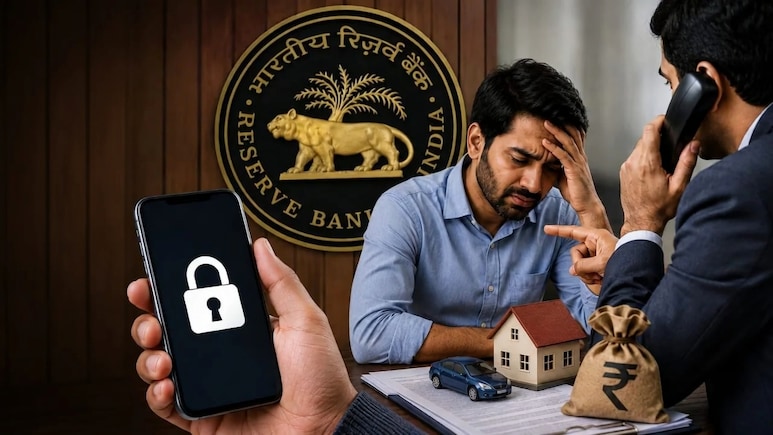
RBI's New Loan Recovery Rules: The Reserve Bank of India (RBI) has come up with new rules to ensure that individuals who miss EMI payments are not harassed by borrowers.
Under its new loan recovery framework, banks and regulated lenders will have to follow stricter rules on how they contact borrowers, what recovery agents can say, when they can call and how they conduct field visits. The rules will come into effect from January 1, 2027.
The RBI has also brought technology-led recovery, including remote locking of financed smartphones, tablets and laptops, under a formal regulatory framework.
Also Read | Layoffs Are Rising In Tech, But These Skills Are Helping People Unlock Better Pay
No More Recovery Calls At Any Hour
The new rules set a clear window for recovery calls and visits.
Banks and recovery agents can generally contact borrowers only between 8 am and 7 pm. Calls or visits outside these hours will be allowed only if the borrower has specifically requested or authorised them.
Recovery agents have also been told to avoid contacting borrowers during sensitive situations such as a bereavement, medical emergency or marriage function.
The RBI has also barred threatening, abusive or intimidating language. Agents cannot make anonymous or threatening calls, repeatedly contact borrowers, publicly humiliate them or threaten their family, assets or reputation.
They cannot misuse social media either. Posting a borrower's personal information, photographs, videos or audio recordings to shame them is not allowed.
A Recovery Agent Cannot Simply Turn Up At Your Door
There is a new layer of transparency around physical visits too. Before the first in-person visit by a recovery agency, the borrower must be informed at least one day in advance. The bank must provide details of the agency assigned to the case.
Borrowers should ordinarily be contacted at a place of their choice. A recovery agent can visit the borrower's home or workplace if no preference has been given, or if the borrower repeatedly fails to appear at the chosen location.
And if someone does turn up, they cannot simply say they are from the bank and demand money.
Recovery agents must carry an identity card, an authorisation letter and the relevant notice. The authorisation letter must also include contact details for the agency and the bank's grievance officer.
Every Recovery Call Will Leave A Record
The RBI is also putting more pressure on banks to monitor what happens during recovery. Banks will have to record recovery conversations and maintain details such as the time and number of calls. These records generally have to be preserved for at least six months.
This could become important when a borrower disputes the behaviour of a recovery agent. The bank cannot simply say that an outside agency was responsible. Even when recovery is outsourced, the lender remains responsible for monitoring the agency and ensuring compliance.
The RBI has also said recovery agents should be properly trained and that banks must ensure their incentive structures do not encourage aggressive recovery tactics.
Your Personal Data Gets Another Layer Of Protection
Another major part of the new framework is privacy. Recovery agents should get only the information they actually need to recover the dues. Banks have been directed to put safeguards in place to prevent misuse of borrowers' personal information.
So, can a bank lock your phone if you miss an EMI? Yes, but not immediately. And not in every case.
The RBI has laid down rules for lenders that use technology to remotely restrict a financed smartphone, tablet or laptop. First, the loan must have been specifically taken to finance that device. A lender cannot take a normal personal loan and use it as a reason to remotely disable your existing phone.
There is also a waiting period. A device cannot be remotely restricted as soon as an EMI is missed. Restrictions can begin only after the loan has remained overdue for at least 30 days.
A complete device restriction can be imposed only after the account has remained overdue for 60 days. Even then, the phone cannot simply become a useless piece of hardware.
Incoming calls, SMS, emergency communication and functions needed for work and employment must continue to remain available. Lenders also cannot use the technology to access unrelated personal information such as contacts, photographs, videos, call logs, SMS messages or location history.
New Timeline For Restoring A Device
The RBI has also set a timeline for restoring a device after the borrower clears the overdue amount or regularises the loan. The device should ordinarily be restored within one hour of payment or settlement.
If the lender fails to do so, the borrower can be entitled to compensation of Rs 250 for every hour of delay, subject to a cap linked to the outstanding loan amount.
The borrower must also be informed in advance that remote restriction is possible. The terms cannot simply be buried somewhere in a lengthy loan agreement.
Ananth Shroff, Co-Founder and CEO at DPDzero, described the RBI's move as a "structural reset" for loan recovery. "The RBI's new framework is not an incremental update -- it is a structural reset," Shroff said.
According to him, compliance can no longer remain a set of instructions sitting inside a manual. It has to become part of everyday collection operations.
Shroff also pointed to the growing role of technology. AI, he said, can help enforce calling windows and frequency limits, flag inappropriate language and maintain records. But human agents are still needed for judgement and empathy, particularly when borrowers are facing financial stress.
Track Latest News Live on NDTV.com and get news updates from India and around the world

