





What does it cost to remove a single word from a food packet?
Potentially hundreds of crores of rupees.
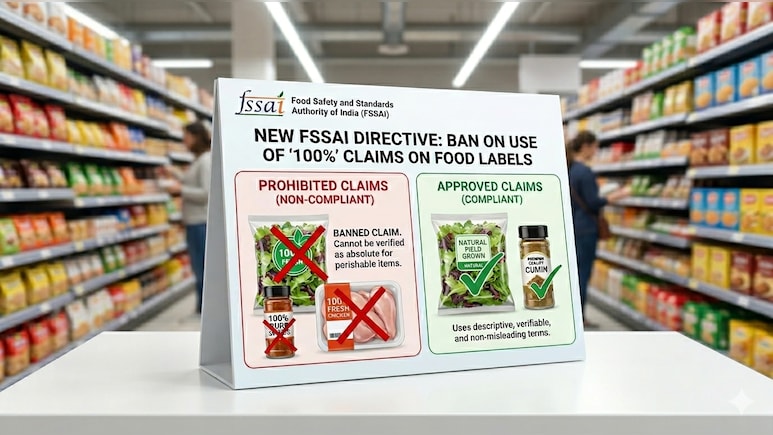
That is the hidden story behind the Food Safety and Standards Authority of India's (FSSAI) decision to bar food companies from using "100%", "100% pure" and similar absolute claims on labels, packaging and promotional material. The move is aimed at preventing misleading marketing and improving transparency for consumers. But for food businesses, it sets off a compliance exercise that reaches far beyond redesigning a pack.
Also Read | Layoffs Are Rising In Tech, But These Skills Are Helping People Unlock Better Pay
The issue has reopened a larger debate: can regulators protect consumers while also reducing the economic burden of compliance? The answer, industry experts say, lies not only in what rules are introduced, but in how they are implemented.
For consumers, the change may look cosmetic. For companies, it is anything but. "A label change can seem straightforward on the outside, just update the packaging and move on. In reality, it triggers a long chain of operational, regulatory and financial consequences across the business," said Rishi Agrawal, CEO and Co-Founder of TeamLease RegTech.
According to Agrawal, a typical mid-sized food company in India already manages 3,285 compliance obligations and 11,554 filings annually across food safety, labour, taxation, environmental and packaging regulations.
That complexity becomes apparent when a new labelling rule arrives.
A mid-sized manufacturer may have between 200 and 500 stock-keeping units (SKUs). Even a simple category like ketchup can exist in multiple pack sizes, packaging formats and regional language variants. Every affected SKU must be redesigned, reviewed, approved and reprinted.
The process involves updating artwork, securing approvals from regulatory and nutrition teams, replacing printing plates and producing fresh packaging material. Across hundreds of SKUs, the bill can quickly run into crores before a single revised product reaches consumers.
'Compliance Costs Come In Three Layers'
Food companies often hold months of pre-printed packaging inventory. Finished products may already be moving through distributors, retailers and quick-commerce warehouses. Old stock has to be sold, reworked, returned or, in some cases, discarded before the compliance deadline.
"The cost reflected in financial statements as a packaging change captures only a fraction of the actual impact," Agrawal said.
He noted that inventory write-offs, stock liquidation efforts, working-capital pressures, operational disruptions and management time often make the real cost several times higher than the visible packaging expense.
The food processing industry is hardly a niche sector. It contributes nearly 17.6 per cent of India's gross value added (GVA) and 7.93 per cent of manufacturing GVA. It is also among the country's largest employers, supporting more than 7 million workers across formal and informal segments.
That scale makes regulatory design especially important.
Agrawal argues that compliance costs come in three layers. The first is the direct cost: redesign work, laminate write-offs, sticker operations and legal review.
The second is opportunity cost.
The food sector already navigates 34 regulatory approvals from over 18 authorities, including FSSAI, BIS, Legal Metrology departments, pollution control boards, labour departments and tax authorities. When regulatory, legal, supply-chain and marketing teams spend months managing a labelling transition, they are not launching products, entering export markets or driving growth.
"For a mid-sized processor with a lean team, one major label-change cycle can stall the innovation pipeline for half a year," Agrawal said.
The third layer, he added, is the systemic cost.
This includes working capital locked in parallel inventories, trade discounts used to clear old stock, relisting challenges on modern retail and quick-commerce platforms, and legal risks arising from inconsistent labels during transition periods.
The latest FSSAI directive arrives at a time when the regulator has also taken steps to make compliance more predictable.
'Predictability More Valuable Than Leniency'
In January 2025, FSSAI fixed July 1 as the annual enforcement date for amendments under the Food Safety and Standards (Labelling and Display) Regulations, 2020. It also mandated a minimum transition period of 180 days from notification to implementation. The regulator said the move was intended to improve ease of doing business while helping consumers make informed choices.
Industry sees that as one of the most significant aspects of the policy. "What FSSAI has institutionalised through the January 2025 announcement is exactly the kind of reform Indian industry has been asking for," Agrawal said.
He pointed out that regulatory updates are far from rare. FSSAI alone issued 61 updates between March 2025 and February 2026, while the Department of Consumer Affairs issued another 58 during the same period.
A fixed implementation calendar, he said, allows businesses to synchronise compliance with routine packaging refresh cycles, negotiate better print contracts and exhaust existing inventory gradually instead of writing it off in a rush.
"Predictability, in cash terms, is more valuable than leniency," Agrawal said. The broader question is whether regulators should estimate the economic consequences of new compliance requirements before introducing them.
Agrawal believes the answer is an unequivocal yes.
He notes that around 98 per cent of India's estimated 25 lakh food processing units are micro and small enterprises. Unlike large corporations, these businesses often lack dedicated compliance teams, have limited working capital and depend on suppliers or trade bodies to learn about regulatory changes.
A multinational may treat a new rule as a project. For a small processor, it can become a survival challenge.
'Don't Underestimate Consequences'
Agrawal argues that every major regulation should undergo a formal impact assessment before notification. Such an exercise would evaluate inventory costs, logistics expenses, transition timelines, consultant fees, training requirements, working-capital burdens and the disproportionate impact on small businesses.
Without such analysis, he warns, policymakers risk underestimating the economic consequences of well-intentioned reforms. Not everyone in the industry is opposed to the substance of FSSAI's latest move.
Amit Anand, Managing Director of Apis India Limited, said the regulator's advisory marks an important step toward greater transparency in food marketing. "Consumers deserve claims that are measurable, verifiable, and backed by evidence," Anand said.
He added that while companies will need time to adapt, the long-term result could be a more credible marketplace where product quality is communicated through scientifically validated standards rather than broad marketing claims.
Anand also called on FSSAI to establish clear purity benchmarks and provide reasonable compliance timelines so responsible brands can continue highlighting product quality without creating confusion.
The debate, therefore, is no longer about whether consumers should be protected from misleading claims. Few in the industry disagree with that objective.
The real conversation is about the price of compliance and who ultimately bears it.
A single word disappearing from a label may look insignificant on a supermarket shelf. Behind the scenes, however, it can trigger redesigns, inventory write-offs, supply-chain adjustments and months of management effort.
Track Latest News Live on NDTV.com and get news updates from India and around the world

