





Your social media posts, photographs, emails and even personal conversations could become valuable training material for artificial intelligence (AI) companies. But does sharing something online or signing up for an AI tool give companies the right to use your personal data to train their models?
The short answer is no, not without your permission.
India's Digital Personal Data Protection (DPDP) Act, 2023, requires companies to obtain consent before processing an individual's personal data. Since using personal information to train an AI model amounts to processing, companies cannot automatically use data collected for one purpose for another.
Also Read | Layoffs Are Rising In Tech, But These Skills Are Helping People Unlock Better Pay
This means that agreeing to share your information while opening an account or using a digital service does not necessarily give the company permission to use it for AI training.
Saakar S Yadav, Founder of Lexlegis.ai, told NDTV that consent under the law must be free, specific, informed and unambiguous. It must also be given through a clear affirmative action and linked to a clearly stated purpose.
A general statement buried in a company's terms and conditions may not be enough to meet this requirement.
"Agreeing to share your data to open an account does not cover training a model," is the principle that companies will have to keep in mind while collecting and using personal information, said Yadav.
Can You Withdraw Permission To Use Your Data For AI Training?
Yes. The DPDP Act also gives individuals the right to withdraw their consent. If a user initially agrees to let a company process their personal information but later changes their mind, they can withdraw that permission. The company must then stop processing the data, subject to the applicable legal requirements.
This could have significant implications for AI companies that collect user information through chatbots, digital assistants and other online services.
However, the law also provides certain exemptions.
For instance, the DPDP Act does not cover personal data that an individual has voluntarily made publicly available. An open social media post could fall under this category.
The Act also provides an exemption for processing personal data for research and statistical purposes, subject to specified conditions. These provisions could become important for AI developers looking to use publicly available information or research datasets to train their models.
However, how broadly these exemptions can be interpreted remains an open question. The Data Protection Board and courts will eventually have to determine where legitimate research ends and commercial AI training begins.
AI Companies Could Face Penalties Of Up To Rs 250 Crore
The DPDP Act provides for substantial financial penalties for companies that fail to meet their data protection obligations. According to the penalty schedule under the Act, the consequences depend on the nature of the violation.
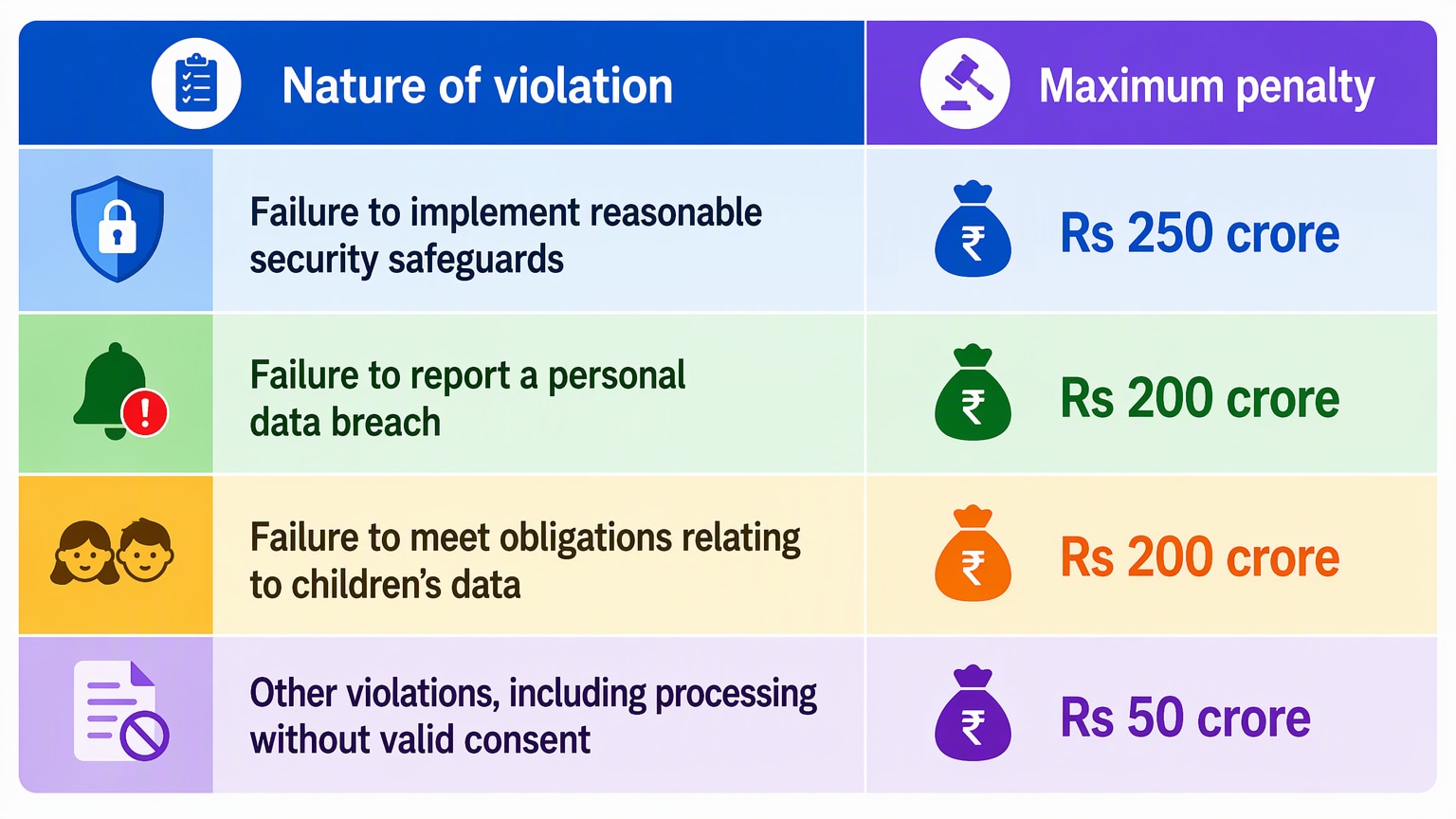
The provisions are particularly relevant for companies developing AI models or purchasing datasets from third parties. They will need to establish whether the information used to train their models was collected legally and whether the necessary permissions were obtained.
The full compliance framework is scheduled to take effect from May 14, 2027, giving companies a limited window to review their data collection and processing practices.
Can AI Companies Use Your Photos, Writing And Music?
Personal data protection is not the only legal safeguard available to individuals. If an AI company uses someone's original writing, photographs, music or computer code to train its models, copyright law could also come into play.
The Copyright Act, 1957, protects original creative works. Unauthorised use can invite civil proceedings, including claims for injunctions and damages.
Knowing copyright infringement can also attract criminal punishment, including imprisonment of up to three years and a fine of up to Rs 2 lakh.
However, the legal position on using copyrighted material to train AI models is still evolving. In July, the Delhi High Court declined to grant an interim injunction in the case involving news agency ANI and OpenAI. The court took an initial view that AI training could potentially fall within the scope of fair dealing. The matter is yet to go to trial, and the final legal position remains unsettled.
Even if information is publicly accessible online, it does not automatically mean that every form of commercial use is legally permitted.
Track Latest News Live on NDTV.com and get news updates from India and around the world

