





- The 8th Pay Commission debate involves a salary formula proposing up to 4.38 fitment factor for senior staff
- Indian Railway Technical Supervisors Association suggests five fitment factors based on pay levels, not one
- Higher fitment factors could significantly raise salaries and pensions, increasing government financial burden
8th Pay Commission News: The 8th Pay Commission has become much bigger than a routine salary revision exercise.
What started as consultations over pay hikes and pensions is now turning into a nationwide debate over how much the government can realistically afford to give its employees.
And at the centre of that debate is a proposal that has grabbed attention across departments -- a salary revision formula that could push pay hikes beyond 400 per cent for some senior employees.
The proposal has come from the Indian Railway Technical Supervisors' Association (IRTSA), one of the key employee bodies participating in the ongoing consultations with the 8th Pay Commission.
Instead of asking for one common fitment factor for everyone, the association has proposed five different fitment factors for different pay levels.
That is a major shift from previous pay commissions.
Under the proposal:
- Levels 1 to 5 would get a fitment factor of 2.92
- Levels 6 to 8 would get 3.50
- Levels 9 to 12 would get 3.80
- Levels 13 to 16 would get 4.09
- Levels 17 to 18 would get 4.38
If accepted, the impact on salaries could be enormous.
For example, an employee earning a basic pay of Rs 2.5 lakh under Levels 17-18 could see revised basic pay jump to nearly Rs 10.95 lakh under the proposed 4.38 factor.
Even mid-level employees would see sharp jumps. A basic salary of Rs 45,000 under Levels 6-8 would rise to Rs 1.57 lakh under the proposed formula.
The association argues that the current system unfairly compresses salary gaps between junior and senior staff, especially technical employees handling safety-critical operations in the Railways.
It has also demanded a separate pay structure for technical railway staff, faster promotions, higher annual increments of 5 per cent, and merger of 50 per cent Dearness Allowance into basic pay before salary revision calculations begin.
8th Pay Commission: The Fitment Factor
At the heart of the debate lies one technical phrase that is now becoming familiar even outside government offices -- the fitment factor.
A fitment factor is simply the multiplier used to revise salaries under a Pay Commission. The formula is straightforward:
{New Basic Pay = Current Basic Pay X Fitment Factor}
Under the 7th Pay Commission, the fitment factor was fixed at 2.57. Now, employee unions across sectors are demanding much higher numbers. Some organisations have sought a 3.83 fitment factor. Others have gone even beyond that.
The National Council-Joint Consultative Machinery has demanded a minimum basic pay of Rs 69,000, while Bharatiya Pratiraksha Mazdoor Sangh has reportedly pushed for Rs 72,000 minimum pay and a 4.0 fitment factor.
But behind the growing excitement lies a difficult question for the government -- can India afford such a massive revision?
Union representatives themselves privately admit that not every demand may be accepted. They acknowledge that the government now has to balance employee welfare with fiscal pressure, pension liabilities and inflation risks.
A very high fitment factor does not just increase salaries. It also increases pensions, allowances, arrears and long-term retirement liabilities across departments.
And the impact does not stop with the Centre. Historically, many state governments also revise their salary structures after a Central Pay Commission recommendation, multiplying the financial burden further.
That is why many insiders now believe the government may ultimately choose a middle path. Some demands linked to inflation and household realities may receive sympathy. Others may be moderated.
8th Pay Commission: Revise 'Family Unit' Formula
One proposal that is gaining strong support among unions is the demand to revise the "family unit" formula from 3 to 5.
Employee bodies argue that modern households are far more financially stretched than when earlier commissions designed the wage formula decades ago.
Today, many employees support spouses, children and ageing parents together while also dealing with rising healthcare, housing and education costs. Follow Markets Live Updates
Meanwhile, the Old Pension Scheme (OPS) debate has also returned to the spotlight. Several unions continue demanding OPS restoration, arguing that the National Pension System leaves retirement income dependent on market performance.
But even some employee representatives now admit that completely dismantling NPS may no longer be practically easy after years of implementation.
As a result, many unions are now focusing on "OPS-like protections" instead of complete rollback. These include guaranteed pension mechanisms, DA-linked pension protection and minimum assured pension structures.
8th Pay Commission: Consultation Phase
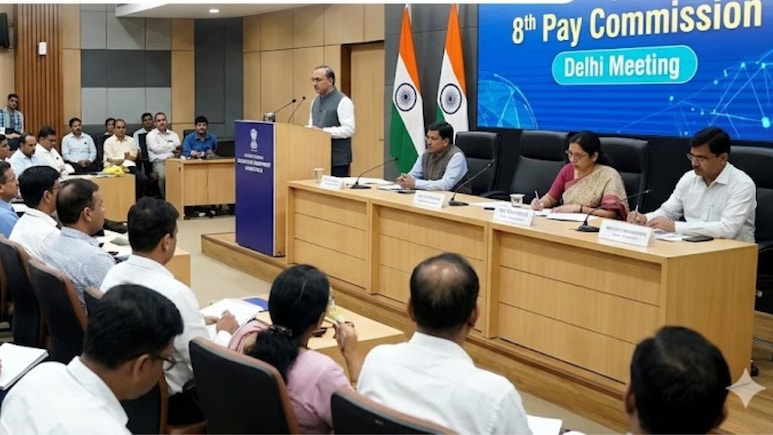
Meanwhile, the 8th Pay Commission itself has entered an intensive consultation phase. The panel, headed by Justice (Retd) Ranjana Prakash Desai, has already held meetings in Delhi and several other regions.
It has now announced visits to Bhubaneswar on July 6 and 7 as part of its nationwide consultation exercise with employee unions, pensioner groups and government organisations.
The Commission has also scheduled consultations in Lucknow, Hyderabad, Srinagar, Ladakh and Jammu & Kashmir.
The stakes are massive.
The recommendations of the 8th Pay Commission are expected to affect more than 1.1 crore beneficiaries, including central government employees, pensioners and their families.
The government formally constituted the 8th Pay Commission on November 3, 2025, continuing a tradition that began in 1946. Since then, India has seen seven pay commissions, usually once every decade.
This time, however, the discussions are unfolding against a far more complicated economic backdrop. Inflation concerns remain high. Pension liabilities are rising. Fiscal pressures are tighter.
And yet, employee expectations have perhaps never been bigger. That is exactly why the ongoing consultations are being watched so closely.
Track Latest News Live on NDTV.com and get news updates from India and around the world

