





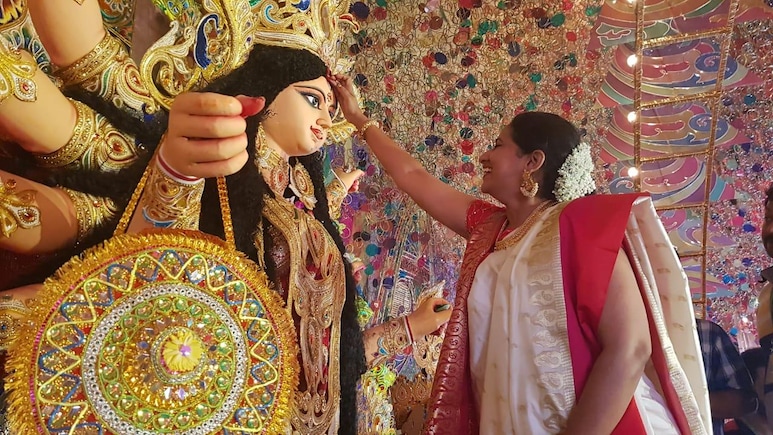
"I am a vegetarian Bengali," I told the priest.
Seeing my devotion and chanting of mantras during Sandhi Puja on Maha Ashtami, the priest at the Mudiali Puja pandal in South Kolkata asked me, "Are you a Bengali?"
"I am a vegetarian Bengali," I underlined again.
That sentence took many by surprise.
As if Bengal and fish are one word. As if Durga Puja cannot be Durga Puja unless there is a piece of mutton on the plate and a silver hilsa on the thali.
-

-
 Is AI Bubble Waiting To Burst? Nikhil Kamath Warns Of Tougher Months Ahead
 -
 "We Don't Have 5 Years": Celebrated American General Sounds Alarm On War
 -
 "There Will Be Issues Between Big Countries": S Jaishankar On India-China
 -
 Neha Goyal Makes Stunning Asian Games Gold Revelation At NDTV World Summit 2026
 -
 Big NDTV Summit Impact: RBI Governor's Tata Sons Listing Remark Makes Top Newspaper Headlines
 -
 "Certainty Is A Problem": Nikhil Kamath On Marriage, Children And Future
 -
 "High Inflation Is Like Tax On Everyone": RBI Governor At NDTV World Summit
 -
 RBI Governor Sanjay Malhotra's Big Hint On Tata Sons Listing Row At NDTV World Summit
 -
 The Mystery Of A Bare Nail In Ashwini Vaishnaw's Office
 -
 To PM Modi's "Failed Product" Jab At Rahul Gandhi, A Shashi Tharoor Counter
I grew up knowing both truths in the same location.
In Bengal, Maa Durga does not come as a guest who must be wrapped in holiness.
She comes as a daughter returning to her father's house. You do not put a daughter on a nine-day fast. You cook what the house knows how to cook. You cook what the river gave you. You cook what the family has always offered when the Goddess is in the courtyard. Here the Goddess is the daughter.
In any Bengali home, "Maa" is a word used to call "Dear Daughter".
That is why, in Bengal, fish and mutton during puja are not a "break from piety."
They are piety.
In the Shakta way of seeing the world, the offering is not a snack. Once it is placed before the deity, it becomes prasad.
The same goat that was once "bali" (sacrifice), the same fish that was once the day's catch, is no longer ordinary meat. It is what the house has given, and what the Goddess has returned.
Navami carries that meaning most clearly.
Ashtami is often the quieter, more satvik day: anjali, khichuri, labra, the long wait in the heat of the pandal.
Navami is different. Traditionally, it was the day of the offering.
In many "bonedi bari" (traditional Bengali households), the memory of sacrifice still lives in the kitchen, even when the sacrifice itself has become symbolic.
The mutton cooked that day is niramish mangsho, no onion, no garlic.
Yes, believe it or not.
Mutton becomes a vegetarian meal for prasad when cooked without onion and garlic.
Ginger, yoghurt, garam masala, patience. "Vegetarian mutton," we joke, because the spices that make everyday cooking "amish" (non-vegetarian) are kept out of the Goddess's plate.
As Ashtami ends and Navami begins, that "muhurat" of 48 minutes, according to the "panchang" (Hindu almanack and calendar), is termed as Sandhi Puja.
Sandhi does not mean evening but the combination of 24 minutes of Ashtami and 24 minutes of Navami. The exact time when Mahishasura was killed by Goddess Durga.
It is after this puja that meat is prepared and offered to Durga and then distributed as Mahaprasad to everyone.
So, my dear Babaji from Central India, mutton is a vegetarian bhog during Durga Puja.
Kali Puja carries the same logic, only sharper.
On that Amavasya night, niramish mangsho is not a feast for the family first. It is offered to Maa Kali. Then it comes back as prasad.
I have seen households where even those who keep a vegetarian kitchen the rest of the year will take a little of that prasad because it is no longer "meat" in the ordinary sense.
It has passed through the ritual. It has been accepted.
I do not eat it. I never have. And still I have never felt that Durga Puja was happening in some other room, without me. Because the festival is larger than one plate.
For most Bengali families, yes, puja without fish feels unfinished.
Hilsa, rui, the mustard gravy, the fried piece that disappears before anyone sits down properly.
For many, Navami without mutton feels like a sentence without its last word. That is their inheritance. I do not argue with it.
My inheritance is different, and it is also Bengali.
I find the festival in the other bhog, the one that feeds the queue outside the pandal and the quiet plate at home.
Khichuri that tastes of ghee and roasted moong and something you cannot recreate in a weekday kitchen at any other time of the year.
Labra in which pumpkin, brinjal, raw banana and beans forget they were separate vegetables.
Luchi so light it almost argues with gravity. Chholar dal with coconut. Aloor dum without onion. Tomato-khejur chutney. Payesh. Mishti doi.
The long afternoon when the dhaak is still sounding, and someone is already asking for a second helping of something that has no meat in it at all.
That meal is not a compromise. It is the public heart of puja. Community pandals feed thousands with it.
Widows eat it. Children eat it.
Visiting cousins who "don't eat non-veg in Navratri" eat it and go quiet because that is the flavour of the festival.
I have stood in those lines not as a journalist but as a daughter of this culture. I have come back from shoots on highways and still timed my day around bhog.
People sometimes want a fight: is puja vegetarian or not?
Bengal refuses the binary.
The same week holds niramish mangsho and khichuri-labra-payesh.
The same faith holds the river's fish and the widow's plate. The same daughter comes home to both kitchens.
Yes, I am a vegetarian Bengali.
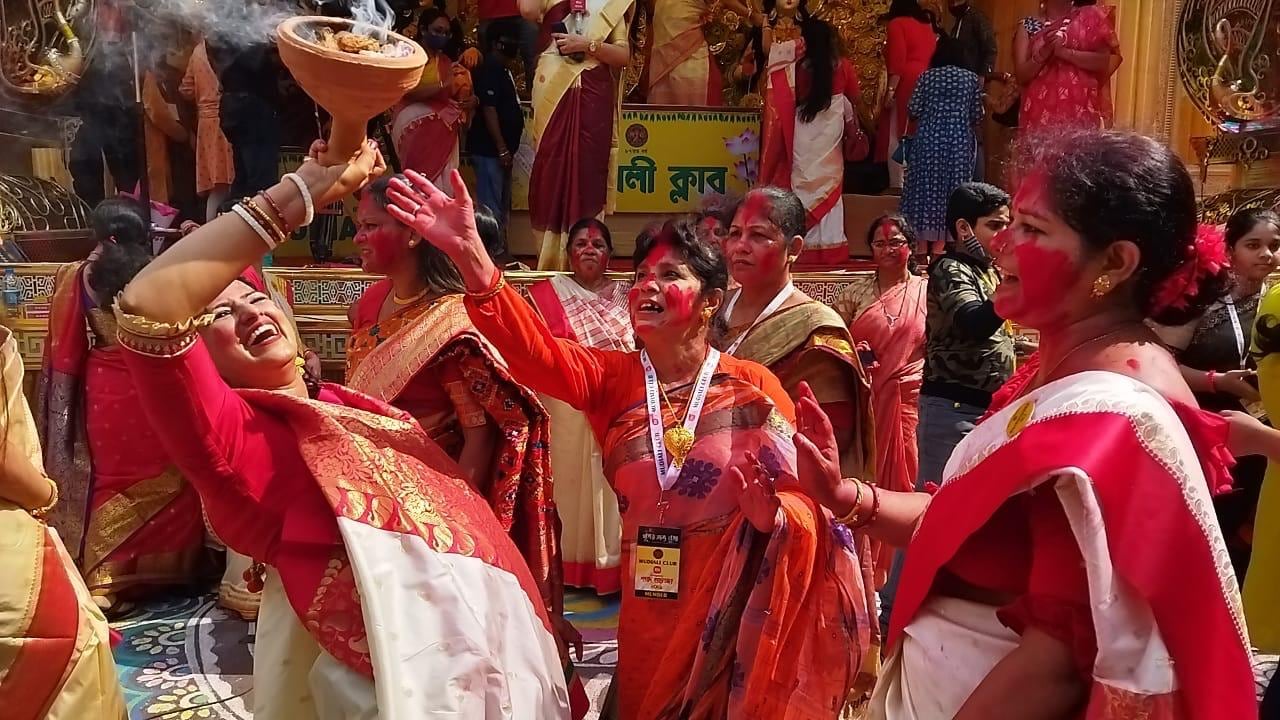
For me, the arrival of Durga Puja is symbolised by the smell of dhuno, the white of the dhaak's feathers, the crush of the crowd at anjali, the first spoon of bhoger khichuri.
There is a version of this thali with mutton on it, and a version without. Mine happens to be the second. Both are still the same feast. The mutton on that plate is bhog, offered and accepted, the same as the khichuri on mine.
And that is why vegetarians continue to celebrate Durga Puja with non-veg on the table.
Track Latest News Live on NDTV.com and get news updates from India and around the world

