





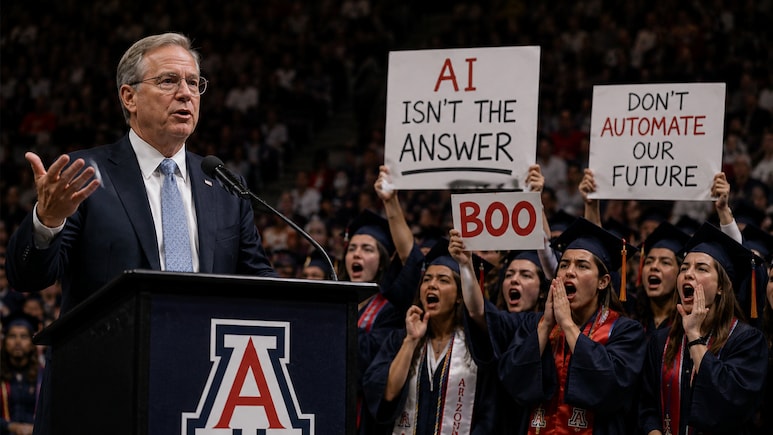
There was a time when bringing up AI at a university graduation would probably earn applause, curiosity, maybe even excitement. Instead, former Google CEO Eric Schmidt was booed down heavily at the University of Arizona while delivering the commencement speech on Sunday, every time he brought up artificial intelligence.
This reaction may perhaps be one of the clearest signs yet of where the public mood around AI stands right now. Schmidt, while addressing graduates, spoke about the impact of modern technology, automation and AI on society. But students repeatedly interrupted with jeers and boos. Mobile phone videos of the incident are circulating online and on social media.
What makes the moment especially striking is who was doing the booing. These are students graduating into an AI-first world. A generation that grew up with ChatGPT, Instagram, TikTok algorithms and AI tools embedded into daily life. If anyone was expected to be relatively pro-AI, it was probably them. Instead, the mood inside at the venue reflected something else entirely: anxiety and disdain.
Many young workers now see AI less as a cool productivity tool and more as a direct threat to entry-level jobs, creative work and long-term career stability. That tension has been building for months across industries ranging from media and design to software and customer support.
AI educator and founder of The Cutting Edge Group, Ansh Mehra says the backlash around AI is deeply tied to human psychology. "People in general are loss averse, which means they would do anything to avoid a loss and worry less about gaining more," he says. "The fear of losing our jobs is stronger than the happiness of automating our work, that's why everyone is freaking out about AI."
According to Mehra, this is also why aggressive AI evangelism increasingly triggers discomfort instead of excitement. "Any narrative that pushes AI too much is now being seen as a threat, not an upgrade," he says.
For many students, the distrust goes beyond jobs and extends to AI's creative limitations. Bhuvi Sharma, a student of Delhi University says, "I believe, AI can only regurgitate what has been fed into its system. It cannot invent or create new ideas. It cannot reach new boundaries, as of yet, or cannot think out of the box, as you call it."
And Schmidt is not even the first speaker this graduation season to face that backlash.
Just days earlier, students at the University of Central Florida booed another commencement speaker after she described AI as "the next Industrial Revolution."
The symbolism here is hard to miss. The people expected to inherit the AI future are increasingly unsure whether they actually want it. Lakshita Gajendra Babu, a student at Christ (Deemed to be University) believes the long-term value may lie in skills AI still struggles to replicate. "Anything that is uniquely human and cannot be fully replicated by a robot," she says.
That said, the picture is not entirely black and white. Economist and professor Abhirup Sarkar says that "AI is inevitable." And in many ways, that remains true. Companies are investing billions into AI infrastructure. Governments are racing to build policy frameworks around it. Tech leaders continue to pitch it as the defining technology shift of this era.
But "inevitable" does not automatically mean "trusted." That gap may be the real story emerging now.
Even among students and educators, the discomfort may be less about AI itself and more about how the transition is being communicated. Dr Prerana Srimaal, Head of Liberal Arts Department at Christ University, Bengaluru, says, "The backlash to Eric Schmidt doesn't surprise me, students aren't anti-AI, they're pushing back against how casually their futures are being framed as collateral in this transition."
Schmidt himself, during the speech, appeared to acknowledge the unease surrounding technology's unintended consequences. He spoke about how the digital systems his generation helped build turned out to be "more complicated" than expected, and even acknowledged fears around AI. "There is a fear in your generation that the future has already been written, that the machines are coming, that the jobs are evaporating, that the climate is breaking, that politics is fractured, and that you are inheriting a mess that you did not create, and I understand that fear," the former Google boss said.
The boos perhaps matter more than people realise because students don't reject technology, far from it, it's because they no longer seem willing to accept Silicon Valley's version of optimism at face value.
Track Latest News Live on NDTV.com and get news updates from India and around the world

