





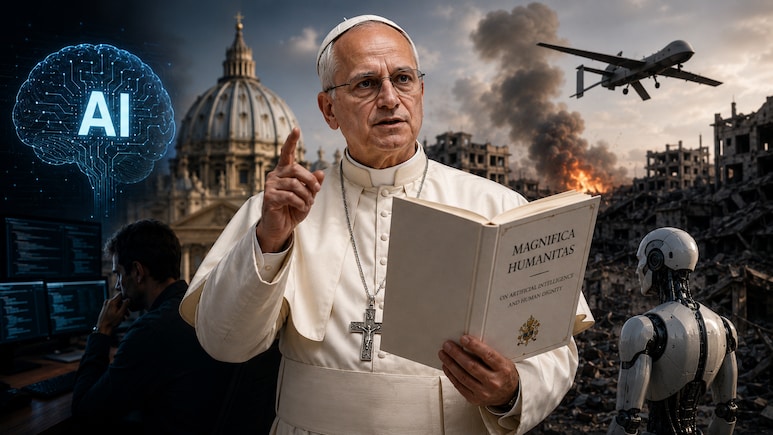
Pope Leo XIV has issued one of the strongest warnings yet from a global leader on the dangers of artificial intelligence, cautioning that the technology risks damaging human dignity, destabilising work and concentrating enormous power in the hands of a few private companies unless governments step in to regulate it properly.
"Artificial intelligence needs to be disarmed," the Pope wrote in Magnifica Humanitas ("Magnificent Humanity"), a sweeping Vatican document (an encyclical) released Monday and spanning 42,300 words.
"The word is strong, I know, but deliberately chosen because this moment needs words capable of attracting attention," the first-ever American Pope added.
The Pope's intervention comes at a moment when governments across the world are still struggling to decide how aggressively AI should be regulated even as the technology rapidly transforms workplaces, education, media and warfare. In the United States, the debate has become increasingly political, with major AI companies lobbying heavily against stricter oversight and policymakers divided over how far governments should go in slowing development. The uncertainty was highlighted recently when US President Donald Trump postponed signing a major AI-related framework document, highlighting the broader hesitation around regulation even as concerns continue to grow. Against that backdrop, Pope Leo's intervention comes at a crucial time.
The Pope has been unusually vocal about AI almost since the beginning of his papacy. On just his second day as pope last year, he told the College of Cardinals that the Church under his leadership would confront the risks AI poses to "human dignity, justice and labor."
Since then, he has repeatedly returned to the subject during public speeches, meetings with Catholic university leaders and even while marking the International Day of Mathematics. Last week, the Vatican also announced a commission of senior Catholic officials tasked with studying the challenges posed by AI.
The Vatican encyclical - essentially a major public letter from the Pope to the world - warns that artificial intelligence could spread misinformation, intensify conflict, undermine meaningful employment and even make war easier to wage. "What is needed is a more active political involvement that is capable of slowing things down when everything is accelerating," the Pope wrote, urging governments to create "robust legal frameworks, independent oversight, informed users and a political system that does not abdicate its responsibility."
One of the most striking aspects of the Vatican event launching the document was the presence of Christopher Olah, co-founder of Anthropic, one of the world's leading AI companies and the maker of the Claude chatbot. Olah is not a catholic and a self-described atheist.
The optics here cannot be ignored. One of the world's most influential religious leaders unveiling a major warning about AI while standing alongside one of the people helping build it, an atheist, no less.
Pope Leo described the moment as a hopeful sign of dialogue between the technological and spiritual worlds. He singled out Olah directly, saying he hoped to work with him "to find a way for humanity in this time of artificial intelligence."
"What a great sign of hope it is that in our differences we can listen to one another," the Pope said. Yet even as the Vatican opened the door to collaboration with Silicon Valley, the Pope warned against allowing a small group of corporations to shape the future of a technology that could affect billions of lives. "A more moral AI is not enough if that morality is determined by a few," he wrote.
A Call to Protect "Humanity"
The document repeatedly returns to the fear that societies may sacrifice human beings in pursuit of speed, efficiency and profit. "A society that guarantees employment to only a small fraction of the population, despite having a high level of technical development, risks exposing many to forced inactivity," he warned.
"This creates a paradox of material progress and anthropological regression that undermines the foundations of a just and stable social peace."
The Pope also called for "the protection of employment opportunities and the irreplaceable role of the individual," warning against a future where technological advancement benefits only a small section of society while millions lose meaningful work and purpose.
The document also focused on war and autonomous weapons. The Pope called for the "most rigorous ethical constraints" on weapons developed using AI, warning that rapidly advancing autonomous systems are reducing human control over warfare itself.
"The growing ease with which autonomous weapons systems can be deployed makes war more 'feasible' and less subject to human control," he wrote. He said that goes against the idea that war should only happen as a last resort and under human control.
Is AI The New Slavery?
Another part of the document that stood out was the Pope linking AI to slavery. Pope Leo included one of the Vatican's strongest apologies yet for the Catholic Church's historical role in the slave trade, writing that it was "impossible not to feel deep sorrow when contemplating the immense suffering and humiliation endured by so many." He added that he "sincerely asked for pardon" in the name of the Church.
But he did not mention that history in isolation. The Pope warned about what he called "new digital slaveries" too, suggesting that societies may once again start accepting systems built around exploitation - this time through data, automation and artificial intelligence.
Interestingly, Christopher Olah, co-founder of Anthropic, seemed largely in agreement with the concerns being raised. "There is a real possibility that AI will displace human labor at a very large scale," he said during the Vatican event. "We need moral voices that the incentives cannot bend."
At another point, Olah said people inside AI companies do not always see every consequence of the technology they are building.
"Today is just the beginning - the start of a long collaboration between those of us who are building this and those who can see what we, from the inside, cannot," he said.
For all the talk about regulation, jobs and autonomous weapons, that seemed to be the larger point running through the Pope's message: AI is no longer just a Silicon Valley story.
Track Latest News Live on NDTV.com and get news updates from India and around the world

