





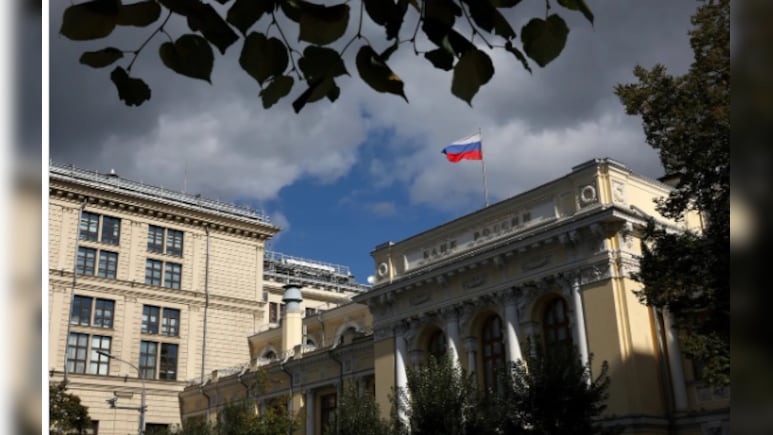
Russia has passed a new law authorising its central bank and other major financial institutions to operate their own anti-drone defence systems and arm staff to repel such attacks from Ukrainian.
The law, approved by Russia's lower house of parliament on Tuesday, grants staff at the country's central bank to respond to attacks on protected facilities, repel the threat of an attack on employees or other persons located at these sites without the involvement of special forces.
Under the law, employees will be allowed to shoot down unmanned aerial vehicle (UAV, or drone) attacks by jamming or converting drone remote control signals, interfering with their control panels, and damaging or destroying the drones.
Russia's largest lender Sberbank, the Russian Cash Collection Association and the Special Postal Service, which handles classified state correspondence are among the other institutions to be allowed to oversee their own drone defense operations, news agency RBC reported Tuesday.
Employees will be “empowered to prevent the operation of unmanned aerial vehicles, underwater and surface vessels and apparatus, unmanned vehicles, and other automated unmanned systems,” RBC reported, citing the law passed in the State Duma.
Chairman of the State Duma Committee on Financial Markets Anatoly Aksakov, one of the authors of the new legislation, told RBC Radio that anti-drone defense systems will be located near key facilities, including the central bank. Staff at those institutions would be issued weapons.
He further claimed that the institutions would handle the cost of drone defence themselves.
“Firstly, jamming will be used to make it more difficult for [the UAVs] to target and attack the relevant targets, ... Plus, we'll also use means to shoot down these drones, thereby protecting the relevant targets,” he said.
“The institutions would pay for the drone defense systems themselves. If it's the central bank, then the central bank will pay; if it's Sberbank, then Sberbank will pay,” Aksakov added.
Russia and Ukraine both deny deliberately targeting civilian infrastructure as part of their ongoing war. The attack on the central bank's office was the first on a major central bank office since the beginning of the war. Ukraine struck the central bank's office in Sevastopol in Crimea with a missile on Wednesday, local governor Mikhail Razvozhaev said. He alleged that it was a British-made Storm Shadow missile, adding that the building was on fire. There were no reported attacks on major Sberbank offices.
Ukraine has been regularly striking Russia with drones since Moscow launched the war in February 2022, with energy infrastructure frequently targeted as Kyiv aims to deprive Moscow of revenues in order to bring the conflict to an end.
Track Latest News Live on NDTV.com and get news updates from India and around the world

