





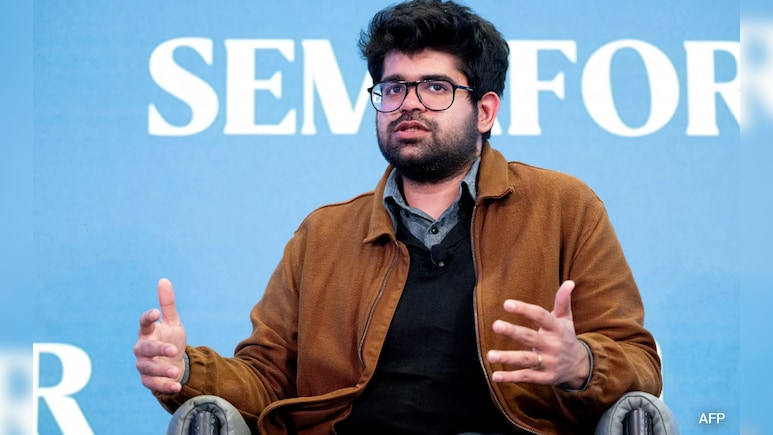
Perplexity CEO Aravind Srinivas believes the future leaders of the artificial intelligence industry will not necessarily be those with the largest models or highest revenues, but those that can generate the greatest economic value from the power their AI systems consume.
Speaking to CNBC on Wednesday, Srinivas said the company that can deliver the “most token value per watt per user” will ultimately emerge as the winner in the AI race in the future.
“Whoever is able to maximize this particular objective really will, by balancing accuracy, latency, cost, privacy and intelligence all together, they're going to win, that's what's going to win long term,” Srinivas said.
Tokens are the basic units of data processed by AI models. Every question asked to an AI chatbot is broken down into tokens. Each requires computing power and energy to be processed. According to Srinivas, the most successful AI firms will be those that achieve the best balance between energy consumption and economic output.
While some AI companies may currently benefit from charging premium prices for powerful models, Srinivas argued that such gains may not translate into lasting advantages.
“It might feel like some model providers are making a lot of money because their models are very expensive, but that's short-term revenue growth,” he added.
Perplexity's Focus On Agentic AI
The comments come as Perplexity deepens its focus into agentic AI, systems capable of completing complex tasks with minimal human supervision. Earlier this year, the company introduced Perplexity Computer, an AI agent designed to execute complex tasks over long periods of time.
A key focus for Perplexity is improving efficiency to achieve the best outcomes while minimizing energy use. To support that goal, Perplexity unveiled Personal Computer this week, a tool which it describes as an “orchestrator.”
The technology automatically determines which AI model should handle a task, how multiple agents should collaborate and whether processing should occur in a data center or directly on a user's device.
Srinivas said the growing shift towards on-device AI processing could make it faster and more secure, improve privacy and energy efficiency by reducing reliance on remote servers.
“The data center is coming to your laptop,” he said, adding that the industry needs an AI operating system capable of unifying different models, devices and computing environments.
On Wednesday, Perplexity announced that Personal Computer will be available on Microsoft's Windows operating system, allowing users to connect the AI assistant to applications such as Word and Outlook, as well as local files. The product is already available on Apple's Mac platform.
Srinivas said that Perplexity is focused on creating a “sustainable, durable advantage” versus competitors and that “this is an orchestration problem.”
“We believe that by solving that, we'll be building a pretty valuable company that has endurable, long-term advantage,” Srinivas said.
Perplexity faces intensifying competition from major AI players including OpenAI, Anthropic and Google, all of which have accelerated investments in AI agents and advanced reasoning systems.
Perplexity, which was last reportedly valued at $20 billion, remains significantly smaller than industry heavyweights. Anthropic and OpenAI have climbed to nearly $1 trillion and just over $850 billion, respectively. Anthropic this week confidentially filed for an initial public offering in the US as investor demand for AI stocks continues.
Track Latest News Live on NDTV.com and get news updates from India and around the world

