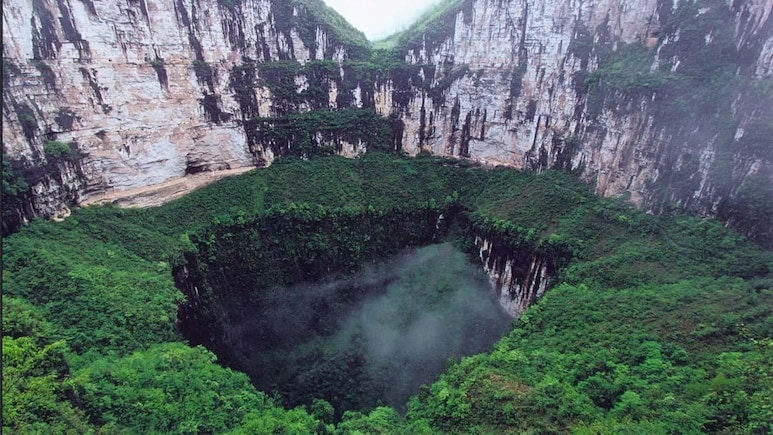
- Xiaozhai Tiankeng in Chongqing, China, is the world's deepest sinkhole with unique ecosystems
- The sinkhole measures up to 662 meters deep and contains its own forest, river, and wildlife
- Discovered in 1994, the pit hosts rare species like the ancient ginkgo and Chinese Giant Salamander
Most travel bucket lists look fairly similar after a while. The Great Wall, Santorini at sunset, the Amalfi Coast, and Machu Picchu. All worthy destinations, all thoroughly photographed. But if you are the kind of traveller who wants something that genuinely stops you in your tracks, something that makes you feel like a tiny human being on a very strange and spectacular planet, there is a place in the mountains of Chongqing, China, that needs to be on your radar in 2026. It is called Xiaozhai Tiankeng. It is the world's deepest sinkhole. It has its own forest, its own weather, its own river, and its own population of rare wildlife. And most people have absolutely no idea it exists.
Also Read: Why You Must Visit Dead Sea, The Only Sea Where You Won't Drown If You Play By The Rules
What Is a Tiankeng?

The word "tiankeng" directly translates from Mandarin as "heavenly pit" or "sky hole." In scientific terms, it is the Chinese name for a specific category of extremely large sinkhole; any sinkhole deeper and wider than 100 metres qualifies as a tiankeng. In ordinary English, a sinkhole is what happens when the rock beneath the earth's surface dissolves and gives way, opening up a hole. But when we're talking about tiankengs, we are not talking about the kind of pothole that swallows a car. We are talking about geological formations so vast that they contain entire ecosystems.
China has more tiankengs than anywhere else in the world. China's expansive Karst region is spread across the provinces of Guizhou, Guangxi, Yunnan, and Chongqing. The South China Karst region is geologically so unique that it has been named a UNESCO World Heritage Site. It is filled with sinkholes that contain their own forests, rivers, and ecosystems, and some are even populated by villages. More than two-thirds of the world's known sinkholes are located in China, with over 200 documented across the country. Guangxi province alone has 30 major tiankengs. And at the very top of this extraordinary geological ranking sits Xiaozhai Tiankeng, the biggest, deepest, and most awe-inspiring of them all.
The Numbers That Make Your Head Spin

The Xiaozhai Tiankeng is a colossal sinkhole, measuring 626 metres long, 537 metres wide, and between 511 and 662 metres deep, with vertical walls. Its volume is 119,349,000 cubic metres, and its opening spans 274,000 square metres. To grasp its size, the Empire State Building could fit inside with room to spare. This doubly nested structure features an upper bowl 320 metres deep and a lower bowl 342 metres deep, separated by a sloping ledge formed by trapped soil. From above, it resembles two massive craters, their walls lush with vegetation where light and moisture foster remarkable plant life. The Tiankeng formed over the Difeng cave, shaped by an underground river originating in the Tianjin fissure gorge. This river flows 8.5 kilometres, dropping 364 metres, and creates a 46-metre-high waterfall above the Migong River. During the rainy season, a dramatic waterfall cascades into the tiankeng, a sight worthy of a David Attenborough documentary.
The Lost World Inside the Pit
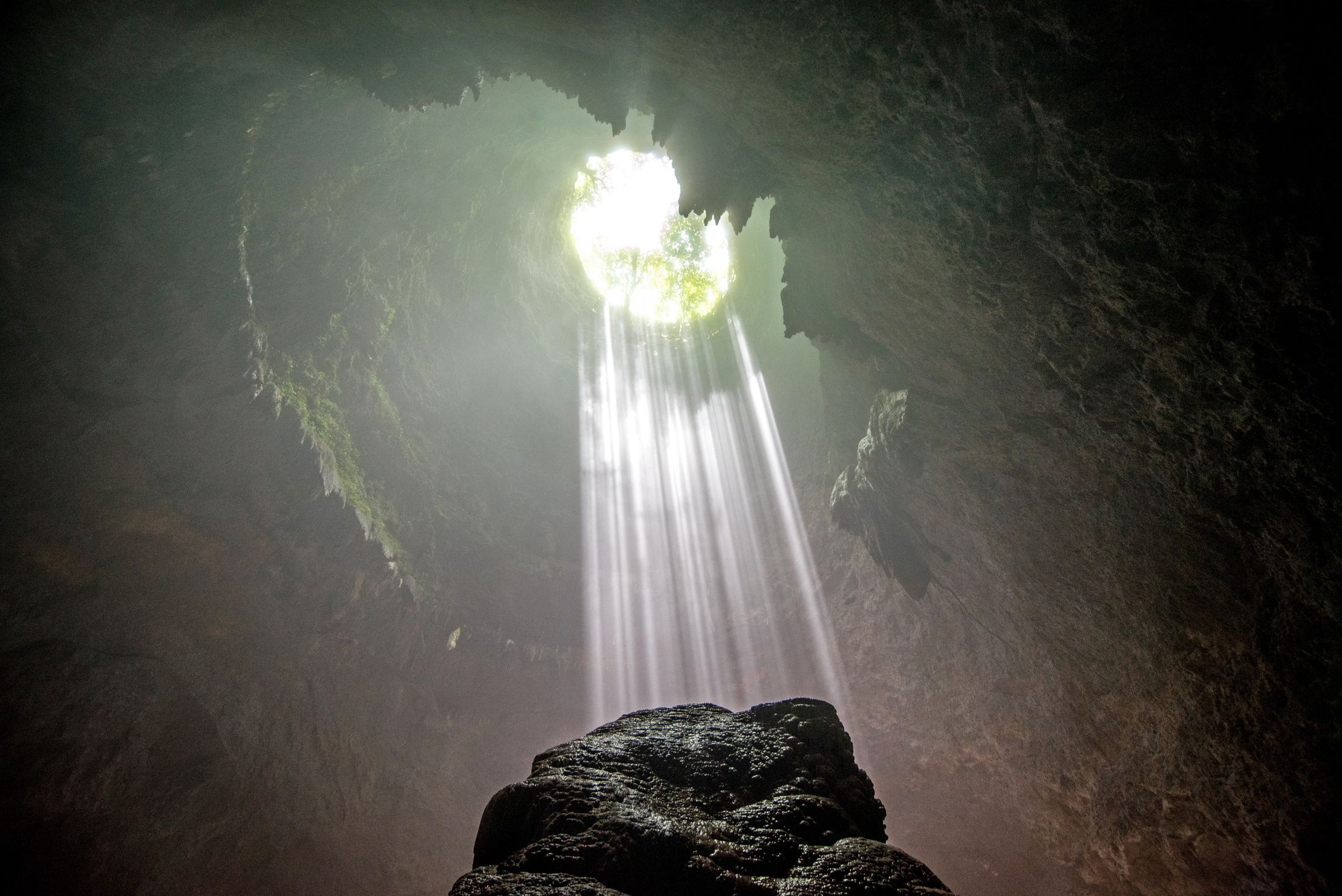
This part of the Xiaozhai Tiankeng story feels like science fiction. The pit's depth and steep sides have created a unique microclimate, cooler, more humid, with its own rainfall and fog patterns. Over thousands of years, this has nurtured an ecosystem distinct from the world above.
In the sinkhole, 1,285 plant species, including the ancient ginkgo, and rare animals like the clouded leopard and Chinese Giant Salamander, have been found. The ginkgo, one of Earth's oldest tree species, has survived since the dinosaurs, unchanged for 270 million years. Its thriving presence at the pit's bottom is a testament to living natural history.
The sinkhole's remote location means many species here haven't been documented elsewhere, possibly offering new scientific discoveries. Scientists continue to uncover wonders: 100-foot-tall trees in near-darkness, rare insects, fungi, and bats. Standing at the bottom feels like being in a place evolving quietly for millennia, entirely on its own terms.
Also Read: 7 Beach Destinations In India Beyond Goa Worth Visiting This Summer
A Place Discovered Remarkably Recently
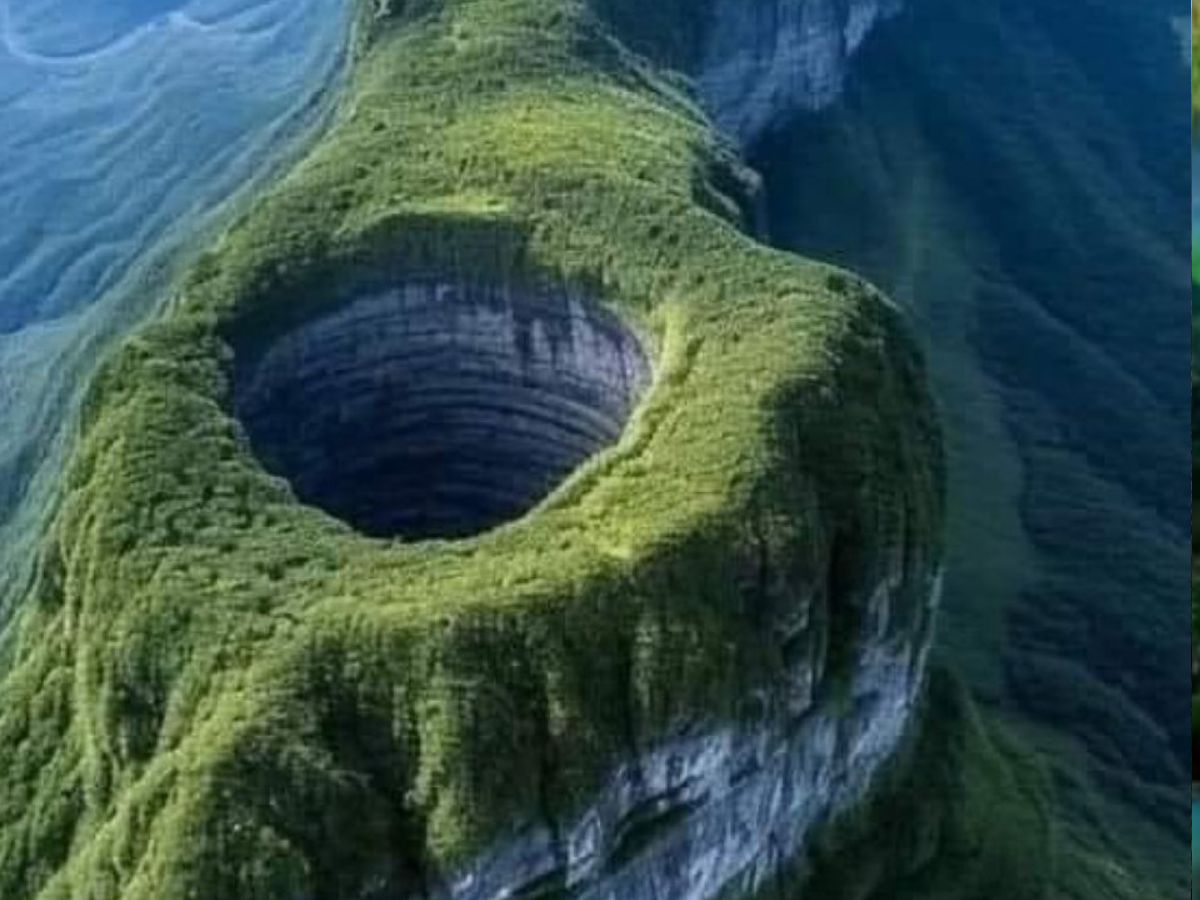
Given its extraordinary scale, you might assume that Xiaozhai Tiankeng has been a celebrated destination for centuries. In fact, despite being hundreds of metres deep, the Xiaozhai Tiankeng sinkhole was not discovered until 1994, when a group of British explorers with the Royal Geographic Society stumbled upon it. Local people in the surrounding Fengjie County have known of the pit for generations. The name "Xiaozhai" comes from a small village that once stood nearby, its name meaning simply "little village”, but the outside world had no record of it.
The China Caves Project, a collaborative exploration effort between British and Chinese cavers, encountered the tiankeng during their survey of the region and immediately understood what they had found. The sinkhole was formed gradually over the course of approximately 128,000 years, a span of time that makes the thirty years since its scientific discovery feel very brief indeed.
Today, the sinkhole is the main feature of the Tiankeng Difeng, literally "the heavenly pit and earth cave”, National Park. The park has been developed for tourism while attempting to preserve the fragile ecosystem within the pit. Scientists have raised concerns about increasing visitor numbers damaging the unique plant and animal life below, which means this is genuinely one of those destinations worth visiting before it becomes harder to access.
What the Experience of Descending Is Actually Like
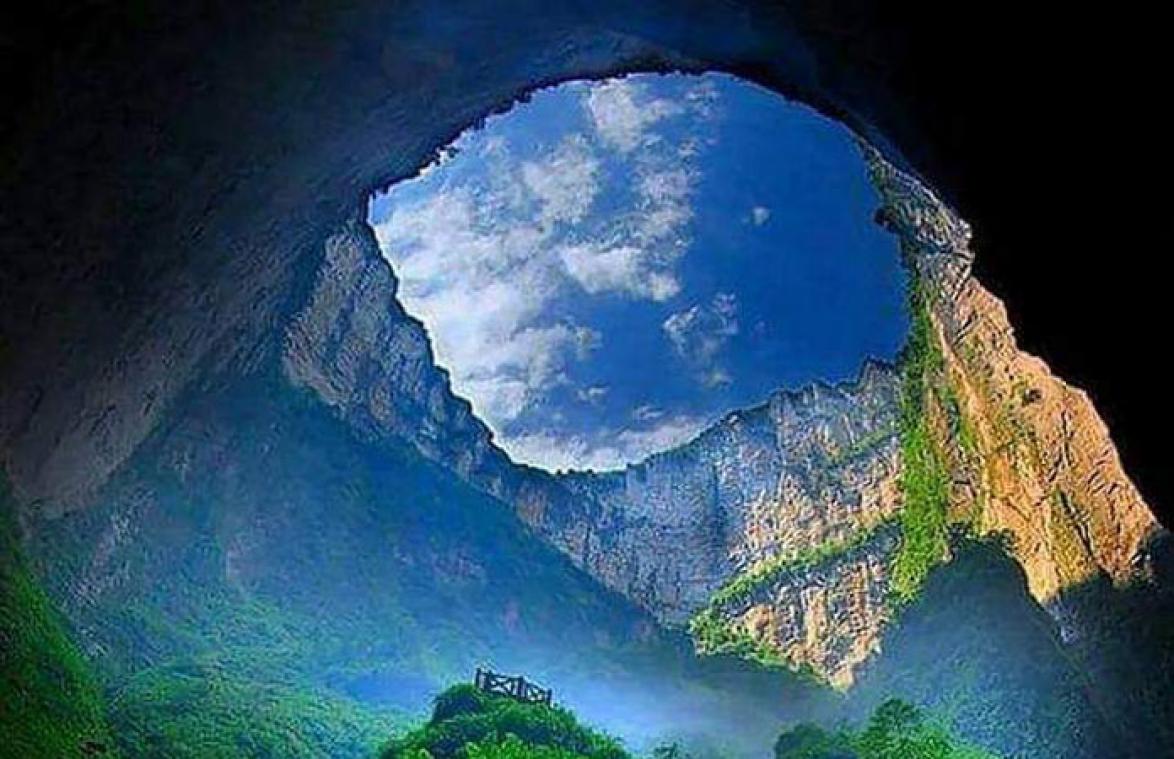
Standing at the rim of the Xiaozhai Tiankeng is a disorienting experience. The hole is so vast that your eye struggles to comprehend its scale. The walls drop vertically, green where light reaches and shadowy below. On clear days, treetops are visible far below. On misty mornings, common in Chongqing, the pit fills with cloud, disappearing into an infinite white nothing.
A zig-zag staircase with 2,800 steps leads to the bottom. The hike is challenging, as the hole is deep enough to fit the Empire State Building with room to spare. If you dare to descend into this heavenly pit, you might spot one of its rare animals.
The descent takes about three to four hours at a comfortable pace, with a similar time for ascent. Start early, ideally by 7 AM, to complete the return climb in daylight. The steps are steep and can be wet and slippery, so proper trekking shoes with grip are essential. Carry water, snacks, and a light layer for the cooler temperatures at the bottom. The best time to visit is in spring, when flowers bloom, or autumn, when the foliage turns gold, creating a breathtaking sweep of colour.
A Comprehensive Travel Guide for Indian Visitors

Getting to Xiaozhai Tiankeng
The Tiankeng is located in Fengjie County, Chongqing Municipality. Chongqing, one of the world's largest cities by administrative area, is built on cliffs above the Yangtze River and is worth exploring for a couple of days. Direct flights from India to Chongqing are limited, so it's best to fly from Delhi or Mumbai via Kuala Lumpur or Singapore with Malaysia Airlines, Singapore Airlines, or Scoot. Alternatively, connections through Bangkok on AirAsia or Thai Airways offer affordable entry into southern China. From Chongqing Jiangbei International Airport, take the metro or a taxi to the city centre.
Stay in Fengjie County, about an hour's drive from Chongqing, which is 400 kilometres east along the Yangtze River. It's reachable by a four to five-hour highway journey or a scenic river cruise. Fengjie, near the famous Three Gorges area, has historical interest. From Fengjie, taxis and local transport can take you to the Tiankeng Difeng National Park entrance.
China's high-speed rail network is excellent. For major cities like Chengdu, Xi'an, or Wuhan, the bullet train to Chongqing is fast and comfortable. Use the Trip.com app to book tickets.
Visa for Indian Passport Holders
Indian citizens need a tourist visa (L Visa) to enter China, with no visa on arrival. Essential documents include a valid passport with 6+ months' validity, a completed visa form, recent passport-size photos, flight and hotel bookings, 3-6 months' bank statements, employment proof, ITR acknowledgement, travel itinerary, cover letter, and all previous passports (mandatory since 2025). Apply via the Chinese Visa Application Service Centre in Delhi, Mumbai, Kolkata, or Chennai. Standard processing is 7-10 days, express is 6 days. Apply 3-4 weeks before travel. The single-entry visa fee is about Rs 2,900 (early 2026), with a Rs 1,00,000 bank balance required.
Payments and Connectivity
China is almost entirely cashless, and the digital payment ecosystem is different from what you are used to in India. UPI is non-existent, and international Visa cards will be rejected by street vendors and medium-sized businesses. Before arriving, install Alipay on your smartphone. Alipay now allows international card linkage for foreign visitors, which gives you access to pay essentially anywhere in China. Set this up before departure; it will save you enormous frustration on the ground.
Mobile internet: get a local SIM at the airport or bring a travel eSIM that includes China coverage. Many international apps, including Google and Instagram, are blocked in China. Download a VPN before you leave India; it cannot be downloaded once you're inside the country.
Complete the Digital Arrival Card on the official NIA portal before you board your flight. Save the QR code screenshot on your phone. It makes immigration significantly faster.
When to Go
The best time to visit Tiankeng is in the spring, when it is covered with peach blossoms and other vibrant plants. It is also worth visiting in autumn, when the leaves turn the hole into a wonderland of colour. Spring runs from March to May; autumn runs from September to November. Both are excellent windows. Avoid June through August, Chongqing is one of China's famous "furnace cities" and summer heat is genuinely brutal, reaching 40 degrees Celsius with high humidity. Avoid the National Day Golden Week (October 1 to 7), when domestic tourist numbers make major attractions overwhelming.
Where to Stay
In Fengjie County, options range from budget guesthouses to comfortable mid-range hotels. For a more comfortable base with better dining options, stay in Chongqing city and do the Tiankeng as a day trip or overnight excursion. Chongqing has a full range of international hotel brands, and the city itself, with its dramatic skyline, famous spicy hotpot cuisine, and surreal elevated highways threading through residential buildings, is worth at least two nights on its own.
Also Read: From Lonavala To Amboli, 7 Hill Stations In Maharashtra You Can Visit For A Cool Break
China Beyond the Headlines
For Indian travellers, China is a destination that has been undervisited in recent years, partly because of border tensions and partly because of the genuine complexity of the visa process. Both concerns are valid, and neither changes the fact that China is home to some of the most extraordinary landscapes and natural wonders on Earth. The Karst region alone is a destination of global significance, and Xiaozhai Tiankeng is its crown jewel. The world's largest sinkhole, with its own forest, its own weather, and its own ancient wildlife, a genuinely lost world sitting below the surface of a mountain in southern China, deserves a place on your list in 2026. Very few places in the world are this spectacular and this little-known at the same time.
Track Latest News Live on NDTV.com and get news updates from India and around the world


