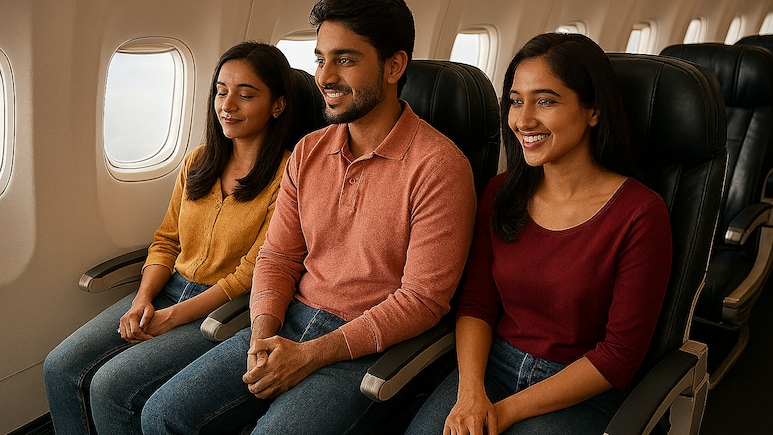
For years, Indian flyers booking tickets under a single PNR have carried a lingering worry: Would they end up scattered across the aircraft unless they paid an extra fee? That uncertainty may now be fading. The Ministry of Civil Aviation has issued a decisive new instruction that puts group seating at the forefront of passenger treatment. Instead of leaving families, friends or colleagues to negotiate seat swaps or endure an entire flight apart, airlines will now be responsible for ensuring that travellers on the same PNR are seated side by side whenever possible.
Unlike earlier norms where group seating was left to chance, convenience or added payment, the new directive redefines it as a fundamental expectation. The government has emphasised that passengers travelling under one booking reference must be placed together, ideally in adjacent seats, making the practice non-negotiable unless a traveller personally chooses otherwise. This shift aims to remove the stress many passengers experience at the boarding gate when last-minute seat maps reveal that their group has been split.
Also Read: Struggling With Jet Lag After Long Flights? Here Are 5 Tips To Help
Photo Credit: Unsplash
Why The PNR Rule Now Matters More Than Ever
India's domestic aviation market is growing at a scale few countries can match. With airports across the nation handling over five lakh passengers every day, the simple act of keeping groups seated together has become more than an issue of comfort. The Ministry's latest instruction signals a recognition that as the flying population expands, so should the reliability of basic travel expectations.
New Ministry Rules That Make Flying Easier
The Ministry has introduced a new set of guidelines to make air travel more transparent and passenger friendly. Here is a simplified look at the key updates, based on information reported by the Economic Times.
1. More free seats for passengers
Airlines must now keep a large share of seats free of any seat-selection charge. At least sixty per cent of the seats on each flight should be available without extra fees, giving passengers a fair chance to choose their place without paying more.
2. Families and groups to be seated together
Travellers who book under the same PNR should be placed next to one another whenever possible. This ensures that families, couples and groups do not get split up across the cabin unless they choose otherwise.
3. Clear rules for special baggage
Airlines must share easy-to-understand policies for items such as sports equipment, musical instruments and pets. This removes confusion and helps passengers plan better before arriving at the airport.
4. Stronger protection when flights go wrong
The Ministry has stressed that airlines must follow passenger-rights rules strictly. This includes proper handling of delays, cancellations and denied boarding, along with clear communication of what help or compensation passengers are entitled to.
Also Read: 5 Best Carry-On Travel Bags To Arrive At The Airport In Style
A Step Toward More Humane Air Travel
While other reforms, including free seat allocation for part of the cabin and clearer rules on baggage and passenger rights, help create a fairer travel environment, the PNR seating rule has the most immediate impact on travellers. It solves the common worry of being separated from your group even when you booked together.
Travel in India is getting busier, and this rule highlights that flying is also about keeping people together and making the journey smoother.
Track Latest News Live on NDTV.com and get news updates from India and around the world


