The latest edition of the Henley Passport Index is out, and it brings a curious twist for India. On paper, the country's global mobility standing has improved. Yet, when you look at the raw numbers, Indian passport holders actually have access to slightly fewer destinations without prior paperwork than they did last year.
India now ranks 75th in 2026, up from 85th in 2025, marking a significant 10-place climb.
In January this year, the position stood at 80th, making the latest jump even more notable in just a month. However, the total number of destinations accessible without securing a visa in advance currently stands at 56. That is an increase from 55 in January 2026, but still lower than the 57 destinations recorded in 2025.
In other words, India has moved up the global leaderboard even though it has lost access to two countries to enter without a visa.
So, how does a passport gain rank but lose access? To understand this, we need to look at what exactly is the Henley Index.
What Is The Henley Passport Index
Published by Henley & Partners, the Henley Passport Index ranks 199 passports to 227 different travel destinations according to how many destinations their holders can access without securing a visa before departure. The ranking draws on data from the International Air Transport Association and includes visa-free, visa-on-arrival and electronic travel authorisations in its scoring methodology.
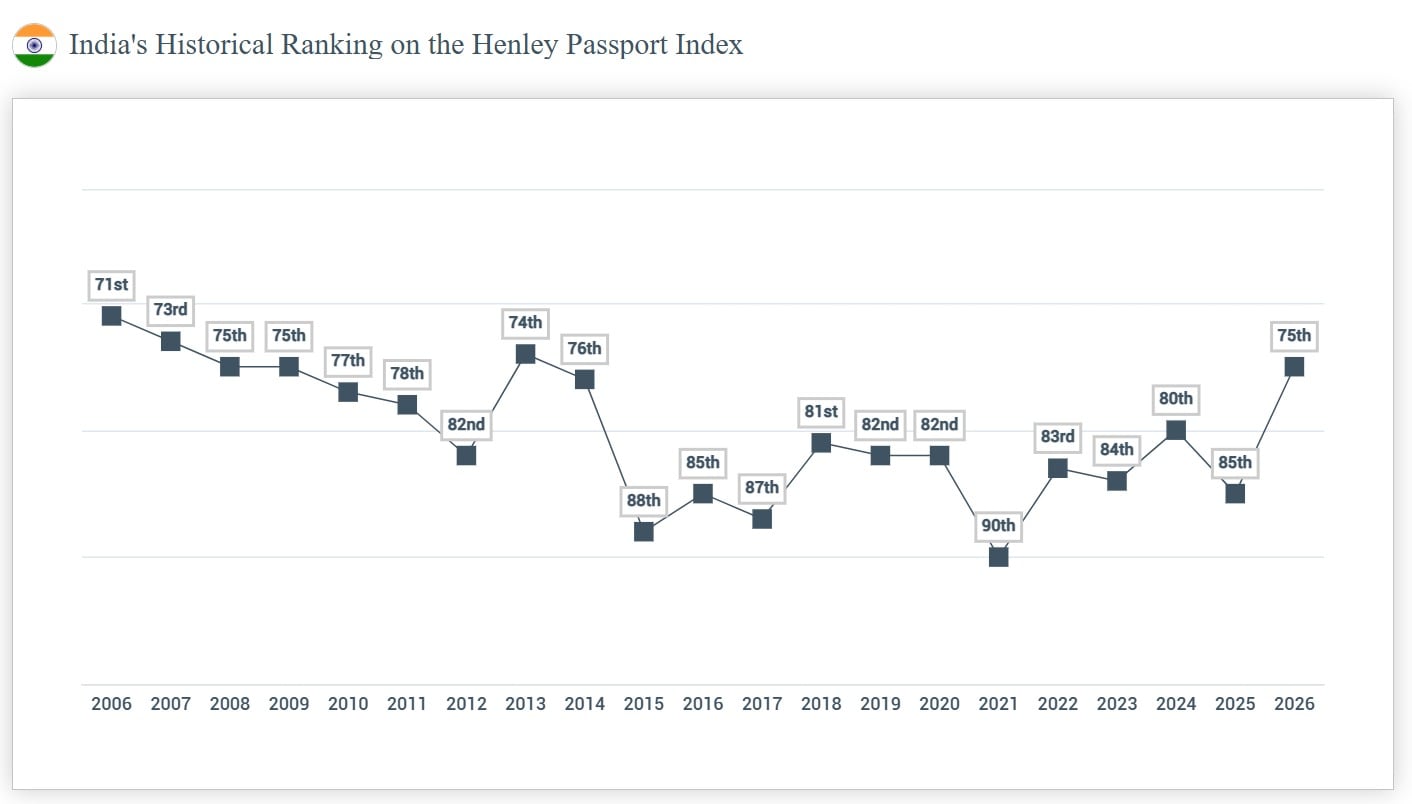
India's ranking over the years. Photo: Henleyglobal.com
In simple terms, the higher the number of destinations accessible without advance paperwork, the stronger the passport's mobility score.
The Two Countries India Lost
In 2025, Indian passport holders had access to 57 visa-free (includes visa-on-arrival and Electronic Travel Authorisation) destinations. By early 2026, that number dropped to 55 (January 26) before settling at 56 (February 2026).
The two countries responsible for the reduction were Iran and Bolivia.
Iran suspended its visa-free entry for ordinary Indian passport holders in November 2025. The decision followed a series of fraud and trafficking cases involving Indian nationals who were allegedly lured to the Islamic Republic with false job offers and then kidnapped for ransom.

Iran suspended its visa-free entry for ordinary Indian passport holders in November 2025. Photo: Unsplash
"Individuals were tricked into journeying to Iran by taking advantage of the visa waiver facility available for ordinary Indian passport holders. On arrival in Iran, many of them were kidnapped for ransom," India's Ministry of External Affairs said in a statement in November last year.
It noted that in view of such incidents, Tehran had suspended the visa waiver facility available to ordinary Indian passport holders visiting Iran.
From late November onwards, Indian travellers were required to obtain a visa in advance. Since the Henley index counts only destinations that do not require prior approval, Iran no longer qualified.
Why Bolivia No Longer Counts
Bolivia's case is different. In 2025, Indian citizens could obtain a visa on arrival, which required no advance paperwork and was treated favourably in the index scoring.

In 2025, Indian citizens could obtain a visa on arrival to Bolivia. Photo: Unsplash
In 2026, Bolivia shifted Indian travellers to an e-visa regime. Applicants must now apply online, upload documents and receive approval before departure. Since the system requires prior authorisation, it no longer qualifies under the same "visa-free" category used in the index methodology.
That technical shift removed Bolivia from India's accessible list.
The January Dip And February Recovery
The timeline within 2026 itself also shows movement.
The January 2026 list reflected a total of 55 accessible destinations after the removal of Iran and Bolivia. However, by February 2026, one country was added back into the tally: The Gambia.
The Gambia's inclusion raised the number from 55 to 56. This addition partially offset the earlier losses, though it did not restore the 2025 total of 57.
In other words:
- 2025: 57 'Visa-free countries'
- January 2026: 55 'Visa-free countries'
- February 2026: 56 'Visa-free countries' (But still lost Iran and Bolivia, but gained The Gambia)
Why The Improved Ranking?
India's passport ranking improved even though its visa-free score dipped slightly because the index works like a class leaderboard. It is not about your exact score alone, but where you stand compared to everyone else.
Think of it like a race. India slowed down a little, losing access to Iran and Bolivia and moving from 57 destinations in 2025 to 55 in early 2026. But several other countries also experienced visa policy changes, some losing more ground than India. When the final positions were sorted, India ended up climbing the table.
That is because the Henley & Partners index ranks passports relative to one another. It evaluates 199 passports against 227 global destinations using data from the International Air Transport Association.
Here is how the scoring works in simple terms.
Each passport receives 1 point for every destination that allows:
- Visa-free entry
- Visa on arrival
- A visitor's permit issued at the border
- A basic Electronic Travel Authorisation that does not require Embassy approval
If a traveller must apply for a visa in advance through an embassy or complete a full pre-departure e-visa process requiring approval before travel, that destination scores 0.
All the points are added up to create a visa-free score. Countries are then ranked from highest to lowest. If two countries have the same score, they share the same rank number.
In short, ranking is positional and India shares its rank with similar-scoring peers like Niger or Algeria; the first 74 spots go to those beating 56, even by 1 point.
In a global system where visa rules change frequently, position can improve even when the raw count barely does.
Track Latest News Live on NDTV.com and get news updates from India and around the world


