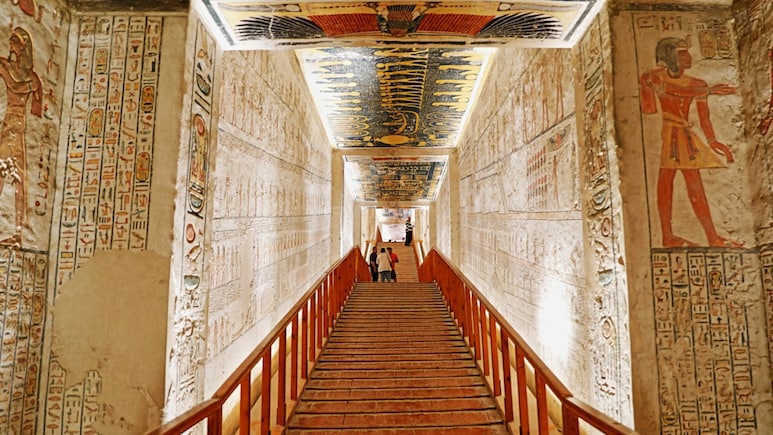
- Indian inscriptions discovered in Egypt’s Valley of the Kings date back around 2,000 years
- Nearly 30 inscriptions in Tamil, Sanskrit, and Prakrit were documented in six tombs
- Findings highlight ancient maritime trade between India, Egypt, and the Roman Empire
More than two millennia ago, traders from the Indian subcontinent may have walked through the same arid landscapes that today draw travellers from across the globe. In a discovery that bridges South India and ancient Egypt, nearly 30 inscriptions in Indian languages have been identified inside the rock-cut tombs of Egypt's Valley of the Kings - a UNESCO World Heritage Site famed for its pharaonic burials. The findings offer striking new evidence of maritime trade links between India and Egypt dating back around 2,000 years.
Ancient Travel Link Between The Indian Subcontinent And Egypt
Around 30 inscriptions have been documented from six rock-cut tombs in the Valley of the Kings, located within ancient Thebes. Of these, 20 are in Tamili (Tamil-Brahmi), while the remaining 10 are in Sanskrit and Prakrit. The inscriptions are believed to date between the 1st and 3rd centuries AD.
The linguistic diversity suggests that people from different parts of the Indian subcontinent travelled to Egypt during this period, likely for trade in spices and other valuable goods.
The Valley of the Kings, known primarily for housing royal tombs including that of Tutankhamun, appears to have also witnessed the presence of Indian merchants.
The Discovery Of Tamili Inscriptions In Egypt
The findings were disclosed by Professor Ingo Strauch of the Department of Slavic and South Asian Studies (SLAS), Lausanne, Switzerland, and Professor Charlotte Schmid of EFEO, Paris, France. As reported by Deccan Herald, the announcement was made at an international conference on Tamil Epigraphy organised by the Tamil Nadu State Department of Archaeology (TNSDA).
One of the most intriguing aspects of the discovery is the repeated appearance of the name "Cikai Korran" (modern Tamil: Sigai Korran). Believed to have been a Tamil-speaking trader from ancient Tamilagam, his name was inscribed eight times across five of the six tombs.
"I could not believe finding Tamili inscriptions in Egypt. The tombs have been visited regularly by hundreds of thousands of people, but nobody had found them. Cikai Korran was inscribed in tomb number 14, and the interesting part is that there was only one graffiti in the whole tomb, which is about 6 metres tall," Professor Ingo Strauch told Deccan Herald.
Uncovering Trade Travels Between India And The West
Professor K Rajan, academic advisor to the TNSDA, noted that ancient India maintained extensive maritime and transoceanic trade networks, stretching from the Indus Valley Civilisation through the early historic period. He emphasised that there was largely a one-way flow of goods from India westward, reported Deccan Herald.
After the Indus Valley Civilisation, a second, intensified phase of trade emerged during the early historic era along India's west and east coasts. Two major trading groups are believed to have operated - one from Gujarat and another from Tamilagam (including Muziri in present-day Kerala), using Tamil as a key language of exchange.
Romans And Their Love For Indian Pepper
Romans, it has long been established, had a strong appetite for Indian luxuries such as pepper. According to Professor Rajan, the newly identified inscriptions further strengthen evidence of trade links between ancient India and the Roman Empire. The findings also reopen discussions on the role of Tamil-Brahmi in early literacy and cultural exchange.
The inscriptions from Thebes can also be correlated with discoveries at Berenike, a Red Sea port that has been under excavation for over three decades. As the professors noted, longer inscriptions in Indian languages - including a recently discovered Tamil inscription - have been found at Berenike as well, reinforcing the depth of Indo-Egyptian connections.
Travel Guide: Visiting Egypt's Historical Valley Of The Kings
Location
The Valley of the Kings lies on the west bank of the Nile near Luxor (ancient Thebes), around 500 km south of Cairo. It is part of the larger Theban Necropolis, a UNESCO World Heritage Site.
Why It Is Famous
The valley served as the royal burial ground for pharaohs and powerful nobles of the New Kingdom (16th to 11th centuries BC). More than 60 tombs have been discovered here, including that of Tutankhamun. The site is renowned for its intricate wall paintings, hieroglyphs and architectural sophistication.
Best Time To Visit
The ideal time to visit is between October and April, when temperatures are cooler. Summers (May to September) can be extremely hot, with daytime temperatures often exceeding 40 degrees Celsius.
Entry And Visiting Tips
Visitors typically purchase a general ticket that grants access to a selection of open tombs, while certain tombs, such as Tutankhamun's, require a separate ticket. Photography rules vary and may require an additional pass. It is advisable to visit early in the morning to avoid both heat and crowds.
How To Reach
Luxor International Airport connects the region to Cairo and select international destinations. From Luxor city, taxis and guided tours are common ways to reach the Valley of the Kings, located roughly 30-40 minutes away.
Today, travellers visit the Valley of the Kings to trace the grandeur of ancient Egyptian civilisation. Yet, as this discovery reveals, the site may also hold quiet echoes of Indian traders who journeyed across seas, leaving behind inscriptions that are only now reshaping our understanding of early global connections.
Track Latest News Live on NDTV.com and get news updates from India and around the world


