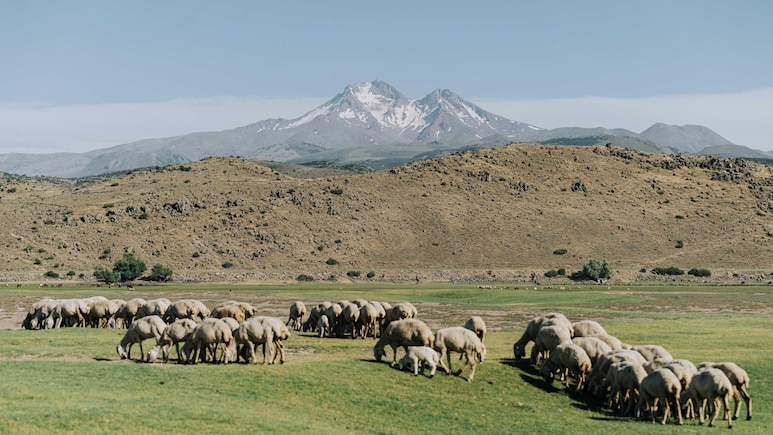
"Would you consider Central Asia or Mongolia instead of more mainstream places such as SEA (South East Asia)?"
A few years ago, a question popped up on Reddit, the kind that often predicts where travel trends are headed.
The user went on to explain the fatigue many long-term travellers and expats were beginning to feel. Southeast Asia, especially places like Thailand, had become oversaturated.
Expat hubs such as Chiang Mai were no longer cheap, no longer quiet, and certainly no longer undiscovered. In contrast, Central Asia and Mongolia felt barely mentioned, almost invisible in mainstream travel conversations.
The post compared Chiang Mai to Ulaanbaatar and Astana and argued that the supposedly "remote" options were actually cheaper.
This was four years ago.
Would you consider Central Asia or Mongolia instead of more mainstream places such as SEA
by in ExpatFIRE
Back then, the question was a hypothetical one. Now, it is reality.
Mongolia, in particular, has stopped being a niche curiosity and is fast becoming the destination of choice for travellers who feel they have already "done" Central Asia.
The Underrated Gem
For years, Mongolia sat in an odd limbo. Too remote for casual tourists, too rugged for comfort travellers, and too misunderstood to be marketed easily. That has changed dramatically over the past two years.
Data shows it too.
- According to official tourism analysis, Mongolia welcomed 8,08,900 international visitors in 2024, a record year that generated roughly USD 1.6 billion in tourism revenue.
- In 2025-26, the momentum has only grown stronger. By September 10, 2025, the country had already received 6,17,000 visitors, with more than 16,000 arriving just since the start of September. This was a record breaker for Mongolia.
- Since the beginning of 2026, according to official data Mongolia has attracted a total of 21,066 foreign tourists in just the first month.
- This surge marks a sharp acceleration. Mongolia received around 5,94,000 tourists in 2023, and far fewer in the decade before. What was once an "untouched" option discussed on Reddit threads has clearly caught up with traveller curiosity.
Why Travellers Are Choosing Mongolia Over The Rest Of Central Asia
Part of Mongolia's appeal lies in what it is not.
Uzbekistan's Silk Road cities are stunning, but they are also increasingly tour-bus heavy. Kyrgyzstan and Tajikistan still attract trekkers, but popular routes now feel crowded during peak season. Kazakhstan's cities are sleek and futuristic, yet many travellers find them urban and sanitised rather than immersive.
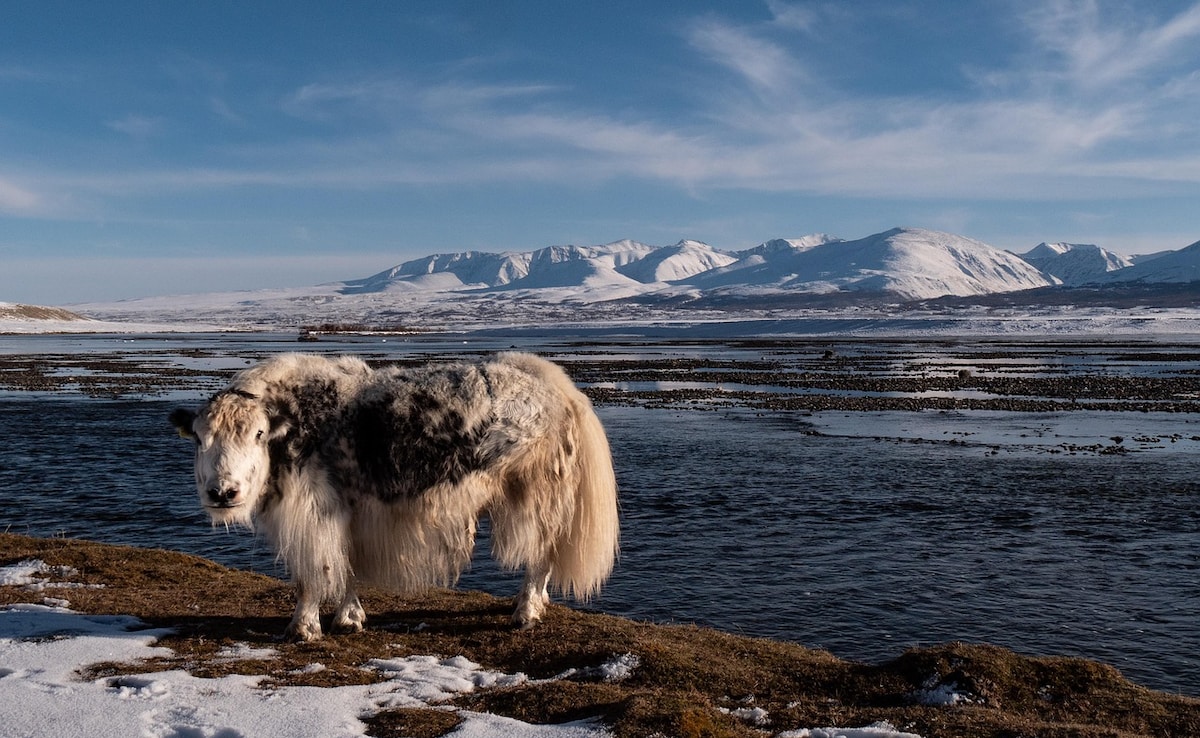
Deserts, mountains, grasslands and frozen lakes coexist within a single itinerary for Mongolia. Photo: Pixabay
Mongolia offers something different. Its population density is one of the lowest in the world. With a total population of approximately 3.5 million people spread across 1.56 million square kilometers, the average density is roughly 2 people per square kilometer.
Vast steppes stretch for hours without a village in sight. Deserts, mountains, grasslands and frozen lakes coexist within a single itinerary. For travellers seeking space, silence and scale, Mongolia feels like Central Asia before the crowds arrived.
Landscape First, Cities Second
Unlike its neighbours, Mongolia sells itself through the land.
The rolling steppe, the dramatic emptiness of the Gobi Desert, the Altai Mountains, and the changing colours of the grasslands form the backbone of most trips. Even outside peak season, travellers report days of driving without seeing another tourist vehicle. This sense of isolation has become a luxury in a world of overcrowded destinations.
Mongolia's strongest differentiators is that nomadic culture is not preserved for tourists. It is lived.
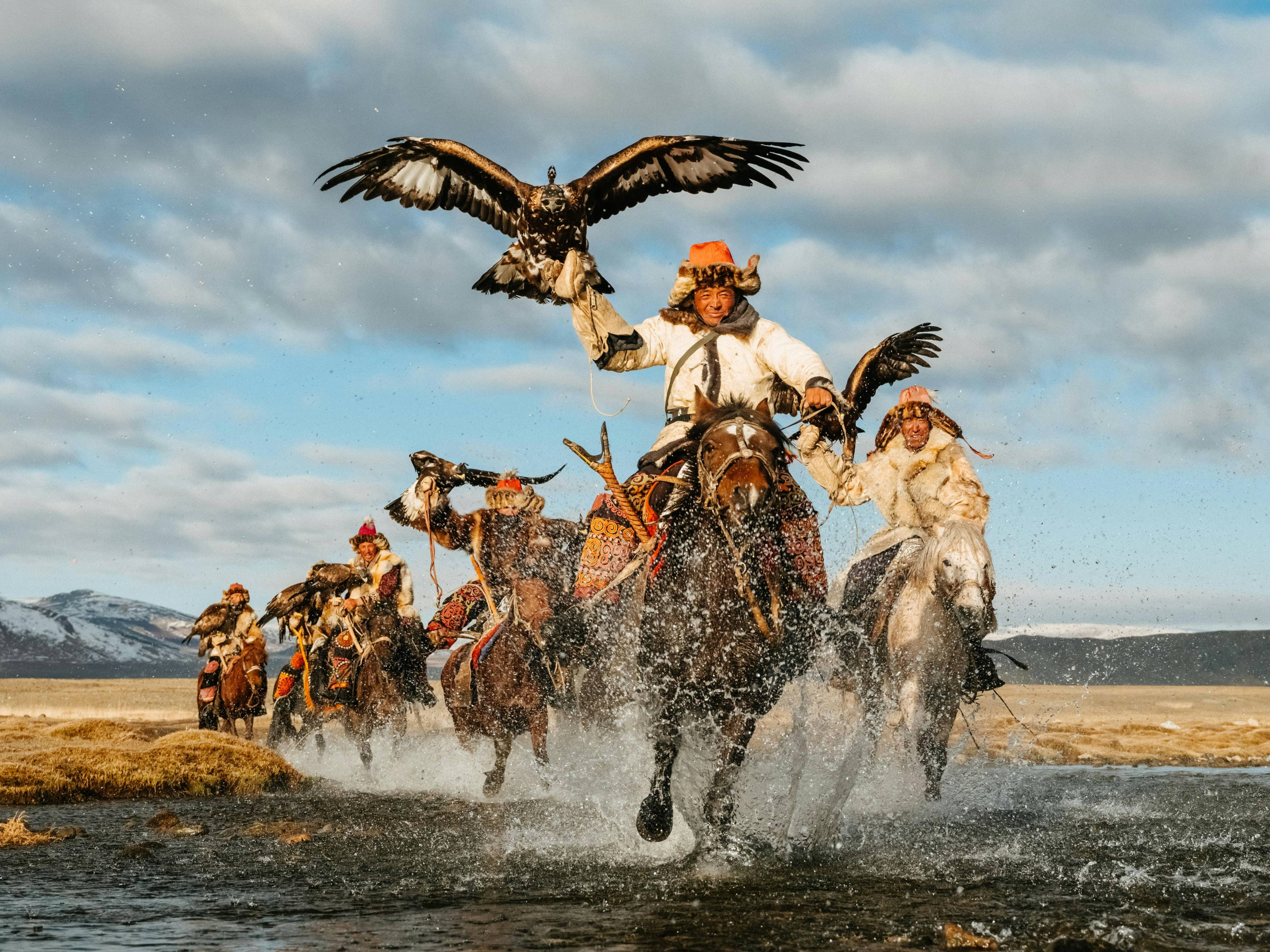
Mongolian nomadic culture is an ancient, UNESCO-recognised pastoral lifestyle. Photo: Unsplash
Around a quarter of Mongolia's population still follows a nomadic or semi-nomadic lifestyle. Travellers stay in traditional gers, ride horses across open plains, help herd animals, and share meals with families who have lived this way for generations. For many visitors, this authenticity feels increasingly rare (Brownie points that all of this is also extremely aesthetically pleasing for social media).
A Distinct Cultural Identity
While Mongolia is often grouped with Central Asia, its cultural roots set it apart. Buddhism and shamanistic traditions dominate spiritual life, rather than Islamic heritage. The legacy of Genghis Khan, the Mongol Empire, and ancient capitals like Karakoram adds a historical depth that feels different from Silk Road narratives further west.
This contrast appeals to travellers who want something fresh without leaving the region entirely.
Cheap Hotels, Low Value Currency: Costs That Still Make Sense
One of the arguments in that Reddit post still holds true. Mongolia remains relatively affordable compared to over-touristed Asian destinations.
While Ulaanbaatar is the country's most expensive city, accommodation, transport and food costs often come in lower than popular hubs in Thailand or Vietnam. Outside the capital, expenses drop significantly. For long-stay travellers, photographers, slow travellers and remote workers willing to adapt, Mongolia offers value without feeling cheapened.
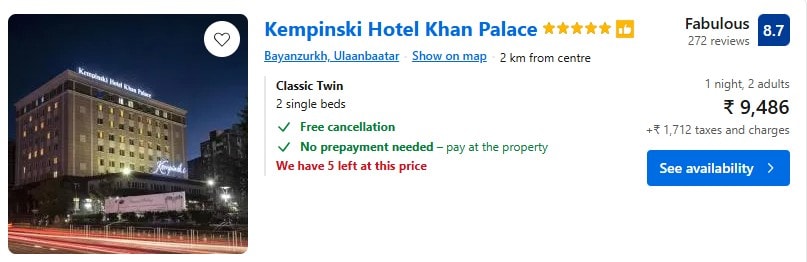
Kempinski Hotel in Ulaanbaatar is a five star hotel, where tariff starts from just Rs 9,486. Photo: Author/Booking.com
Even for Ulaanbaatar, the cheapest 5-star hotel for 9.5k a night, and cheapest hotels can be found for easily under 1-2k per night. Moreover, Mongolian Tugrik (MNT) is considered a low-value currency (1 INR equals 39.40 - 39.60 MNT), which makes the place further cheaper for visitors.
Improved Access To Mongolia
Infrastructure has long been Mongolia's biggest challenge. Roads outside major routes can be rough, domestic flights limited, and facilities in remote areas basic.
That is slowly changing. The government has committed to upgrading roads, expanding domestic air routes, and improving visitor facilities at key sites. From India, there are various one-stop flights available to Mongolia from metro cities like Mumbai, Delhi, Bengaluru and more.
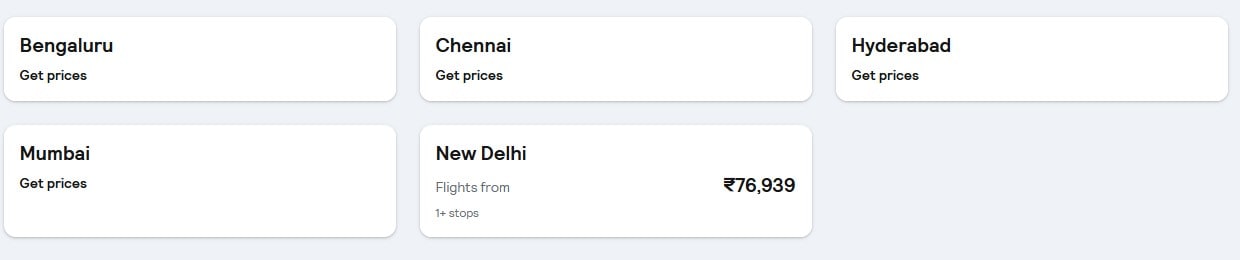
Flights from India to Mongolia. Photo: Skyscanner/Author
Hotels, restaurants and transport services in Ulaanbaatar have improved noticeably, while tourism training programmes aim to address service inconsistencies in rural regions.
Importantly, development has not yet diluted the core experience. Mongolia still feels raw, just slightly easier to reach.
#Mongolia
Social media has helped. Influencers, photographers and travel writers have showcased Mongolia's landscapes, festivals and nomadic life in ways that traditional tourism campaigns never quite managed. The result is curiosity turning into bookings.
Who Is Visiting Mongolia Now
Data shows in 2024, the largest source markets were China, Russia and South Korea, followed by Japan and the United States. Proximity plays a role, but the growing interest from long-haul travellers suggests Mongolia is no longer seen as too difficult or too remote.
What To Do In Mongolia: A Seven-Day Itinerary
Day 1: Ulaanbaatar
Arrive in the capital and acclimatise. Visit the Gandantegchinlen Monastery, explore the National Museum of Mongolia, and get a sense of the country's layered history. Evening food spots in the city offer a mix of traditional Mongolian and modern Asian cuisine.
Day 2: Terelj National Park
A short drive from the capital brings you to wide valleys, rock formations and open grasslands. Stay in a ger camp, hike to Turtle Rock, and experience your first night under Mongolia's famously clear sky.
Day 3: Drive towards the Gobi
Begin the journey south. The landscape changes dramatically as grasslands thin into semi-desert. Stop at small settlements and experience the scale of the country through long, uninterrupted drives.
Day 4: The Gobi Desert
Explore the Flaming Cliffs, known for dinosaur fossil discoveries, and walk through the Khongoryn Els sand dunes. Camel rides and sunset views define the day.
Day 5: Nomadic stay
Spend time with a nomadic family. Learn daily routines, ride horses, and understand how life adapts to extreme climates. This is often the most memorable part of the trip for visitors.
Day 6: Kharkhorin and the Orkhon Valley
Visit the ruins of Kharkhorin, once the capital of the Mongol Empire. The surrounding Orkhon Valley offers waterfalls, monasteries and grazing lands rich in history.
Day 7: Return to Ulaanbaatar
Travel back to the capital for last-minute shopping, museums, or a final city meal before departure.
The Future Of Mongolia's Travel Boom
Mongolia's rise is not accidental. It reflects a broader shift in traveller priorities. People are increasingly seeking destinations that feel less crowded, culturally grounded and unscripted. Mongolia delivers all three.
The country will enter a new phase. The challenge will be maintaining its sense of wilderness while accommodating growth. For now, though, Mongolia occupies a rare position. It is popular enough to be accessible, yet still underrated enough to feel like a discovery.
For travellers who feel they have already seen or are bored with Central Asia's greatest hits, Mongolia offers something else entirely.
Track Latest News Live on NDTV.com and get news updates from India and around the world
