





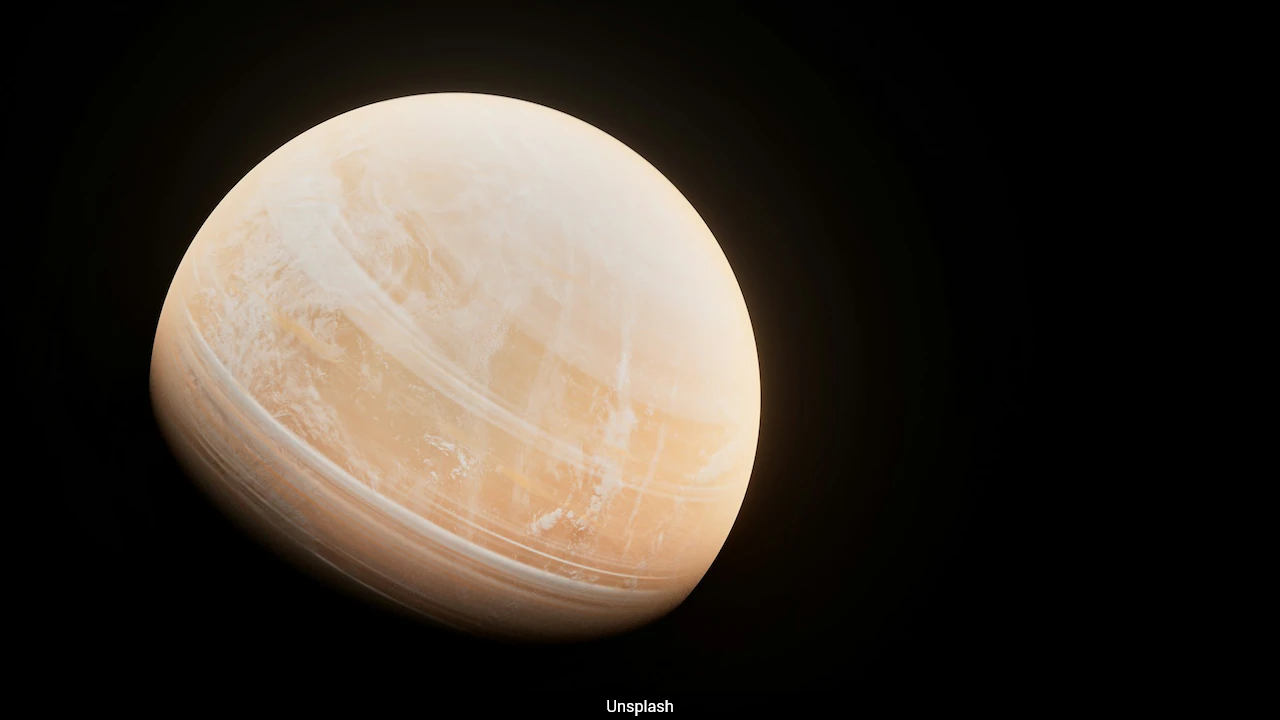
Venus may once have had a moon, but the planet's unusually slow rotation could have caused the satellite to spiral towards it and eventually be destroyed, according to a new study. Venus is similar to Earth in size, mass and rocky composition, yet it is one of only two planets in the Solar System without a natural moon. Scientists have long wondered why Venus has no lunar companion.
Researchers led by Dr Stephen Kane of the University of California, Riverside, used computer simulations to study what could have happened if Venus had formed a moon after a large collision early in its history.
The simulations suggest that the fate of a Venusian moon would have depended heavily on how quickly the young planet was rotating. If Venus had been spinning rapidly, with a day lasting less than about 12 hours, a moon similar in mass to Earth's Moon could potentially have survived for billions of years.
However, if Venus was rotating more slowly, tidal forces would have gradually pulled the moon towards the planet. The moon could eventually have been torn apart by Venus's gravity and crashed into the planet.
The researchers found that a hypothetical moon could have survived for periods ranging from about 30 million years to 1.7 billion years, depending on factors such as its mass and Venus's initial rotation rate.
The study also examined simulations of giant impacts that may have occurred during Venus's early history. These suggest that collisions capable of producing Venus's present slow, backwards rotation could have created debris that either fell back onto Venus or left a possible moon close to the boundary where it could no longer remain in a stable orbit.
This means Venus may not have needed a later catastrophic collision to lose a moon. Instead, normal tidal evolution following an early giant impact could have been enough.
The researchers say the findings could also have implications for planets outside our Solar System. Venus-like planets orbiting close to their stars may face similar difficulties in holding on to large moons if they rotate slowly.
The study does not prove that Venus definitely had a moon in the past. Instead, it shows that the planet's present moonless state can be explained by the way its rotation and gravitational forces would have affected a possible satellite.
The research, titled Tidal Demise: The Evolution and Fate of a Hypothetical Venus Moon, was published in the Astrophysical Journal.
Track Latest News Live on NDTV.com and get news updates from India and around the world

