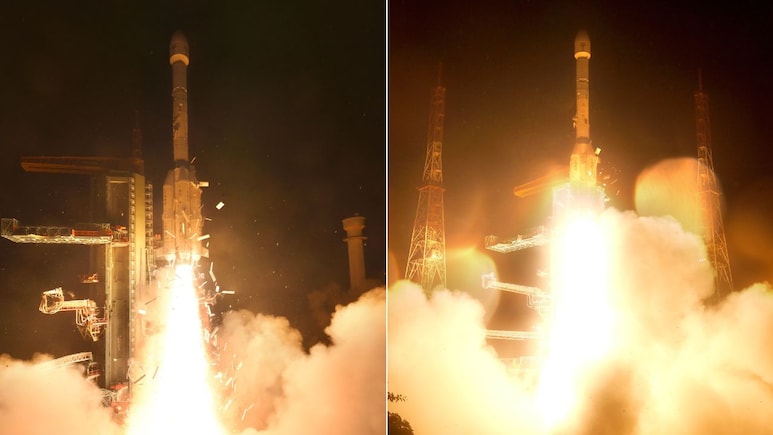

New Delhi: The Indian Space Research Organisation (ISRO) has successfully launched EOS-05 aboard the GSLV-F17 rocket, marking an important milestone in India's Earth observation programme. The launch took place from the Satish Dhawan Space Centre in Sriharikota on September 4, 2026, with the satellite placed into its intended Sub-Geosynchronous Transfer Orbit (Sub-GTO). The mission is significant because EOS-05 is India's first imaging satellite designed to operate from geosynchronous orbit. According to the ISRO mission brochure, GSLV-F17 is the 19th flight of the GSLV and has a lift-off mass of 420.5 tonnes.
5 Things Students Should Know About EOS-05
1. India's First Geosynchronous Imaging Satellite
EOS-05 is a state-of-the-art Earth observation spacecraft and, as stated in the ISRO brochure, India's first imaging satellite from geosynchronous orbit. This orbit allows the satellite to observe large geographical areas.
-

-
 World-Class Chefs, Food And Music: The Fun Side Of NDTV World Summit 2026
 -
 AI, Consciousness And Dharma: Why Ancient Indian Wisdom Matters Now
 -
 NDTV World Summit: What To Expect From PM Modi's Keynote Address
 -
 NDTV World Summit 2026: What To Watch Out For | PM Modi, Jaishankar, AI And Global Power Shifts
 -
 A World Between Orders: What To Expect At NDTV World Summit 2026
 -
 Who Is Rajiv Mehta? Lilavati Hospital Trustee To Speak At NDTV World Summit 2026
 -
 Alain Ebobisse, Africa50 CEO, To Attend NDTV World Summit 2026. All About Him
 -
 Kriti Sanon At NDTV World Summit: A Look At Her Career And Business Ventures
 -
 Ex-CIA Director To Decode 'War In Times Of AI' At NDTV World Summit
 -
 Who Is Vikram Rai, CEO, South Asia GE Aerospace, Set To Attend The NDTV World Summit 2026
2. GSLV-F17 Carried the Satellite
GSLV-F17 is the 19th flight of India's Geosynchronous Satellite Launch Vehicle. The three-stage rocket stands 51.7 metres tall and has a lift-off mass of 420.5 tonnes. It carried an approximately 2,367-kg payload.
3. It Can Observe Large Areas Frequently
EOS-05 has been developed to provide advanced Earth imaging from a much higher orbit than conventional low-Earth-orbit observation satellites. This makes it useful for monitoring broad geographical regions.
4. It Can Support Weather Monitoring
The satellite's observations are expected to help monitor weather-related events. Its frequent imaging capability can provide useful information during rapidly developing natural disasters, while also supporting agriculture, environmental assessment and natural resource management.
5. Useful for Disasters And Other Applications
EOS-05 is expected to support disaster management, agriculture and environmental monitoring. Its observations can help in assessing floods, cyclones and other weather-related events, making space-based imagery useful for planning and emergency response.
