





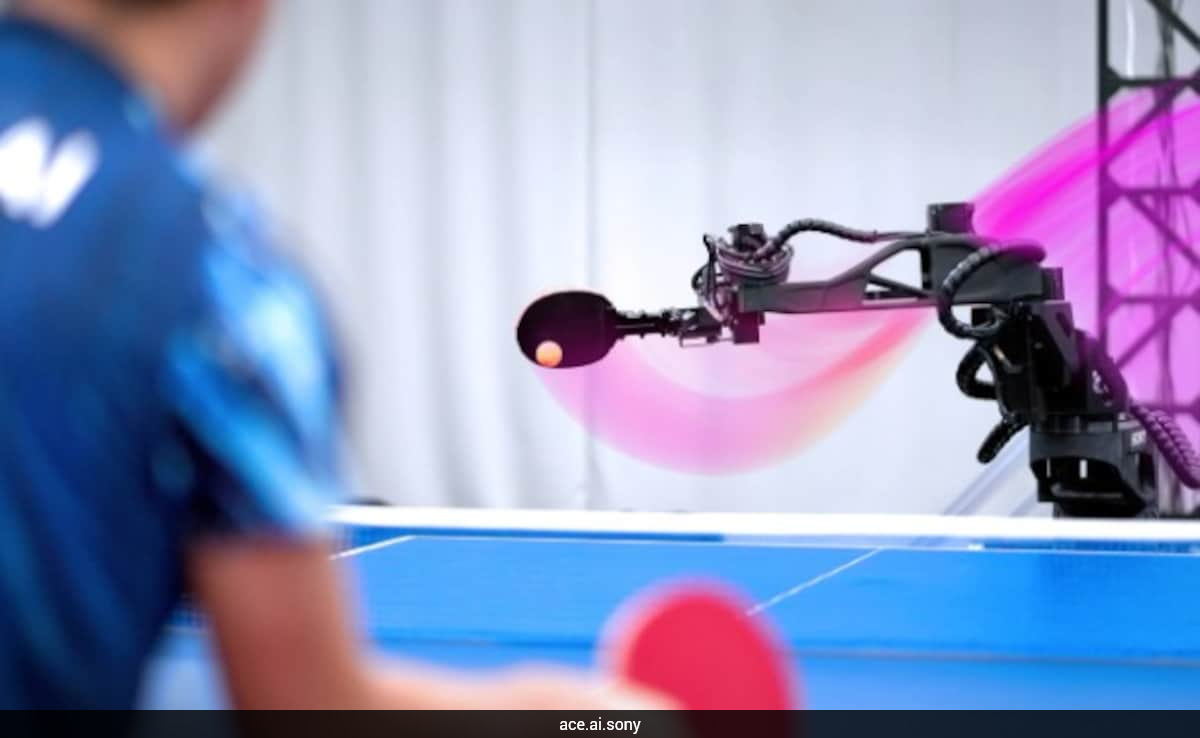
Engineers at Sony AI have built a robot that can defeat some of the world's best amateur table tennis players, in what researchers are calling one of the most significant advances in physical artificial intelligence to date.
The robot, named Ace, won three out of five matches against elite amateur players who have been playing the sport for more than a decade and practise for an average of 20 hours a week. In total, Ace won seven of the 13 games it played against this group.
Against two professional players from the Japanese league, however, the robot found things considerably harder. It won just one game out of seven and lost both matches outright.
Peter Durr, director of Sony AI in Zurich and project lead for Ace, described the achievement as a landmark moment. "This research has shown that an autonomous robot can, in fact, win at a competitive sport, matching or exceeding the reaction time and decision making of humans in a physical space," he said.
Table tennis presents a particular challenge for robotic systems. Unlike virtual games such as chess or Go, a robot competing in the physical world must track a fast-moving ball, read its spin, decide how to respond and execute a precise shot, all within a fraction of a second.
Ace was built around three core components. The first is a perception system capable of tracking the ball and, crucially, detecting its spin. Spin has long been a stumbling block for table tennis robots, as it significantly affects how the ball travels through the air and bounces off the table.
The second component is an AI decision-making system trained through deep reinforcement learning, in which the robot played thousands of simulated games to develop its own understanding of tactics and shot selection. This allows Ace to respond to situations as they unfold, rather than following fixed, pre-programmed instructions.
The third element is a highly agile, eight-jointed robotic arm capable of executing each decision with speed and accuracy.
Analysis of Ace's matches suggests that its spin detection ability was central to its success. The robot returned 75 per cent of spinning balls across a wide variety of spin types, winning points through control and consistency rather than brute force.
The robot also caught human observers off guard on several occasions. Former Olympian and table tennis expert Kinjiro Nakamura, watching one of Ace's shots, said: "No one else would have been able to do that. I didn't think it was possible. But the fact that it was possible means that there is a possibility that a human could do it too."
Sony AI chief scientist Peter Stone said the implications of the research stretch well beyond sport. "It represents a landmark moment in AI research, showing, for the first time, that an AI system can perceive, reason, and act effectively in complex, rapidly changing real-world environments that demand precision and speed," he said. "Once AI can operate at an expert human level under these conditions, it opens the door to an entirely new class of real-world applications that were previously out of reach."
The research has been published in the journal Nature.
Track Latest News Live on NDTV.com and get news updates from India and around the world

