





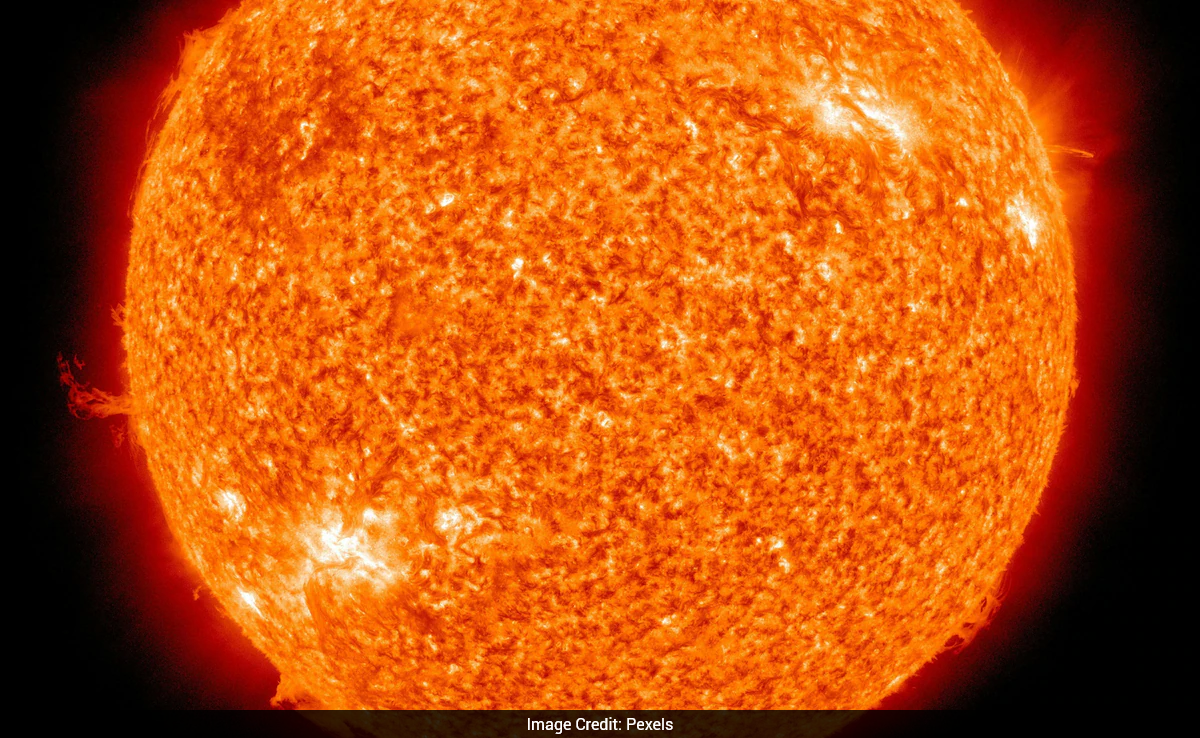
The sun released another major eruption on November 14, sending out an intense X4-class flare. This was the second-most powerful solar event of 2025 so far and came from the same extremely active sunspot region that produced this year's strongest X5 flare just a few days earlier, reported Space.com.
According to NOAA's Space Weather Prediction Centre, the flare reached its maximum intensity at 3:30 am EST (0830 GMT) from sunspot AR4274. The event caused a massive R3-level radio blackout on the sun-facing side of Earth, with the most impact seen in central and eastern Africa.
-

-
 'The Balance Of Global Power Is Shifting': Shashi Tharoor At NDTV World Summit
-
 NDTV World Summit 2026: India's Push To Become A Global Research Superpower
-
 Trump's H-1B Curbs Could Be A Big Opportunity For India: Shivkumar Kalyanaraman
-
 How Far Is India In High-Speed Flight? IISc's Duvvuri Subrahmanyam Answers
-
 'US Is Weakest Country': Mojtaba Aide's Swipe At Trump Over 'Failed Goals'
-
 At NDTV World Summit, Palestinian Envoy's Amitabh Bachchan Reference For India Visit
-
 'When Are We Going To See Flying Ubers?' Dominic Taylor Answers
-
 At NDTV World Summit, Palestinian Envoy's Amitabh Reference For India Visit
-
 Why "Healthy" Mojtaba Can't Appear In Public, Reveals Iranian Diplomat
-
 'Needs Very Rapid New Concept Of Warfare': Ex-CIA Chief's Advice To India
AR4274 is currently near the western edge of the Sun, indicating it will soon be moving out of our view. As it moved toward the edge, it released another powerful burst, which appears to be its final major activity.
A coronal mass ejection (CME) was also observed accompanying this flare. However, because this sunspot is located on the edge of the Sun, facing Earth, a CME is highly unlikely to hit Earth directly. Space weather experts are examining coronagraph data to determine if a small CME could impact Earth in the coming days.
Solar flares are classified based on their strength into classes A, B, C, M, and X, with each class being ten times more powerful than the previous one. X-class flares are the most energetic, and the number after the X indicates their intensity. The X4 flare puts today's event into the category of extremely powerful solar eruptions.
While CMEs release large clouds of charged particles into space, solar flares send out strong waves of electromagnetic radiation that travel at the speed of light and reach Earth in about eight minutes. Today's flare rapidly ioniSed the upper atmosphere, disrupting long-distance radio communications on the sunlit side of Earth.
Track Latest News Live on NDTV.com and get news updates from India and around the world

