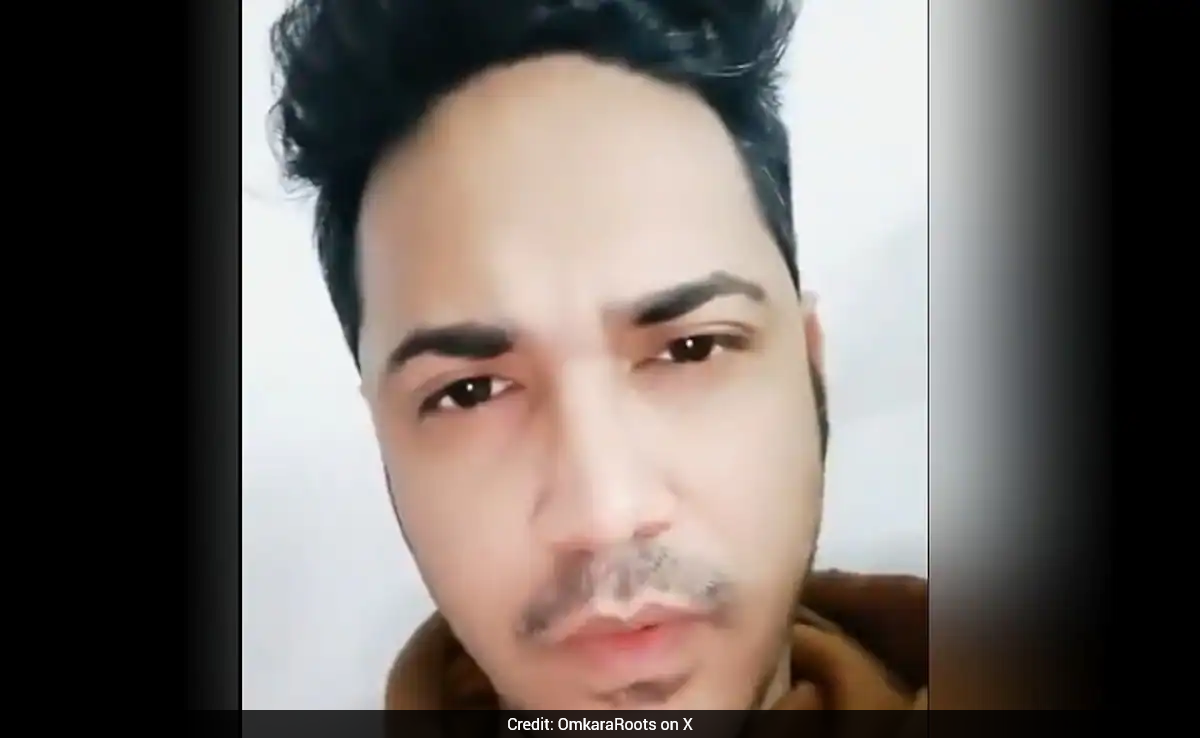
In a twist in the Bangladeshi student leader Osman Hadi's murder case, the prime accused, Faisal Karim Masud, has publicly denied any role in the killing, claiming he was in Dubai, contradicting Bangladesh police's allegations about his presence in India. In a viral video message, whose veracity has not been independently verified by NDTV, Masud insisted he did not kill Hadi, claiming a radical political group was behind the attack.
Masud accepted that he went to Hadi's office before the shooting but insisted his relationship with the Inqilab Moncho spokesperson was strictly business-related. The video message has sparked fresh debate and uncertainty over what really happened.
Viral Video
"I am Faisal Karim Masud. I want to state clearly that I am not involved in the murder of Hadi in any way. This case is completely false and based on a fabricated conspiracy," Masud said in the message.
"Because of this false implication, I was forced to leave the country and come to Dubai. I came here with great difficulty, even though I held a valid five-year multiple-entry Dubai visa," he added.
#BreakingNews: Osman Hadi's killer in Dubai!
— Omkara (@OmkaraRoots) December 31, 2025
Hours after the location of Osman Hadi's killer exposed, now Faisal Karim Masud, one of the key accused, in a video message said. he is currently in Dubai and has no involvement in the killing. pic.twitter.com/fQJ6kI019d
The suspected killer further claimed his family was being falsely implicated in this case and is being severely harassed and tortured, despite being completely innocent.
"They have no involvement whatsoever. This kind of inhumane treatment of my family is unjust and unacceptable, and I strongly protest against it," he said.
Elaborating on his ties with Hadi, Masud said, "Yes, I did go to Hadi's office. I am a businessman; I own an IT firm, and I was previously employed at the Ministry of Finance. I went to meet Hadi regarding a job opportunity. He promised to arrange the job and asked for an advance payment."
"Accordingly, I gave him 500,000 taka. He also asked me to donate to his various programmes, and I provided funds whenever he requested. Just last Friday, I gave him money for one of his programmes," he added.
Masud further accused Jamaat of Hadi's murder. He said that the student leader was "a product of Jamaat" and he was killed by "Jamaati elements".
"This incident is the work of Jamaat. Neither I nor my younger brother was on that motorcycle, and we have been deliberately framed. My family is suffering unjustly. This level of harassment is deeply disturbing and unacceptable."
A purported photo of Masud's UAE visa has also gone viral on social media.
🚨UAE visa of alleged killer of Osman Hadi
— Salah Uddin Shoaib Choudhury (@salah_shoaib) December 31, 2025
Here is the image of the UAE visa of Faisal Karim Masud, the alleged killer of Osman Hadi. Although Pakistani ISI and its cohorts frantically tried to build a false narrative stating, Faisal Karim Masud, the alleged killer of Osman Hadi… pic.twitter.com/CHcqwp1RwE
Bangladesh's Allegation
Bangladeshi police have previously said two accused in Osman Hadi's murder – Faisal Karim Masud and Alamgir Sheikh – fled the country and entered India through the Meghalaya border, where they are currently. Bangladeshi media reports alleged the accused escaped to India through the Haluaghat border in Bangladesh's Mymensingh district and are currently present in India.
India's Stand
New Delhi has, however, strongly rejected the allegations that the attackers had any connection with India. India maintains that the claim was a false narrative sought to be created by extremist elements regarding the assassination attempt on Hadi.
Osama Hadi's Killing
Sharif Osman Hadi, a prominent leader of Bangladesh's student uprising last year, was shot in the head by masked gunmen on December 12 in Dhaka. Six days later, he died at a Singapore hospital. He rose to prominence during last year's student-led protests that led to the end of Sheikh Hasina's rule in Bangladesh.
After Hadi's death, mobs in Dhaka staged mayhem, setting alight the main offices of mass circulation newspapers Prothom Alo and Daily Star and two progressive cultural groups, Chhayanat and Udichi Shilpi Goshthi, in Dhaka. A Hindu factory worker was also lynched by a mob in central Mymensingh.
Track Latest News Live on NDTV.com and get news updates from India and around the world


