





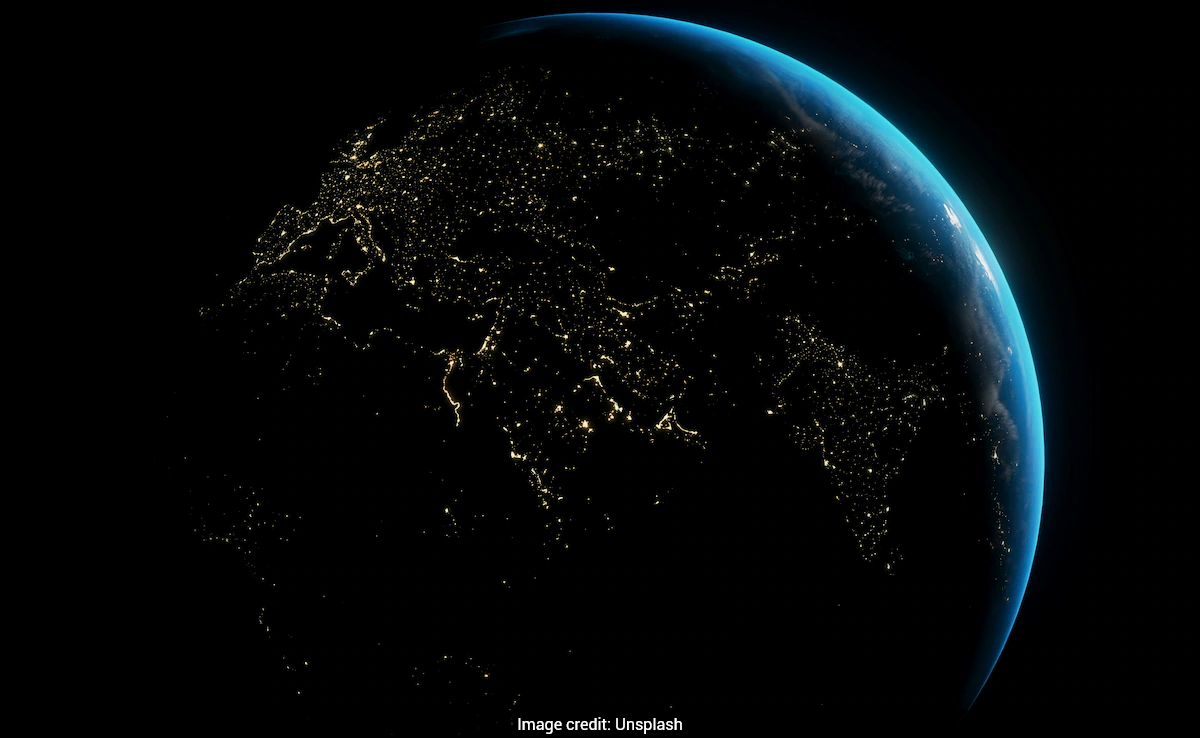
- Light pollution rose 16% globally from 2014 to 2022 with regional variations observed
- Sub-Saharan Africa and Southeast Asia showed rapid brightness increases due to urbanization
- Europe's nighttime light decreased by 4% due to tech upgrades and environmental policies
A recent study has revealed that light pollution has increased by 16% worldwide between 2014 and 2022. However, the changes are not uniform, with some regions experiencing significant brightening while others are intentionally dimming their lights. The study published in the journal Nature, led by Tian Li and Zhe Zhu from the University of Connecticut's Department of Natural Resources and the Environment, was focused on changes in artificial light at night and an increase in the brightness of the night sky. The researchers analysed 1.16 million daily satellite images of the inhabited landmasses of Earth.
Also read | Study Finds How Traffic Heat Contributes To Rising City Temperatures
"When you would read news articles related to [artificial light], it was often said that everything is getting brighter, places are getting brighter. And, you know, on the whole, for the whole world, for whole continents, this is basically true," co-author Professor Christopher Kyba, from Ruhr-Universitat Bochum, told IFLScience.
"What was missing until now was to look at sort of the finer scale: what's happening at these smaller scales?"
They found that Sub-Saharan Africa and Southeast Asia regions are seeing rapid increases in nighttime brightness due to urbanisation, infrastructure growth and improved access to electricity.
Also read | World's 'Oldest' Octopus Was Not Even An Octopus. New Scans Reveal What It Was
Meanwhile, Europe is experiencing a 4% decline in nighttime light radiance, driven by technological upgrades, energy-efficient lighting, and environmental policies.
In the United States, the West Coast is witnessing rising brightness linked to population growth and economic activity. On the other hand, parts of the East Coast and Midwest dimmed due to shifting urban patterns and energy-efficient lighting.
"Brightening contributed a radiance increase equivalent to 34% of the 2014 global baseline, whereas dimming offset this by 18%. Notably, both brightening and dimming have markedly intensified over the past decade," the researchers wrote.
"This evidence of increasing volatility in human night-time activity provides an important dynamic dimension for understanding urban evolution, energy transitions, policy impacts and ecological consequences of rapidly changing illuminated nights."
Track Latest News Live on NDTV.com and get news updates from India and around the world

