





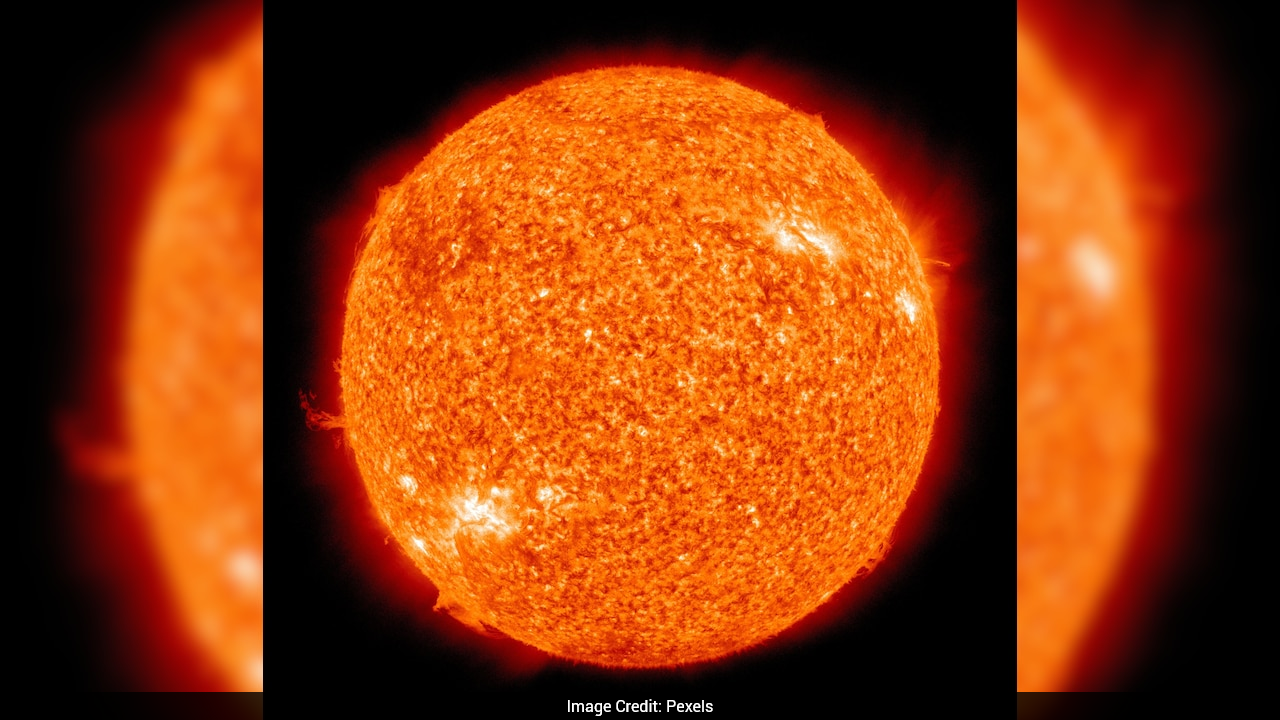
A new study has brought some hope about the distant future of our planet. Contrary to popular belief, researchers say the Earth might survive the fiery death of the Sun instead of being destroyed. The study was published in Astronomy and Astrophysics, reported NYPost.
Head author Mats Esseldeurs, a researcher at the Institute of Astronomy of KU Leuven in Belgium, said that observations of Sun-like giant stars currently point towards Earth's survival.
Esseldeurs and an international team of researchers were studying what could happen when the Sun reaches the end of its life. The Sun is projected to run out of hydrogen to fuse its core about 5 billion years from now. After that, it will expand to hundreds of times its current size.
According to the study, the Sun will first become a red giant star and then grow into an even bigger AGB star. Finally, it will end its life as a white dwarf, which is the ember-like core left behind after a star dies.
Scientists have long believed that these final stages would create a thermonuclear inferno that would consume Mercury, Venus, and Earth. However, after studying stellar evolution models and a nearby dying star called L2 Puppis, which may show what the Sun's future could look like, the researchers concluded that Earth might not be destroyed.
One possible outcome is that as the Sun grows larger, its gravitational tidal forces will pull Earth inward and eventually engulf it. Another possibility shown by the models is that stellar wind could cause the Sun to rapidly lose mass. As a result, its gravitational pull would become weaker, allowing Earth to move farther away before it could be swallowed.
The researchers said the final outcome depends on how quickly the Sun loses its mass. Esseldeurs said that the fate of Earth depends on a delicate balance between these two effects. He added that if tidal interactions dominate, Earth is engulfed, but if mass loss dominates, Earth escapes to a wider orbit.
Track Latest News Live on NDTV.com and get news updates from India and around the world

