





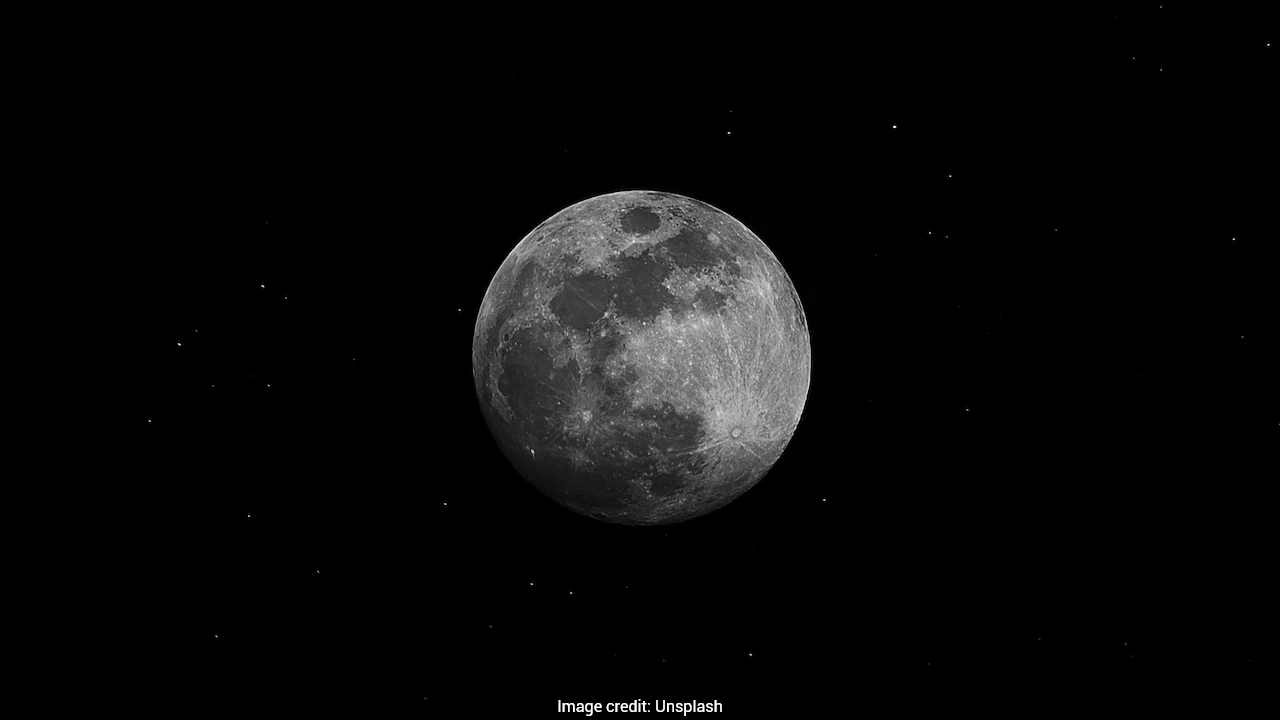
A discarded piece of a human-made space object roughly the height of a five-story building is on a collision course with the Moon. The object, an upper stage from a SpaceX Falcon 9 rocket, is scheduled to slam into the lunar surface on August 5, 2026. The object is expected to impact the lunar surface at 5,400 mph with the force of three tonnes of TNT.
How did it get there?
The rocket part was launched in January 2025 to help deliver lunar landers into space. While the main rocket booster successfully returned to Earth, the upper section spent over a year drifting in a wide orbit. Gradually, the Moon's gravity pulled the abandoned metal cylinder toward a final crash landing.
Also read | Pilot Reports Seeing Mysterious Disc-Shaped Object Near Gatwick Airport In London
What will happen during the crash?
Astronomers estimate the rocket stage will strike near the Einstein crater on the sunlit side of the Moon. William Jo, a graduate research assistant at the University of Texas at Austin and colleagues used physics simulations to understand what might happen.
According to a new study, the debris plume from the impact would have the central ejecta spike reaching roughly 47 miles to over 60 miles (75 kilometres to 100 kilometres) altitude.
The impact is also expected to create a crater approximately 27 meters across and 5 meters deep, kicking up a cloud of lunar soil and rock fragments into space.
"Our calculations suggest the plume should be several orders of magnitude brighter than the dark-sky background for the first few minutes after impact," Jo told Space.com.
"So the plume should be visible, though I'd stress this is a single nominal case. The real one will look different, and the numbers are on the optimistic side. But the point worth making is that the flash isn't really the story here."
"Watching this one gives us a rare chance to open up ejecta-plume science and calibrate those models against a real event, which matters for every future thing we deliver to the moon," Jo added.
Also read | 'Living Nostradamus' Claims Two 2026 Predictions Have Come True, Warns Of Another Conflict
Will it be visible from Earth?
Benjamin Fernando of the Los Alamos National Laboratory in New Mexico said in new research that the impact flash and resultant ejecta plume are "potentially observable" from ground and space-based observational facilities.
As reported by The Guardian, the impact flash would last less than a second. Also, it probably would be so dim, that people from Earth won't be able to see it. But we might be able to see the stream of ejected material for a few minutes, using telescopes.
Fernando and his colleagues stated, "This event provides an opportunity to attempt the recording of an artificial impact in real-time; although many of the properties of the event (such as visual magnitude) are imprecisely predicted at present."
NASA's Lunar Reconnaissance Orbiter (LRO) will sweep over the site to photograph the before-and-after surface changes, providing researchers a rare look at how artificial objects alter the lunar ground.
Is there any danger?
There is no danger to Earth or future human missions. The Moon lacks an atmosphere, so there are no air shocks or weather disruptions caused by the blast.
The event would also provide an opportunity to analyse the Earth's composition.
However, experts point out that this event highlights an urgent problem of space junk. As private and governmental lunar missions increase, scientists warn that space agencies must establish better guidelines for tracking and safely disposing of orbital debris to keep deep space safe for future exploration.
Track Latest News Live on NDTV.com and get news updates from India and around the world

