





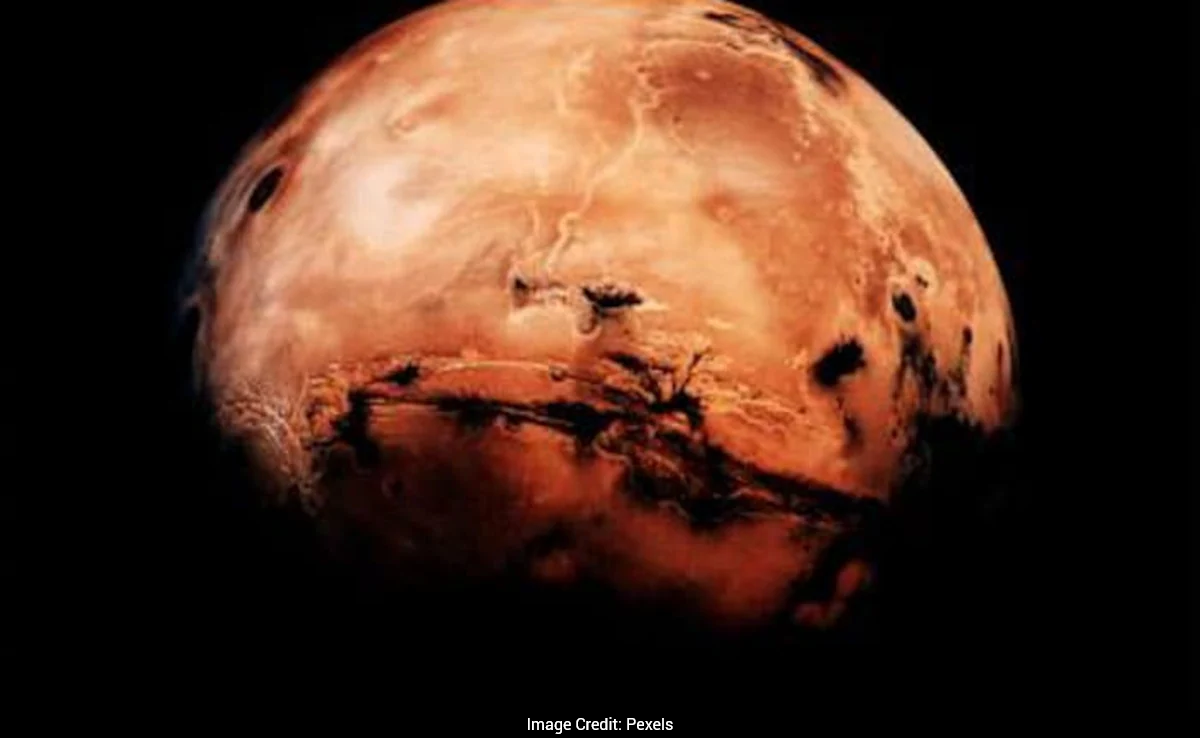
For the first time, scientists have created a detailed map showing huge, continent-sized river drainage systems on Mars. These ancient river networks date back billions of years, to a time when Mars was very different from the cold, dry planet seen today. The findings suggest that parts of Mars once had flowing water on a massive scale and may be among the best places to look for signs of past life, reported Space.com.
In ancient times, water flowed on Mars, profoundly altering its surface. It carved valleys, filled craters, and carved vast gorges. Scientists have long known that traces of dry rivers exist on Mars, but it wasn't clear how these rivers were connected to each other or whether there were once large, well-organized river systems like those on Earth.
Timothy Goudz, assistant professor in the Department of Geological Sciences at the University of Texas at Austin, said in a statement that while it was already known that Mars had rivers, there wasn't a clear understanding of how large and organized their global drainage systems were.
In the new research, Goudz and his team combined decades of data from Mars orbiters with ancient maps of valleys, lake beds, and streams. Much of this information came from NASA's Mars Odyssey spacecraft, which has mapped more than 90 percent of the planet's surface.
Abdallah Zaki, a postdoctoral fellow in the Department of Earth and Planetary Sciences at the University of Austin, who led the study, explained that the team took the simplest approach-they simply mapped these structures and linked them together. Where craters or billions of years of erosion had damaged the surface, researchers looked at the slope of the ground and the direction of valleys to infer how rivers once flowed.
The study revealed that early Mars had many small catchments, but also a few very large river basins that carried water, nutrients, and potential signs of life over long distances.
Scientists identified a total of 16 large drainage basins on Mars. Each basin covered at least 38,610 square miles, which is equivalent to the minimum definition of a large river basin on Earth. Together, these rivers covered approximately 1.5 million square miles, about 5 percent of Mars' ancient surface. Researchers suggest the actual figure could be even higher, as ancient riverbeds have largely been erased over time, reported Space.com.
Unlike Earth, Mars lacks active tectonic activity that creates mountains and deep valleys. Consequently, only 16 large basins were found on Mars, compared to approximately 91 on Earth.
Although their numbers are small, these basins had a significant impact. Studies have found that nearly half of the total sediment carried by Martian rivers flowed through them. One of these basins, which drains into a large valley called Maadim Vallis, alone carried about 15 percent of the total sediment.
Large river systems on Earth are areas where water remains in contact with diverse rock types for long periods of time. Such conditions are favorable for life and preserve chemical signatures. Scientists believe that when liquid water existed on Mars, its large river basins may have provided a similarly favorable environment.
Zaki said in a statement that the longer the water flows, the more it interacts with rocks, increasing the likelihood of chemical reactions that could develop into signs of life. Because these ancient river systems carried a large amount of sediment, they may still harbor evidence of ancient life.
The new map of these large river basins on Mars could serve as a guide for future missions, especially those that seek chemical signatures of life or plan to return samples to Earth. Gaudz said in a statement that choosing the right location for future missions and the search for life is crucial.
This research was published on November 24 in the journal Proceedings of the National Academy of Sciences.
Track Latest News Live on NDTV.com and get news updates from India and around the world

