





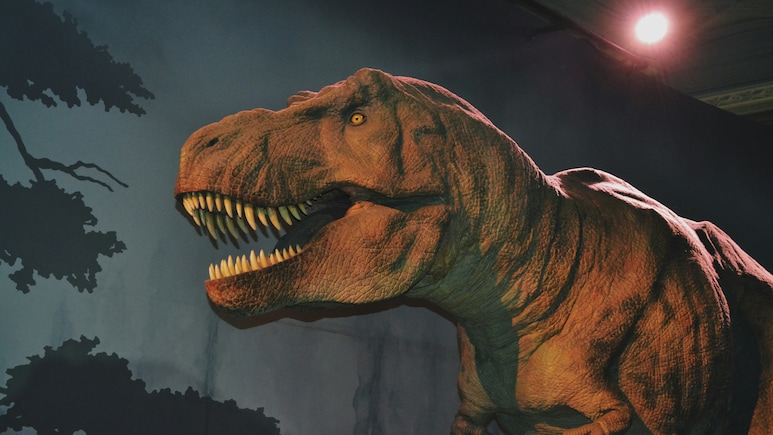
For years, dinosaurs were generally thought to be cold-blooded animals because they were classified as reptiles. But a new study suggests that one of the most famous dinosaurs, Tyrannosaurus rex, may have been much warmer than previously believed. Researchers at the University of California, Los Angeles (UCLA) estimate that T. rex had a body temperature of around 36°C (97°F), close to that of humans. The findings, published in Science Advances, offer the first direct numerical estimate of the dinosaur's internal temperature.
The study was conducted with the Natural History Museum of Los Angeles County, which provided tiny samples from the teeth of Thomas, a roughly 70% complete T. rex skeleton discovered in Montana in 2003.
"No one's been able to make a temperature measurement like this before," Robert Eagle, a study co-author and geobiologist at the University of California Los Angeles (UCLA), said in a statement.
Scientists examined the chemical makeup of the dinosaur's tooth enamel. Certain carbon and oxygen isotopes form bonds that are influenced by temperature, allowing researchers to use the fossilised enamel as a kind of ancient thermometer.
"Tooth enamel forms inside the animal at body temperature, so the enamel chemistry is a thermometer," said UCLA geoscientist Aradhna Tripati.
The UCLA team spent more than a decade refining the technique and reduced the amount of fossil material needed by about 90%. That made it possible to study the teeth without taking large pieces from the rare fossils.
The findings add to growing evidence that T. rex was warm-blooded, meaning it could generate and maintain its own body heat. Such animals generally have greater stamina and can remain active across a wider range of temperatures than cold-blooded reptiles, which rely more heavily on their surroundings for warmth.
"This was a warm-bodied organism, which really places new constraints on its behaviour, its physiology, how it interacted with other species and how much food it needed, for example," said Robert Eagle.
A warm-bodied T. rex would therefore have been an active predator or scavenger rather than a slow-moving animal that needed to bask in the sun to warm up.
"Higher metabolic rates mean higher food requirements and potentially more active hunting to acquire it. An endothermic T. rex would have had to acquire significantly more food to sustain its higher metabolic rate but would also be capable of more sustained activity to find food and migrate and live in colder environments," Eagle added.
Researchers say knowing the dinosaur's approximate body temperature could also help scientists understand its behaviour, energy needs and interactions with other species millions of years ago. So far, the technique has been used on a handful of ancient species, including other dinosaurs, woolly mammoths and megalodons.
T. rex lived around 66 to 68 million years ago during the Late Cretaceous period and was among the last non-avian dinosaurs to roam Earth before the mass extinction that ended the age of the dinosaurs. Adults could reach around 12 to 13 feet in height at the hips.
Track Latest News Live on NDTV.com and get news updates from India and around the world

