





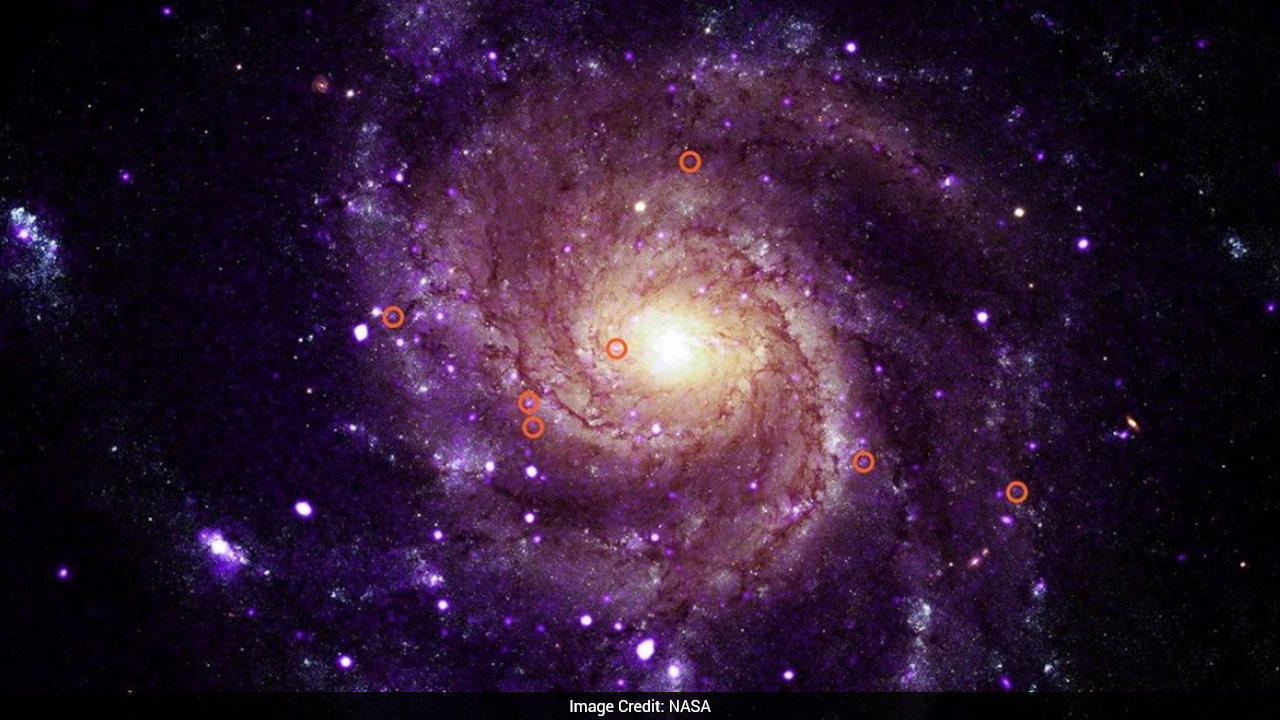
Scientists using NASA's Chandra X-ray Observatory have discovered a new class of objects that behave differently from anything they have seen before. The newly spotted objects give off unusually low-energy X-rays but intense ultraviolet radiation, and scientists believe they could help explain two long-standing questions in astrophysics, according to NASA.
The discovery is featured in a paper published Wednesday in Nature Astronomy. Researchers found 84 of these objects, called hypersoft X-ray sources, across six different galaxies using publicly available data from the Chandra archive.
Two of the galaxies are spiral galaxies, M31, also known as the Andromeda galaxy, and M101, known as the Pinwheel galaxy.
The other four are elliptical galaxies. The sources were found in both areas with active star formation and regions containing older stars.
The team discovered these sources by identifying objects that appeared in Chandra images capturing the lowest-energy X-rays but were invisible in images capturing higher-energy X-rays.
This revealed that these objects emit significantly more low-energy X-rays compared to high-energy X-rays.
Since low-energy X-rays lie close to energetic ultraviolet radiation on the electromagnetic spectrum, researchers inferred that these sources also produce large amounts of energetic ultraviolet radiation.
Researchers have not yet definitively identified the nature of these objects. They speculate that the systems could involve a black hole, neutron star, or white dwarf accreting material from a companion star.
The material drawn from the companion star heats up to produce X-rays before eventually falling onto the white dwarf or neutron star, or into the black hole.
This discovery suggests that there are many binary systems producing energetic ultraviolet radiation that have remained undetected until now.
Track Latest News Live on NDTV.com and get news updates from India and around the world

