





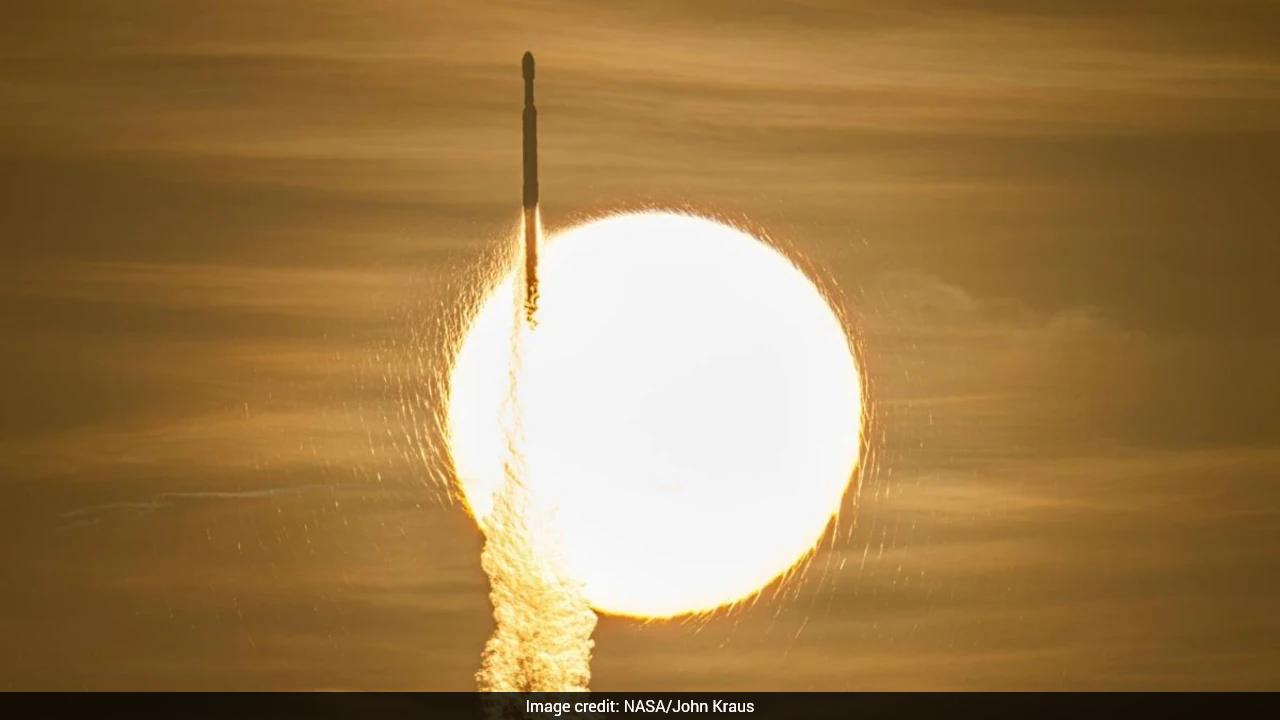
NASA has successfully launched its latest space observatory into orbit. Lifting off aboard a SpaceX Falcon Heavy rocket from the Kennedy Space Center in Florida, the Nancy Grace Roman Space Telescope is officially on its way to deep space to help scientists unlock some of the universe's greatest mysteries. Named in honour of NASA's first chief astronomer, the telescope is set to travel to a region about one million miles (1.6 million kilometres) away from Earth. It will be the same neighbourhood where the James Webb Space Telescope currently operates.
"Roman is exactly the kind of success story we want to see across NASA," NASA Administrator Jared Isaacman said in a statement. "Delivered ahead of schedule and on budget, this mission reflects more than a decade of dedication from the NASA workforce and our industry partners."
"Now, Roman will give us a new atlas of the universe, push the boundaries of discovery, and demonstrate what is possible when America's space program pairs bold ambition with disciplined execution."
Also read | Earth Microbes May Survive On Moon's South Pole, NASA Study Finds
Instruments on the Nancy Grace Roman Space Telescope
According to NASA, the telescope has a large field of view with crisp infrared vision to explore the deep space and probe into cosmic history. It relies on two primary instruments to conduct its deep-space surveys, the Wide Field Instrument (WFI) and the Coronagraph Instrument (CGI).
-

-
 "High Inflation Is Like Tax On Everyone": RBI Governor At NDTV World Summit
 -
 AI Agents To Outnumber Humans Soon? What Futurist Mike Walsh Told NDTV
 -
 This Delhi Boy Has 3 Michelin Stars. His Heart Still Goes To Rajindar Da Dhaba
 -
 Ashwini Vaishnaw Explains Semiconductor Complexity: 'Everything On This Tiny Nail'
 -
 Indian-Branded Mobile Phones By October 23, 2028, Says Ashwini Vaishnaw
 -
 AI Law In India Soon? What Ashwini Vaishnaw Said At NDTV World Summit
 -
 'Need To Look At Next 10 Years': Bondada Chairperson To NDTV On Solar Energy
 -
 World's 1st AI Actor Tilly Norwood Was Asked If She Knew Hindi. A Conversation Followed
 -
 AI Law In India Soon? What Ashwini Vaishnaw Said At NDTV World Summit
 -
 Iran's Supreme Leader's Representative Says India Can Play 'Big Role' In Middle East Peace
Wide Field Instrument (WFI): This is the telescope's camera. It features a massive 300-megapixel near-infrared focal plane array consisting of 18 individual detectors. As per NASA, these detectors collect photons of light that will be decoded into crisp cosmic panoramas.
Coronagraph Instrument (CGI): This is designed for advanced exoplanet studies. This allows astronomers to directly image faint planets orbiting near bright stars and analyse their atmospheric composition.
"Roman will be a discovery machine that will bring us closer than ever before to answering humanity's most profound questions about our cosmic history," Nicky Fox, associate administrator for the Science Mission Directorate at NASA Headquarters in Washington, said.
"With its large field of view and fast survey speeds, Roman will usher us into a new era of discovery and make the invisible visible, setting the foundation for humanity's search for life beyond our solar system."
Also read | Man Hospitalised After Desperate Attempt To Treat Incontinence At Home
Hunting for dark energy and new planets
NASA states that the Roman telescope is designed to survey the universe a thousand times faster than the Hubble Space Telescope. It has a five-year primary lifespan with a goal to operate for 10 years. And during this time, the telescope will scan billions of galaxies.
Scientists hope to use this vast dataset to understand dark energy and dark matter, find hidden exoplanets, and by observing how massive objects bend light over immense distances, researchers will test whether Albert Einstein's laws of gravity on a cosmic scale.
"We've never been able to view the universe with eyes like Roman's before," said Julie McEnery, Roman's senior project scientist at NASA Goddard. "There's no telling what more we'll know and have seen by this time next year."
Track Latest News Live on NDTV.com and get news updates from India and around the world

