





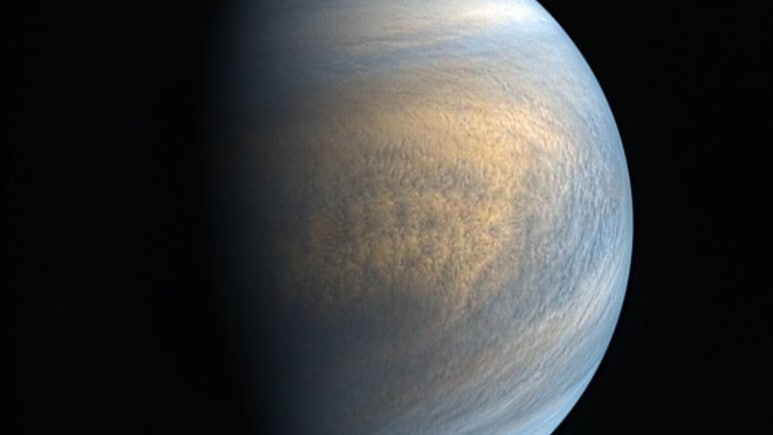
A huge and unusual cloud system on Venus has puzzled scientists for years. Stretching thousands of kilometers across the planet, this massive formation moves quickly and has a sharp edge. Now, researchers have found a clear explanation for how it forms, reported Space.com.
A gigantic bank of cloud, about 3,700 miles (6,000 kilometers) long, sweeps around Venus every few days. Scientists say it is created by rising sulfuric acid vapour that is pushed high into the atmosphere. This process is similar to how water spreads out when it flows from a running tap into a sink.
In 2016, the Japanese Aerospace Exploration Agency's Akatsuki mission discovered this cloud system about 31 miles (50 kilometers) above Venus's dense atmosphere. The weather system is aligned with the planet's equator, but its huge size, speed, and sharp leading edge remained unexplained for years.
After nearly a decade, an international team of astronomers has now solved the mystery using mathematical models. These models explain how gases move and rise in Venus's atmosphere.
Scientists found that the phenomenon is caused by something called a hydraulic jump. This happens when a fast-moving, shallow flow suddenly slows down and becomes deeper. A simple example is water flowing from a tap into a sink, where it spreads out and slows after hitting the surface.
A similar process occurs in Venus's atmosphere, which is mostly made of carbon dioxide, along with small amounts of nitrogen and other gases like sulfur dioxide. Not far above the planet's hot surface, an eastward-moving atmospheric wave travels across the equator. This planetary wave spans thousands of kilometers.
On Earth, such a wave is known as a Kelvin wave, which can occur in both oceans and the atmosphere. However, since Venus has extremely high temperatures and no oceans, its Kelvin wave exists only in the atmosphere.
When this wave slows down, it triggers a hydraulic jump. This creates a strong upward movement of sulfuric acid vapor, which rises to about 31 miles (50 kilometers) and forms a massive cloud bank. These clouds then trail behind the wave, which forms the leading edge.
Study leader Takeshi Imamura from the University of Tokyo said that they are now able to show that this cloud disruption is caused by the largest known hydraulic jump in the solar system. He added that their discovery of the hydraulic jump on Venus connects a very large-scale horizontal process with a strong localized vertical wave, which is unexpected because these are usually disconnected in fluid dynamics.
This is the first time a hydraulic jump has been identified on a planet beyond Earth. Scientists say that its unusual behavior shows how different atmospheric processes can be on other planets compared to Earth.
Venus has an extreme atmosphere. It is rich in carbon dioxide and has a surface pressure of 92 bar. Its atmosphere also rotates very quickly, circling the planet in just four Earth days, while the planet itself takes 243 days to complete one rotation.
The discovery also fills an important gap in understanding Venus's atmosphere. Imamura said that until now, scientists used a global circulation model similar to Earth's, but it did not include the hydraulic jump they have now identified. He added that the next step will be to test this finding using a more complete climate model that includes other atmospheric processes. He also noted that this will be challenging because such simulations require a huge amount of processing power, and even modern supercomputers struggle with it.
Track Latest News Live on NDTV.com and get news updates from India and around the world

