





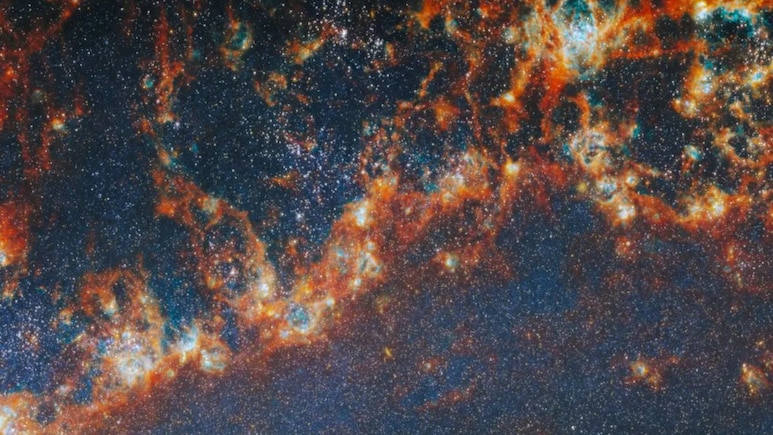
Astronomers using the NASA's James Webb Space Telescope along with the Hubble Space Telescope have made new discoveries about how star clusters form and evolve inside galaxies. By studying thousands of young star clusters in four nearby galaxies, researchers found that massive star clusters emerge more quickly from the clouds of gas in which they are born, reported NASA.
The findings provide scientists with a deeper understanding of how stars form, how galaxies evolve and how conditions for planet formation may be affected. Stars are formed when large clouds of gas collapse under gravity, creating groups known as star clusters. Over time, strong stellar winds, ultraviolet radiation and supernova explosions from massive stars push away the surrounding gas clouds, bringing star formation in that region to an end.
Astronomers have long studied this process because it helps explain how galaxies change over time. Once the gas surrounding a star cluster disappears, the light from those stars can affect other nearby regions where stars are forming. This process is known as stellar feedback.
Researchers explained that much of the gas inside galaxies is never used to form stars because of this feedback process. While nearby star-forming regions inside the Milky Way and neighbouring dwarf galaxies can be studied in detail, scientists said observing nearby galaxies allows them to examine thousands of star clusters at different stages of development.The development of infrared astronomy has allowed scientists to look through thick gas clouds and study the earliest stages of star formation.
The team identified nearly 9,000 star clusters at different stages of evolution. Some clusters were just beginning to emerge from their gas clouds, while others had already cleared the surrounding material and were fully visible in optical light.
Using Webb's ability to look inside gas clouds, scientists estimated the age and mass of each cluster through its light spectrum.
The study, published in the journal Nature Astronomy, found that the most massive star clusters clear away their surrounding gas much faster than smaller clusters.
According to the findings, massive star clusters dispersed their gas clouds in around five million years, while smaller clusters took between seven and eight million years to emerge fully.
Angela Adamo of Stockholm University and the Oskar Klein Centre in Sweden, who is a lead author of the study and principal investigator of the FEAST programme, explained that simulations of star formation and stellar feedback have struggled to reproduce how star clusters form and emerge from their birth clouds. She said the new results provide important constraints for understanding this process.
Researchers said the findings may also help scientists better understand how planets form around stars.
The study explained that when gas around a star cluster disappears more quickly, protoplanetary discs surrounding young stars become exposed earlier to strong ultraviolet radiation from nearby stars. As a result, these discs have less opportunity to gather gas and dust needed for planet formation.
Scientists believe the new observations will improve predictions about how stars and planets develop inside galaxies over time.
Track Latest News Live on NDTV.com and get news updates from India and around the world

