





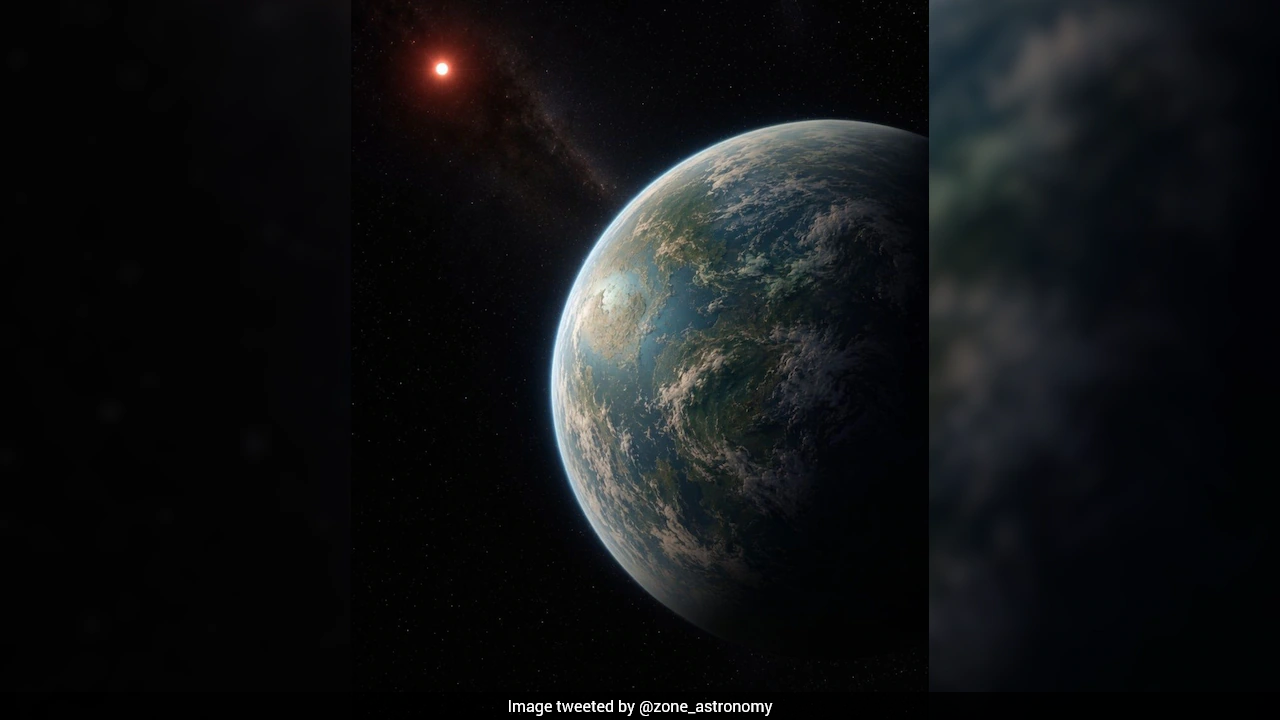
A newly discovered exoplanet that scientists are calling Earth's "next-door neighbour" could become one of the most promising places to search for extraterrestrial life. The planet, named GJ 3378b, is a 'super-Earth' roughly twice the size of our planet. It orbits a nearby red dwarf star within the star's habitable, or 'Goldilocks', zone - the region where temperatures are considered just right for liquid water to exist on a planet's surface.
"This one's exciting. Twenty-five light years sounds like a long way, but the Milky Way is about 100,000 light years across, so in that respect it's our next-door neighbour," said Paul Robertson, the lead author of a new study published in The Astrophysical Journal.
Its location makes GJ 3378b particularly exciting for astronomers. Because it lies in one of the closest star systems to Earth, the planet is an ideal target for future observations aimed at determining whether it could support life.
The discovery was made using the Habitable-zone Planet Finder on the 10-metre Hobby-Eberly Telescope at McDonald Observatory in Texas, along with the NEID spectrometer on the WIYN telescope at Kitt Peak National Observatory in Arizona. "This super-Earth gets about 90 per cent of the radiation from its host star as Earth gets from its sun, so it's right in the sweet spot," said Robertson.
Despite its promising location, one major question remains unanswered: does GJ 3378b have an atmosphere?
An atmosphere is considered essential for maintaining stable surface conditions and protecting a planet from harmful radiation. Researchers say GJ 3378b lies on the edge of what they call the 'cosmic shoreline - a threshold that determines whether a planet's gravity is strong enough to hold onto its atmosphere despite radiation from its host star.
"If you scale the Earth down to the size of an apple, its atmosphere would be about as thick as the skin of the apple. That's just enough to maintain the kinds of surface pressures where you can have liquid water. It's enough that there'll be breathable air, and it provides maybe a little bit of protection from the harsh radiation environment of space," Robertson added.
Mars offers a cautionary example. Scientists believe the Red Planet may once have had a thicker atmosphere, but much of it was gradually stripped away by solar radiation, leaving the cold, dry world we see today.
Because of its size, location and proximity to Earth, GJ 3378b has quickly become one of the most compelling candidates in the search for potentially habitable worlds. However, confirming whether it truly has an atmosphere will require the next generation of powerful space- and ground-based observatories. Researchers say detecting an atmosphere would open the door to searching for biosignatures, liquid water and other potential indicators of life.
“If a planet in the habitable zone has a proper atmosphere, we can justify further research looking for biosignatures, liquid water or other signs of life that require both an atmosphere and the right amount of heating from the host star,” said Gogod James, a UC Irvine student in Robertson's group who worked to characterise the size of GJ 3378b.
Track Latest News Live on NDTV.com and get news updates from India and around the world

