





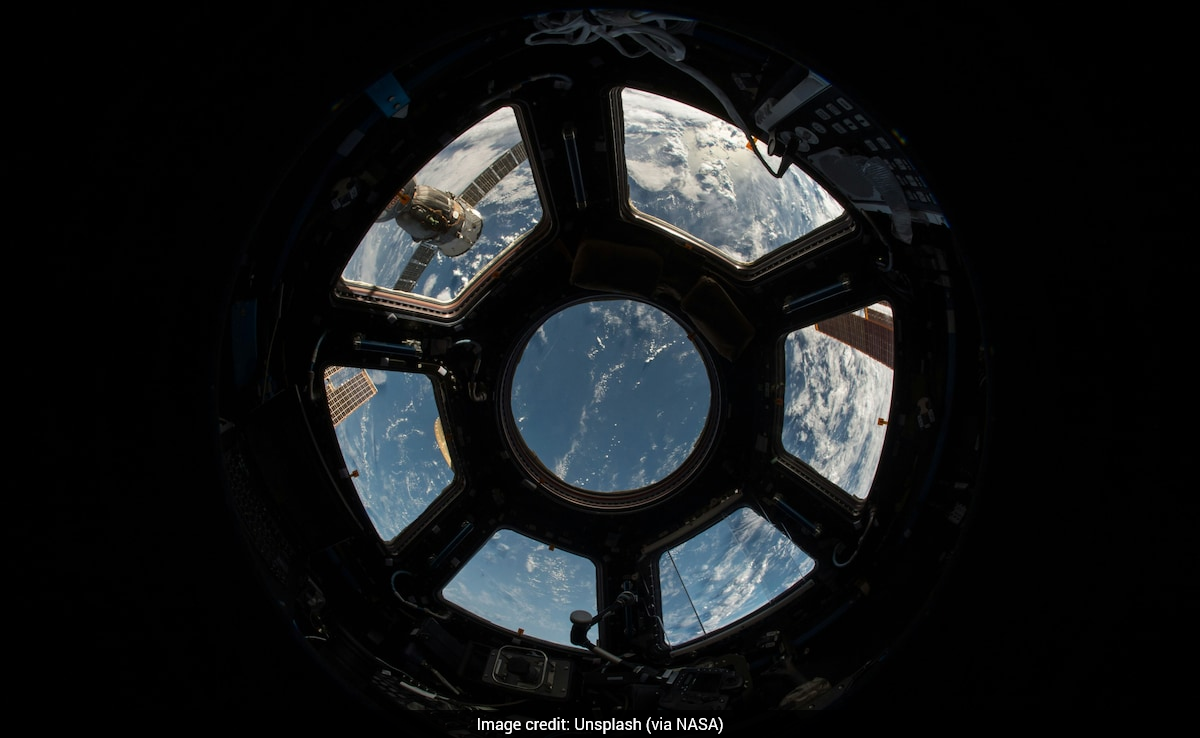
Chinese researchers aimed to study how microgravity and cosmic radiation affect the earliest stages of human development. To do so, they launched the world's first space experiment using human artificial embryo models and sent stem cell-derived structures to the Tiangong space station, IFL Science reported. The samples travelled aboard the Tianzhou-10 cargo spacecraft, which docked with Tiangong in early May. The experiment is being run by researchers at the Chinese Academy of Sciences' Institute of Zoology.
Also read | European Space Agency Shares Details Of "Most Perfect Geometrical" Forms Created In Space
What's actually in orbit?
As per the report, the "embryos" are not capable of becoming a fetus. Scientists call them artificial embryo models, which are grown from human stem cells that mimic real embryos up to about 14-21 days after fertilisation.
-

-
 World-Class Chefs, Food And Music: The Fun Side Of NDTV World Summit 2026
 -
 AI, Consciousness And Dharma: Why Ancient Indian Wisdom Matters Now
 -
 NDTV World Summit: What To Expect From PM Modi's Keynote Address
 -
 NDTV World Summit 2026: What To Watch Out For | PM Modi, Jaishankar, AI And Global Power Shifts
 -
 A World Between Orders: What To Expect At NDTV World Summit 2026
 -
 Who Is Rajiv Mehta? Lilavati Hospital Trustee To Speak At NDTV World Summit 2026
 -
 Alain Ebobisse, Africa50 CEO, To Attend NDTV World Summit 2026. All About Him
 -
 Kriti Sanon At NDTV World Summit: A Look At Her Career And Business Ventures
 -
 Ex-CIA Director To Decode 'War In Times Of AI' At NDTV World Summit
 -
 Who Is Vikram Rai, CEO, South Asia GE Aerospace, Set To Attend The NDTV World Summit 2026
They can self-organise and divide, but won't develop into a person. That distinction allows researchers to study early human development while avoiding ethical restrictions on work with real embryos.
"We hope that by comparing the development of space and ground samples, we can identify the factors affecting early human embryonic growth in the space environment, and address the risks and challenges humans may face during long-term space habitation," project leader Yu Leqian at the Chinese Academy of Sciences Institute of Zoology said in a statement.
"This is not a real human embryo and does not have the ability to develop into an individual. However, it can serve as a model for studying early human development."
Also read | Plane Hits Paraglider Mid-Air, Tears Through Canopy In Shocking Video
Life on Earth evolved under gravity. Microgravity and higher radiation levels in orbit could disrupt cell alignment, gene expression, or organ formation.
As humans plan to stay for a long duration in space stations, it's important to study those effects.
Project lead Yu Leqian said the goal is to answer a basic question: "Can humans survive and reproduce in space?"
He told CCTV that once researchers understand how gravity influences early development, they can look for ways to counteract any negative effects.
Track Latest News Live on NDTV.com and get news updates from India and around the world

