





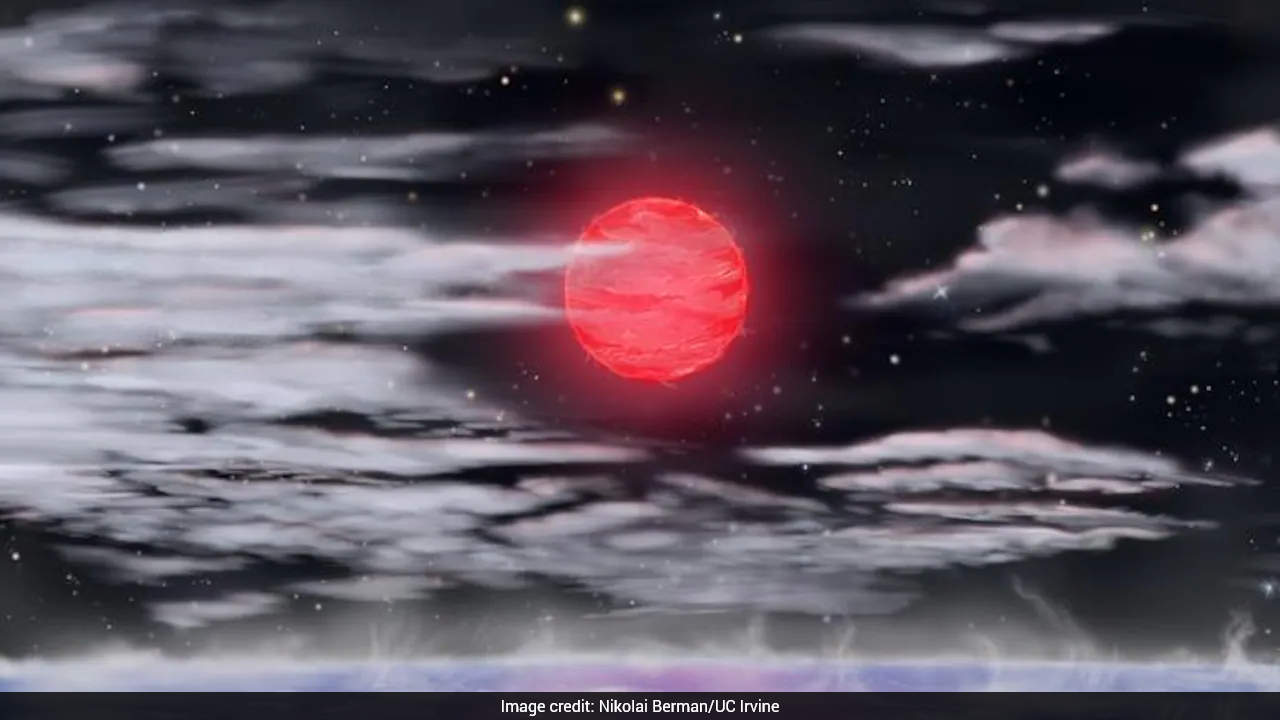
Astronomers have used the Hobby-Eberly Telescope at McDonald Observatory to take a fresh look at a rocky exoplanet just 25 light-years away and say it could be more Earth-like and also potentially habitable than earlier data suggested. According to a study published in The Astrophysical Journal, the exoplanet, known as GJ 3378b, orbits a small, cool M4V red dwarf star located in the northern constellation Camelopardalis, only 7.7 parsecs (25 light-years) from Earth.
The planet was first reported in 2024, but new radial-velocity observations from the Habitable-Zone Planet Finder (HPF) at McDonald Observatory and the NEID spectrometer at Kitt Peak have revised its properties.
"Our mantra is 'follow the water,'" Paul Robertson, who is an astronomer at the University of California, Irvine and lead author on the new study of GJ 3378b, explained as mentioned in the press release.
"It's the one thing every known living thing on Earth needs, so that's the first thing we look for when trying to find environments that could sustain life."
Also read | Earth Will Be Farthest From Sun On July 6. Here's What It Means
The press release mentioned that Red dwarfs are the coolest group of stars in existence, and they are much smaller and dimmer than our sun and often appear reddish. They are a suitable and quite an important target in the search for life outside our solar system, as they are the most common stars in our galaxy.
"About 70% of stars in our galaxy are red dwarfs, so they represent the standard," Michael Endl, an astronomer at UT Austin, a member of its Center for Planetary Systems Habitability, and co-author on the paper, said as quoted. "It's really important that we understand the planet population around these stars."
When astronomers observed it, they found that when the planet orbits, its gravitational force tugs on the star, which creates a subtle wobble in the host star. The movement can help the scientists to calculate the planet's mass and orbit.
"The Habitable-zone Planet Finder is optimized to use infrared light," Robertson explained. "As stars get smaller, they get cooler, and most of their energy comes out in infrared wavelengths. So, we put an infrared spectrometer on a 10-meter telescope (33 feet), and that gives us more raw light-collecting power to observe these faint stars."
"The name of the game is precision," Endl added. "In order to find those low-mass planets, you're always looking for tiny signals. If your instruments aren't precise enough, you won't find them. You can't find them."
Also read | All About NASA's Daring Plan To Save Swift Telescope From Falling To Earth
When it was first discovered in 2024, it was thought to be about five times the mass of Earth. However, the updated analysis cuts the planet's minimum mass from about 5.3 times Earth's down to around 2.3, and shortens its orbital period from 24.7 days to around 21 days.
That puts GJ 3378b firmly in the "super-Earth" category: a world more massive than Earth but likely rocky in composition.
"The ultimate goal is biosignatures. We really want to know, 'Are we alone in the universe?'" Endl said.
"We are still in the reconnaissance phase of our solar neighbourhood, trying to find the planets around the nearest stars because those will be the easiest ones to detect a biosignature on. This planet brings us one step closer to knowing all of our neighbors and, ultimately, which might be hospitable for life."
Track Latest News Live on NDTV.com and get news updates from India and around the world

