





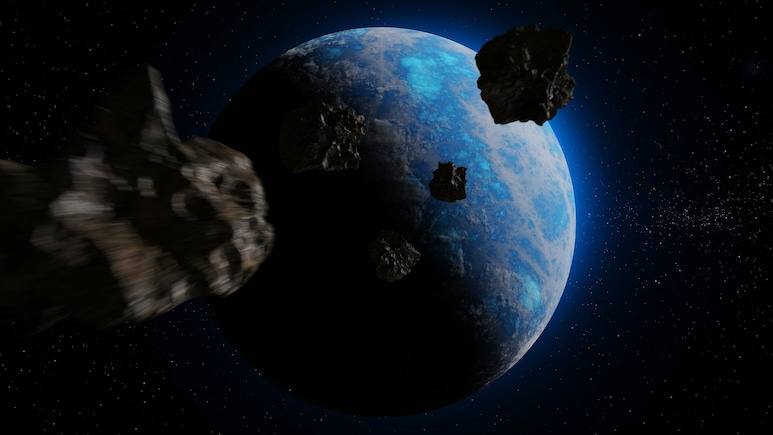
Asteroid 2024 YR4, a 60-meter-wide building-size space rock, has a 4.3% chance of colliding with the Moon on December 22, 2032. If it does, the impact could create an "optical flash" visible from Earth, potentially as bright as Venus, and lasting several minutes, Live Science reported.
In 2024, this asteroid created a buzz over reports that it would hit Earth; however, after further observations, NASA confirmed that the object poses no significant impact risk to Earth in 2032 and beyond.
According to a yet-to-be-peer-reviewed study, recently posted on the preprint server arXiv.org, the impact would release energy equivalent to 5.2-8 megatons of TNT, creating a crater approximately 1 kilometre wide. The flash would be followed by an infrared afterglow, lasting several hours.
Also read | Scientists Plan To Build 150-Meter Wall To Mitigate "Doomsday Glacier" Melting Crisis
The scientists wrote that it would be the "most energetic lunar impact event ever recorded in human history", which would also generate a meteor shower, with debris potentially threatening satellites and space infrastructure.
"Our results suggest an optical flash of visual magnitude from -2.5 to -3 lasting several minutes directly after the impact, followed by hours of infrared afterglow from 2000 K molten rock cooling to a few hundred K," the researchers noted.
The event would provide a rare opportunity to study lunar impact physics and the Moon's surface dynamics, and the scientists could gain valuable insights into asteroid composition and the effects of impacts on celestial bodies.
The researchers have stated that they will continue tracking Asteroid 2024 YR4, refining its orbit and impact probability estimates.
Also read | Study Reveals How "Lithospheric Drip" Shaped Utah's Green River Path
"Finally, we integrate these results into a coordinated observation timeline, identifying the best detection windows for ground-based telescopes, lunar orbiters, and surface stations," they said in the study.
"If this scenario plays out, it will be a milestone for planetary science, turning the Earth-Moon system into a grand stage for validating our understanding of asteroid impacts," Yixuan Wu, a researcher at Tsinghua University in China and an author of the paper, told Live Science.
Last year, the astronomers also speculated that the 4% probability could increase to over 30% based on upcoming observations by the James Webb Space Telescope (JWST) in February 2026. According to scientists, there is an 80% chance that the odds of a lunar impact will drop below 1%. Also, a 5% chance that the odds will increase to over 30%.
The James Webb Space Telescope (JWST) will have narrow viewing windows on February 18 and 26 to gather crucial data on the asteroid's trajectory and what to do about it.
To tackle the asteroid, NASA and the European Space Agency are also considering possible deflection scenarios, including detonating a nuclear bomb near the asteroid, but no concrete plans are in place yet.
Track Latest News Live on NDTV.com and get news updates from India and around the world

