





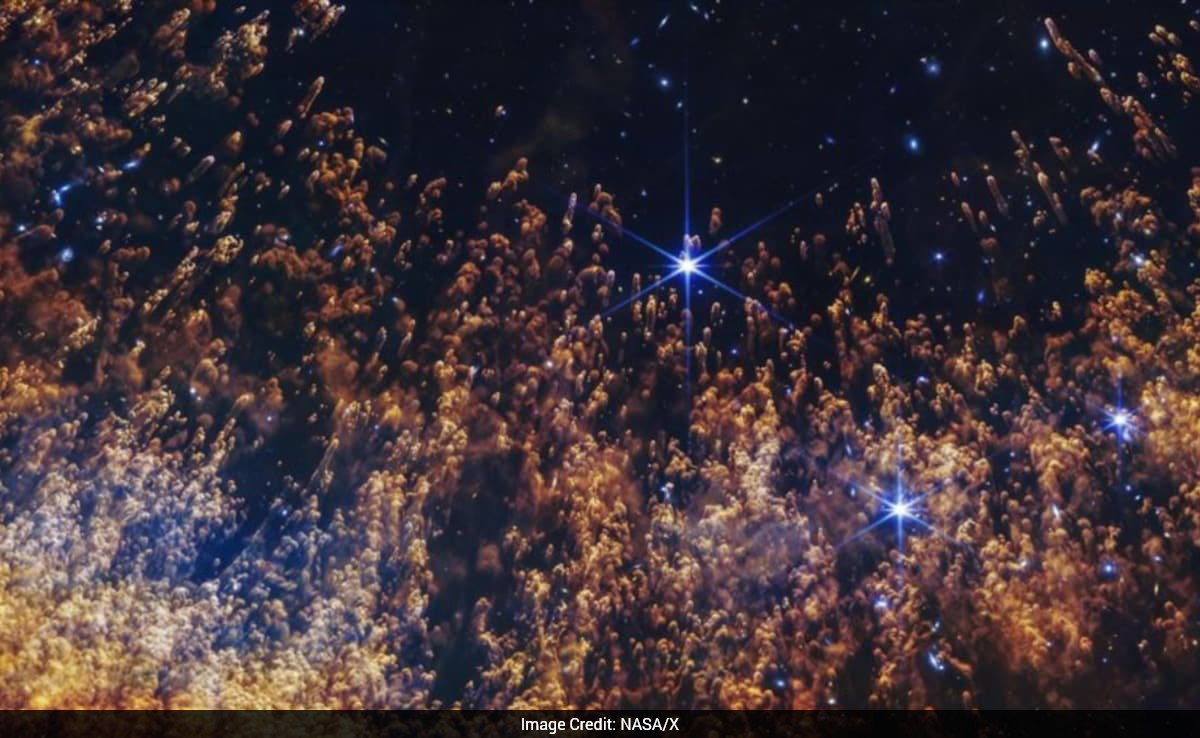
NASA's James Webb Space Telescope has captured an extraordinary view of the Helix Nebula, showing what could be the eventual fate of our own Sun and planetary system. The telescope's high-resolution images reveal how a dying star sheds its gas and dust, recycling material back into space to help form future stars and planets, reported NASA.
Webb's Near-Infrared Camera (NIRCam) has revealed columns of gas that appear long-tailed, comet-like, and reveal the inner boundary of the expanding shell surrounding the dying star. Fast, hot winds emanating from the star collide with colder, slower-moving gas and dust previously ejected, shaping the nebula into its distinctive and beautiful structure.
The Helix Nebula has been studied by astronomers for nearly two centuries, using both ground-based and space-based telescopes. Webb's near-infrared view reveals the gas knots and structures more clearly than images from the Hubble Space Telescope. It also provides more detailed and sharper detail than NASA's retired Spitzer Space Telescope, clearly revealing the transition from the hottest gas near the star to the cooler gas farther out.
At the center of the nebula is a burning white dwarf, the remnant core of a dying star, and is not visible in Webb's image. Its intense radiation illuminates the surrounding gas and gives rise to various coloured features. Hot ionized gas is present near the white dwarf, cold molecular hydrogen extends beyond, and dust forms protective pockets within, where complex molecules can form. This process provides the raw material that could fuel future planet formation in other star systems.
The colours in Webb's image reflect the temperature and chemical composition of the gas. Blue represents the hottest gas, energized by the white dwarf's ultraviolet light. Further back, yellow represents the region where hydrogen molecules fuse into molecular bonds. Red represents the coolest gas and dust, where the gas is thin and dust begins to form. These colours together reveal the process of converting a star's final breath into the building blocks of new planets and worlds.
Formation Of Complex Molecules
Previous Spitzer studies have indicated the formation of complex molecules in the Helix Nebula. Now, Webb's high-resolution images reveal these molecules forming in protected regions. The dark areas visible between the glowing orange and red areas indicate where these molecules develop. This reveals how stars contribute to the formation of future planets by recycling their material.
Track Latest News Live on NDTV.com and get news updates from India and around the world

