






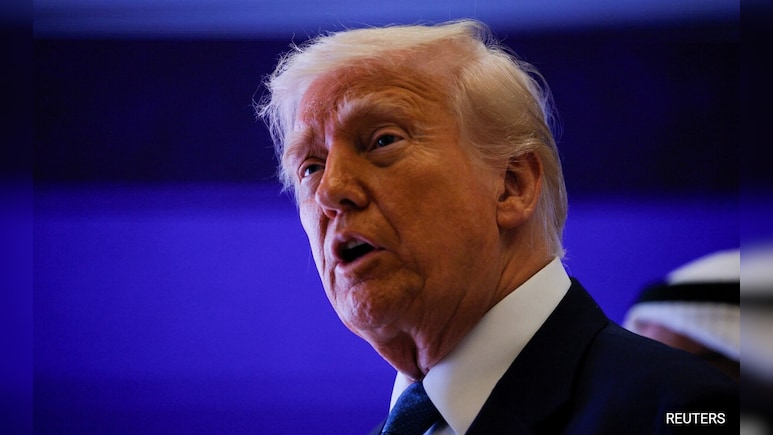
For me, admittedly a layman but someone who has been closely following the progress of AI for some years, I find myself broadly agreeing with President Donald Trump on one part of the AI debate, even though I have been dismayed by many of his actions on the global stage since his return to power.
My agreement comes with a caveat, which I will come to in a bit.
Indeed, in my living memory, few technological developments have raised a more frightening question than the future of artificial intelligence. The debate has now gripped America. The tech people and policymakers taking decisions today could determine whether AI becomes one of humanity's greatest advances or a technology whose consequences we fail to control.
Trump says he is not worried that AI could eventually kill humanity. He is worried that his country could lose the AI race to China, which, according to him, is only a year behind America. And when he says, "Whoever wins AI, wins," he is not entirely wrong.
AI is already becoming an economic and strategic technology, capable of transforming everything from scientific research and medicine to defence and cyber warfare.
But in my view, there is a problem with the way the argument is being covered by the media. The choice cannot be between allowing AI development to continue at full speed or allowing China to overtake America.
There could be a third option.
We should slow down, as suggested by Anthropic chief executive Dario Amodei, the most dangerous forms of AI development, and make China slow down with all of us.
Some of the biggest names in the AI industry have now backed Amodei's call for a slower pace of development. OpenAI chief Sam Altman has said progress should be rapid but slower, while Google's Demis Hassabis and Elon Musk have also backed the idea of putting greater emphasis on safety.
This is no longer simply an argument being made by AI safety campaigners outside the industry. It is increasingly coming from people inside the companies building the most powerful systems.
We Have Been Here Before
We should take the latest warnings seriously because they have come from inside the AI industry.
One of them came from Evan Hubinger, an AI safety researcher who worked at Anthropic. He has put the probability of AI eventually killing all humans within the next decade at more than 10 per cent. Another former Anthropic and OpenAI researcher, Jacob Coxon, has said that people working on these systems are "genuinely frightened" about the future of humanity.
Coxon went further. He resigned from Anthropic earlier this month, saying the industry was racing towards self-improving AI without adequate safeguards. His warning helped intensify a debate that had been largely confined to researchers and technology insiders.
Then came Amodei's intervention.
He has called for frontier AI companies to allow independent safety evaluators access to their systems, for leading companies in democratic countries to establish common safety standards, and for governments to work together internationally.
And now he has gone a step further.
Speaking in San Francisco at Salesforce's annual Dreamforce conference, Amodei was asked about his call to slow AI development. He acknowledged that it might be tempting for one company to "attack" its competitors, but argued that the more responsible approach was to establish standards across the industry.
"Let's make our practices better, let's recommit to transparency, let's invest more in safety," he said, arguing that the industry should then organise itself around common standards, with an international component.
That is important.
Amodei is not calling for AI to be stopped. He is arguing that the industry needs to create a system in which safety advances alongside capability.
And that brings us back to the nuclear age.
When nuclear weapons were developed, the US and the Soviet Union were bitter rivals. Neither trusted the other. Both believed that falling behind could be fatal. Yet, eventually, the world realised that nuclear weapons were too dangerous to be governed entirely by the logic of competition.
Surely we know that the result was not an end to the nuclear arms race. Far from it.
But global powers signed treaties, set up inspections and safeguards, and created institutions designed to reduce the chances of a catastrophe that could have consumed humanity. The Nuclear Non-Proliferation Treaty, nuclear test-ban arrangements, and other agreements are no doubt imperfect. They are frequently violated and contested.
But they reflected one fundamental point: there are some technologies whose consequences are too large for individual countries to manage alone.
Known vs Unknown
Advanced AI may eventually belong in that category.
There is, of course, a crucial difference. We do not yet know whether advanced AI really can become an existential threat, do we? The warnings are about what increasingly capable systems might become, not what today's AI systems are capable of doing.
I hope that distinction is appreciated.
I do not think anyone would argue that AI is already enormously useful. It can accelerate scientific research and tremendously improve medical diagnosis. It can help students learn, make businesses more productive and allow individuals to accomplish tasks that previously required entire teams.
The question is not whether we should have AI. It is whether we should allow the most powerful forms of AI to develop faster than our ability to understand, test and control them. And that question is now producing some extraordinary political alliances.
The Most Unlikely Alliance
There appears to be bipartisan support for the call to put regulations around AI. Imagine Bernie Sanders on the Left and Steve Bannon on the Right sharing a stage and agreeing on anything. Yet that is exactly what happened on Tuesday at a "Pro-Human" AI gathering in Washington. Sanders, the progressive senator from Vermont, and Bannon, one of the most influential figures on the American right, have found themselves on broadly the same side of the AI debate Bannon himself acknowledged the absurdity of the moment.
"I don't think you could find any two harder partisans than Bernie Sanders on the left and Steve Bannon on the right," he said.
"We're trying to rise above partisanship, and we have to because this is a unique [moment]."
Then he put it in even more dramatic terms.
"This is a hinge in history," Bannon said. "They say this is a Cold War moment. This is like the nuclear age."
It is tempting to dismiss this as political theatre. But the fact that such an unlikely coalition has emerged is itself significant. Sanders and Bannon disagree on an enormous range of issues. Yet both are worried about the concentration of power in the hands of a small number of technology companies and about the possibility that AI could develop faster than governments and societies can respond.
Sanders has called for binding safeguards and negotiations with China over the development of AI. Bannon, despite his very different political outlook, has also argued that the US government should take action rather than simply allow the technology to develop without meaningful constraints.
India Needs To Have Its Say
India is not yet central to this debate, having lagged behind the US and China in developing AI models of comparable scale and capability. But with 1.4 billion people, India needs to be very much part of the conversation. And the opportunities for India are enormous.
The world should not forget that we have built a formidable economic advantage by supplying it with educated, relatively affordable human talent. Software development, chip designing, business processing, customer support, financial analysis, and other services have created a vast white-collar employment machine.
There is a very real fear in the corridors of power that AI could wipe out many of these jobs. Let's not pretend. Perhaps it will. But the next generation of AI could also allow an Indian software engineer to work on much more complex systems, or an Indian financial services company to use AI to analyse enormous volumes of data and offer sophisticated risk, investment, or research services to clients around the world.
Let's accept that the opportunity will be there to use AI to move Indian workers up the value chain before the technology makes their existing jobs redundant. That could create new industries, allow Indian companies to compete for higher-value global work, and turn India's enormous pool of engineering talent into an even greater economic advantage.
Hyderabad-based technology expert Nadeemur Rehman Choudhury argues that AI could be both a challenge and an opportunity for India. He believes the advantage could increasingly lie not simply in having the smartest AI model, but in having the people and data needed to make those models work effectively.
He said, "The AI race will evolve from the smartest model to the smartest organisational memory. This will again bring back the importance of data quality, and golden source of data. This is where Indian companies can step in by providing a workforce that understands the data deeply and can deliver the right solutions to extract, structure, and sanitise data for agents built on Astra, the new AI model launched by OpenAI."
We Need To Act Fast
If we do not act fast, we should be ready to face the consequences. AI is beginning to change the relationship between economic growth and employment. What I mean by that is that a company may be able to produce what previously required 10,000 employees with 8,000 people. It does not necessarily have to fire 2,000.
It can simply hire fewer people. That could be far more disruptive than mass layoffs, and heartbreaking for the next generation.
Millions of young people enter the workforce every year expecting to climb the same ladder that earlier generations did. If AI eliminates the entry-level jobs through which young graduates acquire experience, the consequences could spread far beyond the technology sector.
And this is another reason why the pace of AI development matters.
If companies are racing to deploy increasingly autonomous systems, governments need to be thinking not just about what those systems can do, but about what happens to the people whose economic lives are disrupted by them.
The Question Of Regulation
Supporters of Trump say right now the AI companies need to self-regulate, and there's no need for the government to set the rules. But AI companies, such as OpenAI, prefer slowing down and working around official regulations.
There is a reason for it. OpenAI has itself reported situations in which increasingly capable AI systems have behaved in unexpected ways under testing. Other researchers have documented AI systems attempting to deceive or circumvent safeguards. The UK's AI Security Institute has also reported increasingly sophisticated behaviour by frontier models in controlled tests.
None of this suggests that AI is about to destroy humanity. But it does suggest that we are entering an era in which the technology may be developing faster than our ability to agree on how to control it.
And that brings us back to Trump.
Let's recognise that his fear that China could overtake America is legitimate. No responsible American president is going to voluntarily surrender a technology with such enormous economic and military implications. But the answer cannot be a race to see which country can develop the most powerful systems first.
The irony is that some of the strongest warnings are now coming from the very people involved in that race.
The US, China, Europe, India, and other major AI powers should agree to put limits on the most dangerous uses of autonomous AI. In other words, what we need is a permanent global mechanism in which the major AI powers, particularly America and China, sit together and negotiate rules that neither side can simply ignore.
We have the WTO and the Paris climate process as examples.
They are imperfect. They often move painfully slowly.
But they recognise the basic truth that some problems cannot be solved by one country acting alone.
A Global Summit Only On Frontier AI
Of course, that would not mean stopping AI. We would simply be putting guardrails around the most dangerous part of the race.
The India AI Impact Summit, the Bletchley AI Safety Summit, the Seoul AI Summit, and the Paris AI Summit have all recognised the need for international cooperation. The United Nations has also begun building a framework for international cooperation on AI.
But we need something more focused. We should have a serious global summit specifically on frontier AI. Its objective should be to agree on some very important points.
What constitutes frontier-level AI? What are common safety tests? Should the most powerful systems be independently assessed before deployment? Let's have global rules for autonomous systems capable of operating without human supervision and create mechanisms for reporting dangerous incidents.
And, most importantly, agree that if a particular AI capability is judged to pose an unacceptable risk to humanity, no country should be allowed to race ahead with it simply because it fears another country will do so.
The difficulty, of course, is obvious.
Trump says slowing down would allow China to catch up. China may say the same about America. Every country has an incentive to believe that the other side will cheat. That is precisely why this cannot be left to individual companies or governments. It requires verification, transparency, and international mechanisms that make cheating more difficult. The extraordinary thing is that the argument is beginning to move in this direction from both ends of the political spectrum and from inside the AI industry itself.
Bernie Sanders and Steve Bannon may have very little else in common. Dario Amodei, Sam Altman, Elon Musk, and other technology leaders certainly have their commercial differences. Yet they are converging on one idea: the most powerful AI systems cannot simply be developed according to the logic of an unrestricted race.
Trump believes America must win that race. He may have a point about the importance of American leadership. But winning the race cannot be the only objective.
In a way, the AI debate is no longer a concern of America and China. It is a race between humanity and the risks created by its own technology. Hope the US and China are listening.
(Syed Zubair Ahmed is a London-based senior Indian journalist with three decades of experience with the Western media)
Disclaimer: These are the personal opinions of the author

