






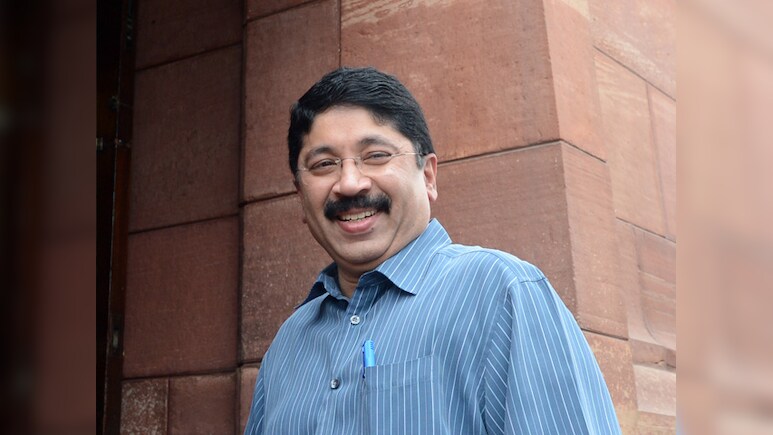
DMK (Dravida Munnetra Kazhagam) MP Dayanidhi Maran's recent remark (January 14) comparing women in Tamil Nadu with women in North India, suggesting that Tamil women are encouraged to study while North Indian women are restricted to kitchens and childbearing, has sparked a predictable political firestorm.
The statement quickly drew sharp criticism from opposition parties, including the BJP, which called the remarks offensive, divisive, and based on sweeping generalisations. It has reignited debates on regionalism, patriarchy, and the responsibility of public representatives.
The pertinent question, however, is not merely whether Maran was offensive, but whether there is any merit in what he said-and if so, how such truths should be expressed in a diverse democracy like India.
Setting context
Maran delivered the speech during a state government programme distributing laptops to female students under Tamil Nadu's 'Ulagam Ungal Kaiyil' scheme. His reference to the Dravidian model of governance and Tamil Nadu's long history of social welfare programmes -from free education to reserved government jobs - are correct.
However, his choice to contrast the state's achievements with what he described as more traditional gender roles in parts of North India quickly shifted the focus from empowerment to regional stereotyping.
It is true that Tamil Nadu has generally higher female literacy rates and workforce participation compared with several northern states.
Tamil Nadu's female literacy (73.44% in 2011) is significantly higher than the national average (around 65.5%) and north Indian states - like Uttar Pradesh (57.18%) and Rajasthan (52.12%). In 2021-22, the state's female GER (Gross Enrolment Ratio) was around 47.3%, compared to the national average of 28.5%, placing it among the best large states.
Moreover, Tamil Nadu consistently reports a more balanced sex ratio and stronger indicators on women's health and education.
However, the political context of Maran's remarks cannot be ignored either. Tamil Nadu politics has often positioned itself in opposition to 'Hindi heartland' supremacy, and such remarks play well with a base that sees the North as culturally conservative and politically imposing. This rhetorical strategy is dangerous. It deepens regional fault lines at a time when India needs cooperative federalism, not cultural one-upmanship. Worse, it allows opponents to shift the debate from women's rights to identity politics, effectively sidelining substantive gender issues.
Real issue, not gender binary
Northern India is not a monolith; states like Haryana, Uttar Pradesh, Rajasthan, Bihar, and Madhya Pradesh - often grouped under the 'North' label - show considerable internal diversity in women's socio-economic participation. In recent years, government initiatives and civil society programmes have significantly increased female literacy, entrepreneurship, and employment opportunities even in regions once considered more conservative.
According to the 2011 census and recent data, northern states like Delhi - 82.4%, Punjab - 70.73% and Haryana (65.94% -2011 census), with recent estimates around 71.3%, have shown great improvement in female literacy. So has Himachal Pradesh, with a female literacy rate - 75.93% - significantly higher than the national average.
Additionally, urban centres across northern states, from Delhi to Chandigarh to Lucknow, have highly educated and professionally accomplished women excelling in every field from science and technology to administration and arts - including political leadership, corporate roles, and defence services. These counterexamples make it reductive to suggest that women in North India are predominantly confined to household roles.
The comments disregard North Indian women's decades of struggle, progress, and leadership. From political leaders and athletes to entrepreneurs, teachers, and grassroots activists, North India has produced countless women who defy precisely the stereotype Maran invoked. To reduce them to domestic roles is not only inaccurate but also insulting, particularly coming from a male politician claiming to champion women's empowerment.
Maran's underlying point - that women's education and economic participation should be prioritised - is broadly valid. Across India, women face social norms that limit opportunities - from early marriage pressures to unequal access to education, safety concerns, and labour market discrimination. National surveys show that female labour force participation remains significantly below that of men, and even states with strong indicators like Tamil Nadu are still grappling with gender gaps in STEM fields, senior leadership roles, and rural employment.
However, framing these challenges through a North versus South binary oversimplifies a nuanced reality. Women in northern states are not uniformly relegated to household roles, nor are women in Tamil Nadu free from the gendered challenges that persist across India.
If the aim is to highlight best practices, the conversation should be about what states can learn from one another. How can successful interventions in Tamil Nadu be adapted in Uttar Pradesh or Bihar? How can grassroots movements led by North Indian women inform policy in the South? Maran has been a union minister in the Late PM Manmohan Singh's government.
His narrow views deepen regional fault lines at a time when India needs cooperative federalism - not cultural one-upmanship.
Progress is not a zero-sum game, and feminism cannot thrive on regional contempt. When empowerment is framed through regional superiority - "our women are liberated, theirs are oppressed"- it shifts focus away from systemic patriarchy that exists across India. Celebrating relative progress should not slide into complacency or moral grandstanding.
(The author is Contributing Editor, NDTV)
Disclaimer: These are the personal opinions of the author

