






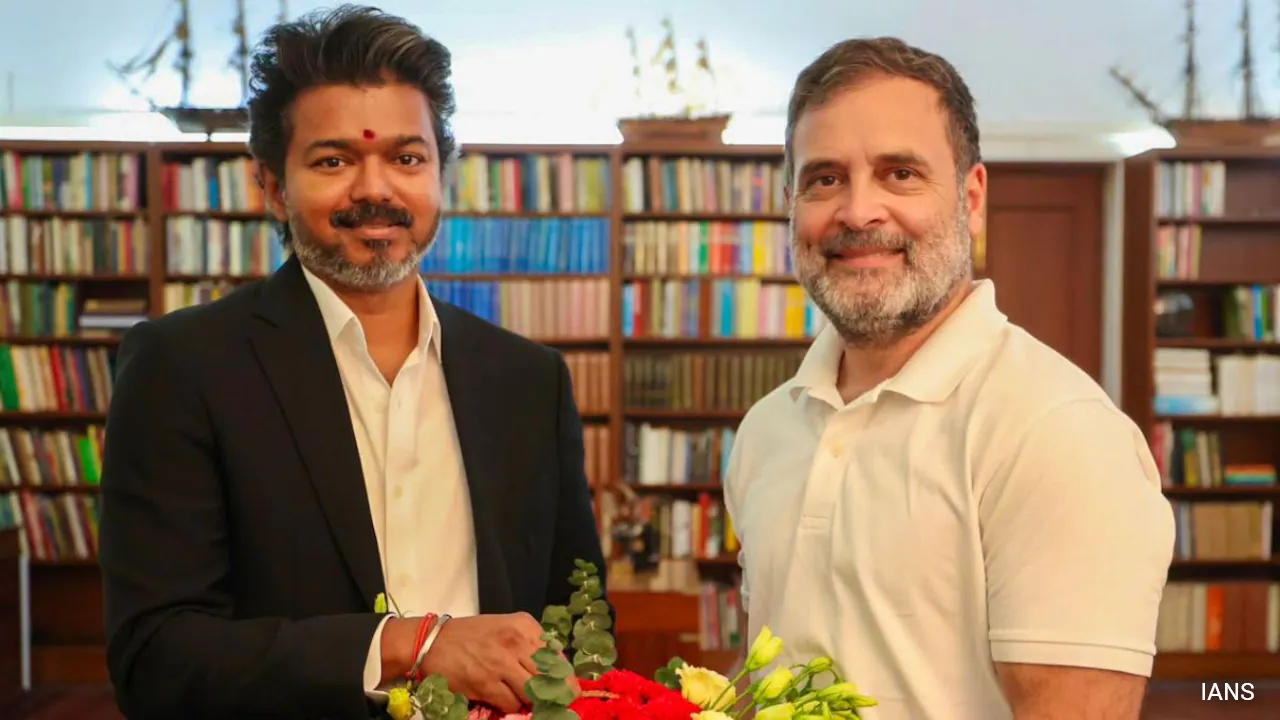
For Congress leader Rahul Gandhi, the road to 7, Lok Kalyan Marg (formerly Race Course Road), or, more accurately, the Prime Minister's Office in a new India, is becoming a little more complex with every passing year. The Congress has been steadily building the case that Rahul Gandhi should be the natural Prime Ministerial face of the INDIA bloc in 2029. Yet, the biggest obstacle to that ambition may not be the BJP. It may again be the very allies whose support Rahul Gandhi will need to reach the top.
The latest flashpoint is Tamil Nadu.
Congress leaders in the state have now claimed that Tamil Nadu Chief Minister and TVK (Tamilaga Vettri Kazhagam) leader Vijay has backed Rahul Gandhi as the INDIA bloc's Prime Ministerial candidate. Congress leader Tharahai Cuthbert has even dismissed reports of a rift and maintained that Vijay and Rahul share mutual respect.
But politics is rarely as simple as public reassurance.
Only days earlier, the Congress-TVK alliance was under considerable strain over reports of a 'Vijay for PM' campaign. A Congress minister went so far as to threaten resignation if TVK refused to endorse Rahul Gandhi for 2029.
That itself exposes Rahul Gandhi's fundamental problem - even when an ally eventually supports him, the support cannot necessarily be assumed to be unconditional.
False assumption of the bloc
The INDIA bloc was never created as a conventional political party with one leader, one ideology and one command structure. It was an electoral coalition of parties with sharply different regional interests and ambitions. That makes Rahul Gandhi's claim to the top job particularly difficult.
Mamata Banerjee had demonstrated that the Trinamool Congress had its own national ambitions and did not necessarily see the Congress as the unquestioned leader of the opposition. Arvind Kejriwal's AAP had similarly sought political space independent of Congress. Akhilesh Yadav's Samajwadi Party, meanwhile, has emerged as a powerful player in Uttar Pradesh and has its own calculations about who should lead the opposition nationally.
This is the central contradiction Rahul Gandhi faces- Congress wants the INDIA bloc to behave like a coalition led by the largest national opposition party, while several regional parties see the alliance primarily as a vehicle for defeating the BJP-not necessarily for making Rahul Gandhi Prime Minister.
That distinction could become decisive in 2029.
Bargaining powerThe Congress' continuing love for its scion never lets the party lose hope in Rahul and they point out to his positive transformation since 2014. His political communication has become sharper, his parliamentary interventions have acquired greater visibility and the 'Bharat Jodo Yatra' gave him an image that was markedly different from the caricature of the reluctant politician that his opponents had successfully constructed.
The 2024 Lok Sabha election also gave Congress a psychological boost. The party improved substantially on its 2019 tally, while Rahul Gandhi emerged as the Leader of the Opposition. But a stronger Congress does not automatically translate into Rahul Gandhi becoming the consensus Prime Ministerial candidate.
For that, Congress must answer a more difficult question - how many seats can it realistically win on its own, and how dependent will it remain on regional allies?
The answer to that question will determine the bargaining power of Rahul Gandhi.
If Congress performs strongly across Uttar Pradesh, Maharashtra, Karnataka, Rajasthan, Madhya Pradesh, Telangana and other states, Rahul's claim becomes considerably stronger. But if regional parties remain dominant in crucial states, the Prime Ministerial question could once again become a post-election negotiation.
That is precisely where CM Vijay becomes significant.
CM Vijay's ambition
CM Vijay is not merely another regional politician. He brings enormous public recognition and has already demonstrated that his political ambitions extend beyond Tamil Nadu. A recent India Today-CVoter survey cited in reports put Vijay behind Narendra Modi and Rahul Gandhi in preferences for the next Prime Minister, with Vijay receiving 9.2 per cent compared with Rahul's 27.1 per cent.
Those numbers should not be mistaken for a prediction of 2029. But politically, they send an important message - new claimants to national leadership can emerge surprisingly quickly.
For Rahul, therefore, the challenge is not simply defeating Narendra Modi's political legacy or the BJP's organisational machinery. It is preventing the opposition's own success from producing multiple claimants to leadership.
There is another danger. The more Congress insists on Rahul Gandhi as the Prime Ministerial candidate before the election, the greater the possibility that regional allies will feel compelled to negotiate harder.
It is a classic political dilemma - declare the leader too early and alienate allies; declare him too late and weaken his authority.
The Congress's task, therefore, is much bigger than repeatedly announcing Rahul Gandhi as its choice. It must make him the acceptable choice for allies, not merely the preferred choice of Congress.
That requires political trust, electoral strength and a willingness to accommodate regional leaders without appearing weak. Congress has already lost that propriety by dumping the DMK - its earlier ally - after the Tamil Nadu assembly election.
The Tamil Nadu episode is an early warning. Congress may now claim that the rift with Vijay has been resolved and that the TVK chief supports Rahul Gandhi. But the fact that such a disagreement surfaced three years before the next Lok Sabha election demonstrates how difficult the road ahead could be.
Rahul Gandhi has travelled a long distance politically since 2014. But becoming Prime Minister is a different challenge altogether.
He does not merely have to win against the BJP.
He has to win enough seats to make Congress indispensable, persuade regional satraps that his leadership will not eclipse theirs, keep the INDIA bloc together and ensure that no ally emerges from the 2029 election with a stronger claim to the top job.
(The author is Contributing Editor, NDTV)
Disclaimer: These are the personal opinions of the author

