




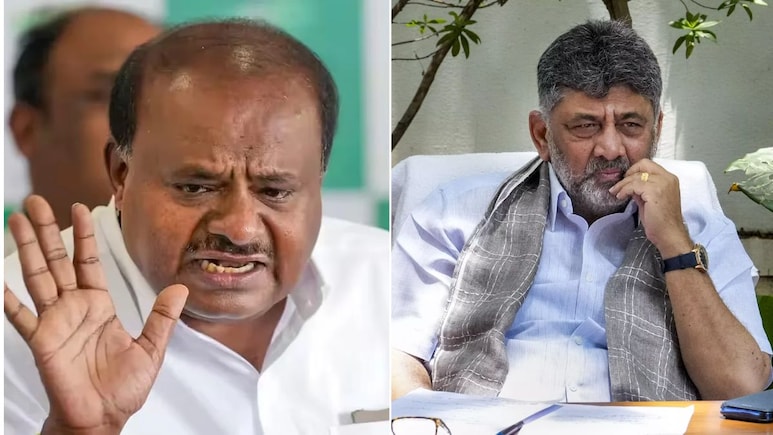
Karnataka's latest political controversy has all the ingredients of a political thriller - an alleged sting operation, a former Chief Minister fighting to protect his reputation, allegations of an intra-party conspiracy, an expelled Congress functionary, a serving chief minister facing questions about internal factionalism. And, then came the entry of a former chief minister from the opposition – bringing an entirely new dimension to the whole saga.
What began as an apparent attempt to target former Karnataka chief minister Siddaramaiah has evolved into a complicated political contest involving the Congress, the JD(S), and Union Minister H D Kumaraswamy. More importantly, it has once again raised uncomfortable questions about the methods politicians in Karnataka employ to weaken opponents, settle internal scores, and gain political leverage. Sensational allegations, leaked videos, and competing narratives rather than political debate have become the order of the day.
Also, with this diversion masterstroke, the Karnataka Congress has been able to divert attention from its own intra-party feud.
Change In Political Narrative
Until November 1, the principal question was whether the alleged sting operation was connected to the Congress's own internal power struggle. The emergence of Kumaraswamy's alleged connection has shifted attention towards the opposition and the possible political networks behind the circulation of the video.
The political significance of the development lies in the fact that the police investigation has now brought Kumaraswamy's political circle into the picture. Bengaluru Police Commissioner Seemant Kumar Singh recently said an accused had told investigators that a mobile phone allegedly used to upload the video was handed over to an associate at Kumaraswamy's official residence in New Delhi.
The police also said that this is an investigative lead, not proof of Kumaraswamy's involvement.
Kumaraswamy, predictably, has rejected the allegations and accused the Congress government of manipulating the investigation to divert attention from the alleged masterminds.
His response has been to turn the spotlight back on Chief Minister D K Shivakumar, questioning his alleged role in the political developments surrounding the circulation of videos involving his nephew Prajwal Revanna.
A purported sting, whether genuine or fabricated, can damage reputations long before the truth is established. The political consequences can be immediate, while the legal process takes months or years. The individual targeted is forced into damage control, party colleagues are compelled to take sides, and opponents gain an opportunity to exploit the resulting uncertainty.
Karnataka has witnessed several such controversies. The 2021 video controversy involving then BJP minister Ramesh Jarkiholi resulted in his resignation. Jarkiholi subsequently accused Shivakumar of orchestrating the operation, an allegation Shivakumar denied. The parallels are difficult to ignore.
Diversionary Tactics
The Siddaramaiah-Shivakumar relationship has been a subject of political speculation since the Congress returned to power in Karnataka in 2023. The leadership arrangement and subsequent transition have kept questions of power-sharing, political influence, and succession alive. Siddaramaiah's supporters have expressed concerns about his diminishing position since he relinquished the CM's post in May 2026. While Shivakumar may have fulfilled his ambition of becoming the CM, he still has to navigate the expectations of a powerful faction within his own party.
The sting controversy threatened to turn these differences into an open confrontation. Siddaramaiah took the matter to the Congress high command and even met Rahul Gandhi during his November 1 visit to Delhi. His demand was for a fair investigation, but the political subtext was equally significant - he wanted the national leadership to recognise the implications of what he perceived as an attempt to undermine him.
His son and Karnataka minister Yathindra Siddaramaiah had also alleged the involvement of Congress leaders in the controversy.
These allegations, combined with the expulsion of former Karnataka Pradesh Congress Committee general secretary Krupa Alva (for her alleged involvement in sting operations targeting Congress leaders) on October 27, had made the affair increasingly uncomfortable for the state Congress leadership. Alva was expelled for six years after reportedly failing to respond to a show-cause notice. Then came the Kumaraswamy development.
For the moment, the focus may have shifted from the visible intra-party feud, but it is sure to haunt the Congress again soon.
For the Congress, this is undoubtedly a more convenient political terrain. It can now argue that the controversy needs to be examined as a possible politically motivated operation rather than merely an internal party dispute. Shivakumar's government can point to the police investigation, while Siddaramaiah's supporters wait for the alleged conspiracy to be exposed.
However, there is an important distinction between a change in the political narrative and a resolution of the underlying problem.
Kumaraswamy has denied wrongdoing, the police investigation is incomplete, and the allegations against various political figures remain subject to verification. If subsequent evidence does not establish the suggested links, the Congress could find itself confronting the original questions all over again.
There is also a danger in treating the controversy as an opportunity to settle political scores. If the investigation becomes an instrument for targeting political adversaries, its credibility will suffer irrespective of which party benefits from the immediate headlines.
Ultimately, Karnataka's political class needs to introspect about political competition stooping so low. Recordings, counter-recordings, anonymous disclosures, and allegations of clandestine operations is not real politics.
Political parties need to draw a line between legitimate political scrutiny and the deliberate manufacture or circulation of damaging narratives to secure an advantage.
(The author is Contributing Editor, NDTV)
Disclaimer: These are the personal opinions of the author

