




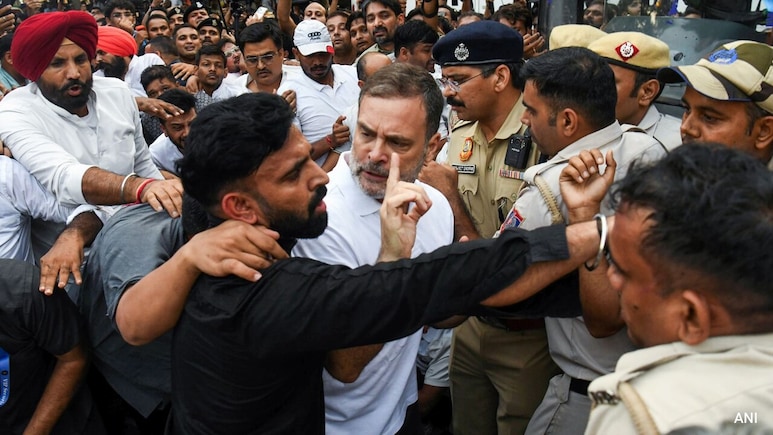
Indian politics has never been short of theatrics. The recent INDIA bloc protest march to the Supreme Court against Chief Election Commissioner Gyanesh Kumar and SIR (Special Intensive Revision) was full of such spectacles.
Congress leaders and siblings Rahul Gandhi and Priyanka Gandhi Vadra have been at the centre of demonstrations in which confrontation with the police, dramatic roadside protests, and emotionally charged gestures have attracted considerable public attention. Footage showing Rahul Gandhi apparently elbowing a fellow protester and pulling back the 'kurta' of his own party chief minister - Karnataka Chief Minister DK Shivakumar - has added another layer to the controversy.
The opposition alliance had come together to condemn the police crackdown on October 10-11 protesters - organised independently by youth and student movements - the CJP (Cockroach Janta Party) led by Abhijeet Dipke and left-wing students like AISA (All India Students' Association).
When political protest increasingly revolves around physical jostling, confrontational gestures, viral videos, and carefully captured moments of defiance, an uncomfortable question arises - is the Opposition communicating a political message, or is the spectacle becoming the message itself? Secondly, isn't the CJP - the propagator of the recent Gen Z agitation - being sidelined by the INDIA bloc?
Performative resistance?
Rahul Gandhi has made the protection of constitutional institutions, electoral integrity, and democratic accountability central to his political messaging. The INDIA bloc's campaign against the Election Commission's SIR of electoral rolls is rooted in concerns about voter deletions and the integrity of electoral processes.
These are serious issues that deserve examination through evidence, parliamentary scrutiny, and judicial review.
However, the public's attention shifted rapidly from the substance of the protest to the behaviour of its participants. When television screens and social media feeds focus on who pushed whom, who was pulled back, and who stood guard over whom, the original political demand risks becoming secondary.
The controversy surrounding Rahul Gandhi and Shivakumar illustrates this dilemma. Shivakumar is not merely another party worker in a crowd - he is the elected chief minister of Karnataka. Any footage appearing to show him being physically pulled back by a senior colleague naturally invites questions about personal space, leadership conduct, and the treatment of fellow party members.
Of course, Shivakumar on Tuesday denied being pushed by Rahul Gandhi during a protest march to the Supreme Court. But visuals speak louder. As Leader of Opposition, demanding accountability from powerful institutions, Rahul Gandhi must understand that his own conduct will be scrutinised just as closely.
Another Gandhi family member, Priyanka Gandhi Vadra's participation, has added an intensely personal dimension to the demonstrations. During the Delhi protest, she lay on the road holding a copy of the Constitution while Rahul Gandhi stood nearby and challenged police personnel attempting to move the protesters. His reported declaration - 'This is my sister' - became one of the defining moments of the confrontation.
For supporters, the scene represented solidarity between siblings standing against the use of state power. However, for many, it turned a political demonstration into a family-centred spectacle.
Both interpretations point to a larger problem. When the Gandhi siblings become the principal characters in every protest, the movement's institutional demands can become inseparable from their personal political image. The public may remember the dramatic exchange between a brother and sister more readily than the details of electoral-roll revision.
That is a communications challenge for the Congress. The party must explain why its campaign matters to ordinary citizens who may be less interested in the political fortunes of individual leaders than in whether their own names remain on electoral rolls and whether the election process is transparent.
Sidelining the CJP
The emergence of the youth-led CJP movement has introduced a distinctive form of political satire into the debate. Its protests and symbolic performances have attracted attention through humour, irreverence, and unconventional messaging.
The CJP's opposition to the Election Commission has also intersected with the broader campaign against SIR.
The comparison becomes particularly relevant when established parties like Congress and the INDIA bloc adopt similar forms of theatrical protest but hesitate to give credit to the CJP.
In fact, on social media, some Congress supporters are openly discrediting the CJP and see it as a plot to undermine Rahul Gandhi's youth base. The CJP leaders' absence from Rahul Gandhi's tea party, thrown for all protesters (including the INDIA bloc members and AISA leaders) the same evening, has brought much glee for the government.
Ultimately, the Gandhi siblings and the INDIA bloc face a question that extends well beyond a protest or controversial video - can they make institutional accountability the centre of their politics without allowing confrontation to overshadow it?
For a political leader who aspires to challenge Prime Minister Narendra Modi, every public gesture carries significance. Rahul Gandhi can't afford the grand image of an 'entitled prince' running on the street just because he happens to be a fifth-generational political dynast. Today, in a few seconds' time, people can make out the intentions of politicians. Gandhi siblings are enjoying the adrenaline that comes with street protests - but they just don't belong to that genre.
India needs an Opposition that can challenge authority fearlessly and scrutinise institutions rigorously. The CJP, which has successfully challenged the until now invincible NDA government, can't be left in the cold by opposition parties.
(The author is Contributing Editor, NDTV)
Disclaimer: These are the personal opinions of the author

