






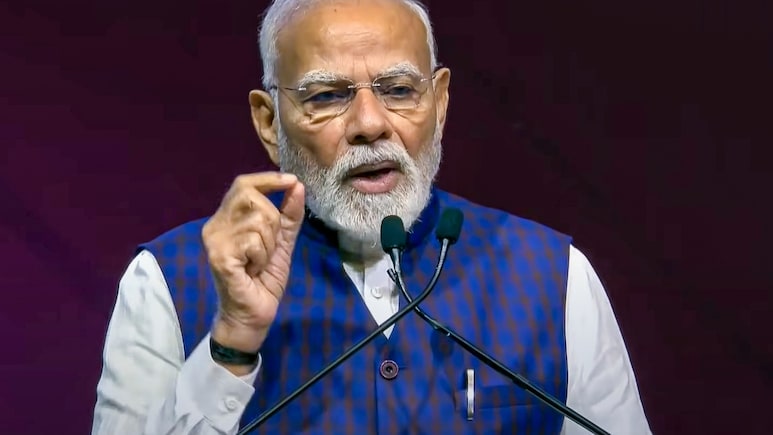
October 7 marks a quarter-century since Prime Minister Narendra Modi first assumed public office as Gujarat's Chief Minister. The moment deserves analysis rather than nostalgia, because these years are held together not by any single policy but by a governing logic summarised in an idiom: Reform, Perform, Transform. Reform the architecture, perform through saturation delivery, and let transformation be measurable. Beneath it run Nation First and Minimum Government, Maximum Governance: build systems so reliable that citizens meet the state as a service, not a supplicant.
PM Modi has developed a distinctive theory of governance: a nation earns its place at the table only after it proves it can govern itself. Twenty-five years after he first took public office, that theory has become India's operating method. He rose from grassroots karyakarta to Pradhan Sevak, and the Seva Sankalp Abhiyan launched on his birthday is that instinct in miniature: turning Jan Sewa into Rashtra Sewa, and asking all 140 crore Indians to carry that vigour towards a Viksit Bharat by 2047.
The template was forged in Gujarat, where he took the oath on 7 October 2001, in the wake of the Bhuj earthquake. He answered devastation with reconstruction for resilience. Vibrant Gujarat, launched in 2003, made the state an investment destination; Jyotigram separated farm and household feeders to steady village power. The logic is sequential: rebuild better, institutionalise the lesson, then scale it, as the Coalition for Disaster Resilient Infrastructure later did globally.
This foundational trust among Gujarat's populace subsequently broadened across the country, cementing Narendra Modi as India's longest-tenured continuously elected Prime Minister since 2014. India recorded 7.8 per cent GDP growth in the first quarter of FY 2026-27, despite global volatility as global crude oil prices surpassed $100 a barrel; the deliberate policy formulations led to holding retail price increases below 5 per cent by managing energy supply chains directly, so that LPG continued to reach households and fuel continued to reach vehicles, without the disruption several oil- exporting and importing economies elsewhere are experiencing. Capital expenditure has risen from ₹2 lakh crore in 2014-15 to ₹12.2 lakh crore in Budget 2026-27, even as the fiscal deficit has fallen from 9.2 to a budgeted 4.3 per cent of GDP. Direct benefit transfer via the JAM triad - Jan Dhan accounts, Aadhaar identity, and mobile connectivity—formed the operational backbone of saturation welfare, eventually powering a UPI network that handles 49% of worldwide real-time payments valued at approximately ₹314 lakh crore during FY 2025-26.
A parallel acceleration unfolded across physical infrastructure, where the pace of National Highway expansion surged from roughly 12 kilometres daily in 2013-14 to 34 kilometres per day by 2025. India's semiconductor story has advanced rapidly in a short period. In 2021, the country had no commercial chip plant. By 2026, twelve units stand approved, and five are in production. Students across hundreds of colleges are now designing chips. None of this was inevitable. Each was a decision made and defended, before consensus existed.
Abroad, that same discipline has matured into convening power. Hosting the BRICS Summit 2026 in New Delhi under India's chairmanship, PM Modi brought together leaders from across a fractured world, several of them active protagonists in the very conflicts dividing it, and secured a rare consensus outcome in a volatile political season. Under India's chairmanship this year, BRICS has prioritised the Global South: the New Development Bank has expanded its corpus so that developing nations can draw concessional loans for their own priorities, and the summit has introduced climate mitigation instruments, early-warning systems for farmers, and India's own Digital Public Infrastructure for BRICS countries to adopt.
That achievement is a clear vindication of his Vishwamitra approach to foreign policy: India as a genuine friend to the world rather than a partisan of any bloc, at a moment when such neutrality is rare and increasingly sought after. It echoes an earlier decision. When COVID-19 struck as a once-in-a-century shock, and few vaccine-producing nations were willing to share their supply, PM Modi launched Vaccine Maitri, positioning India as first responder and net security provider to the Global South rather than just a bystander to its distress.
That same conviction that inspired Vasudhaiva Kutumbakam, the world as one family, was placed at the heart of India's 2023 G20 presidency, projecting India's rise as reassurance rather than competition. PM Modi's message to the Summit was unusually direct for a communiqué season: humanity is one family, conflicts must be resolved through dialogue and diplomacy; as he put it plainly, this is not an era of war.
This same proactive ethos extends across the Indo-Pacific. The SAGAR framework - Security and Growth for All in the Region - conceived by Prime Minister Modi in 2015, has now evolved into MAHASAGAR, anchored in a single, steadfast belief: Indian assistance arrives before a formal appeal is even articulated. When Nepal suffered a devastating earthquake in 2015, Indian relief teams reached the site within hours. As Sri Lanka faced severe economic distress in 2022, nearly $4 billion in financial support was dispatched long before multilateral agencies finalised their assessments - a swiftness echoed when Operation Dost deployed field hospitals to Turkey and Syria in 2023. That same resolve routinely ensures the safe return of countrymen caught in overseas conflicts. Operation Ganga brought thousands home from war-torn Ukraine in 2022, Operation Kaveri navigated complex cross-domain risks during Sudan's 2023 crisis, and Indian military transports were among the first to evacuate citizens as Kabul fell in 2021. Guided by PM Modi's unyielding commitment that no Indian be left behind during international crises, these missions prove that acting as a net security provider is a deeply ingrained institutional practice.
Perhaps that is the truer measure of these twenty-five years. While many nations contend with unrest and instability, India has been steadied by a leadership willing to take hard decisions on domestic and international issues. The international order of the past seventy-five years is giving way to something genuinely new, and India is well positioned to meet it.
(Harsh Vardhan Shringla is a Rajya Sabha MP and former Foreign Secretary of India and Ambassador to USA, Bangladesh and Thailand.)
Disclaimer: These are the personal opinions of the author

