




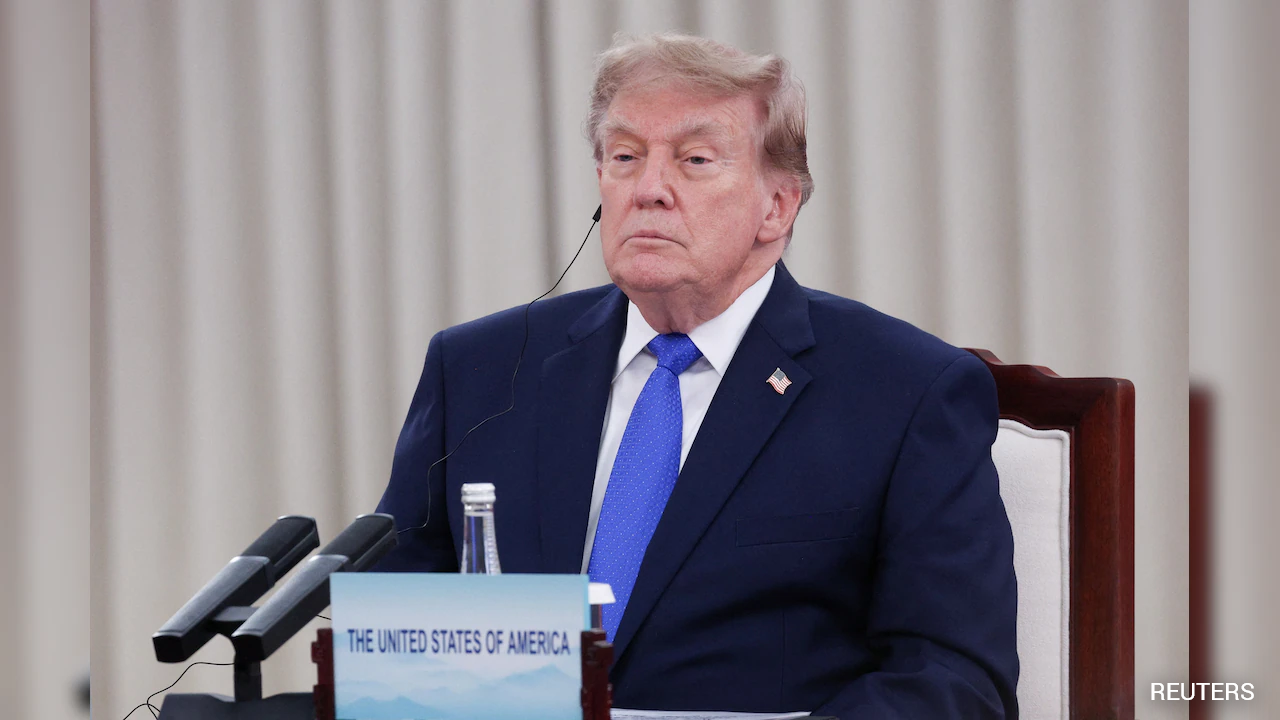
It is difficult to analyse coherently and confidently the state of global geopolitics today.
There are too many uncertainties.
The Trump administration has created these uncertainties through its highly disruptive policies, which have in many ways upended the global order as it has existed.
That order was already under stress for many reasons - the non-functioning of the UN Security Council, the erosion of multilateralism, the corrosion of the WTO, the failure to address Sustainable Development Goals, the drift on climate change issues, and so on.
The Trump administration repudiated the whole issue of climate change, walked out of the Paris Climate Change Agreement, the WHO, UNESCO and altogether 46 international organisations, used tariffs as a weapon in violation of the WTO charter, and suspended payments and contributions to the WTO budget, thereby delivering body blows to multilateralism.
Trump has violated the UN Charter through its military intervention in Venezuela and the abduction of its president. He has enunciated a Donroe Doctrine with regard to the Western Hemisphere. By interfering in the Brazilian elections, he has damaged ties with Brazil under President Lula.
He has created a crisis in US-Canada relations.
He has caused serious tensions in US relations with Europe, with his claims over Greenland, targeting the EU as an entity, interfering in the internal affairs of major European countries through his support for right-wing parties and slamming, in particular, their immigration policies. He has not spared the UK either.
The issue of European security, anchored in NATO and US protection, is causing tremors in the transatlantic alliance.
The important point is that the US still remains at the centre of developments in global geopolitics more than any other country.
No other power, be it China or Russia, affects geopolitics to that degree.
Neither country has been able to protect its interests in Venezuela, counter US policies in the Western Hemisphere, or assist Cuba meaningfully, where they have important interests.
Neither has been able to play any significant role in dealing with the US war on Iran or the security of Gulf states.
It remains unclear what effect Trump's debacle in the midterm elections will have on geopolitics.
His executive powers in the foreign policy domain make it difficult to predict what choices he will make. Whether he will be constrained or continue to be disruptive is an open question. Because he is combative by nature, he remains unpredictable.
Trump has destabilised the security architecture in critical geopolitical parts of the world.
His approach to the Ukraine conflict has disturbed the security architecture in Europe.
He has disturbed the security architecture in West Asia by attacking Iran.
In both cases, the geopolitical consequences are very considerable.
Europe has now lost trust in the US. It is now seeking to develop its own defence capabilities and rearm itself. It now seeks greater strategic and policy autonomy.
These US-European differences can add to internal strains in Europe. Germany wants to be the strongest military power in Europe, which no doubt worries France. The NATO umbrella under US control kept intra-European disputes in check. The lifting or weakening of this umbrella can sharpen inter se rivalries in Europe.
The marginalisation of Europe by the US in exploring ways to end the Ukraine conflict has adversely affected Europe's global role and image.
Whether current US mediation to end the Ukraine conflict will succeed is open to question. The fundamental positions of Russia and Ukraine, as stressed by Zelensky in a series of press conferences even while the talks are going on, are far apart. Europe seems determined to fuel the conflict by supporting Zelensky, who is now defying Trump.
The Global South is deeply concerned about the impact of this conflict on them. Food, fuel, fertilisers and supply chain disruptions are huge issues for them. India is voicing these concerns, including over the attacks on commercial shipping in the Black Sea.
In West Asia, the failure of the US to protect its own military bases and assets in the region has led to efforts to create a regional security architecture, as signified by the Mecca Defence Agreement between Saudi Arabia, Turkey and Pakistan. These countries, with their limitations, are not in a position to provide any meaningful security.
The real solution lies in the GCC countries reaching an understanding with Iran, which has emerged as a very consequential power in the region. The war on Iran was in part intended to contain its regional role, but the irony is that the opposite has happened. Iran will not yield on its position of controlling shipping lanes in the Strait of Hormuz.
Saudi Arabia would also need to reach a settlement with the Houthis to prevent another choke point - the Bab el-Mandab - from being leveraged against unhindered commercial shipping.
Until now, transatlantic unity and the G7 were pillars of the West's global hegemony. The US has alienated other G7 members in various ways. This development will yield more geopolitical space to non-Western powers.
Trump's bullying of Canada has resulted in PM Carney seeking to become an associate member of the EU.
Carney launched the idea at Davos of middle powers possessing significant economic, technological and diplomatic weight exerting influence by shaping norms, building coalitions and acting as system stabilisers, rather than letting the big powers dictate global rules unilaterally.
The so-called "middle powers" have already been broadly identified in the G20 membership, though some others could be added. Whether they could agree on an agenda and make recommendations beyond those that have already been made in G20 declarations is questionable.
As it happens, the US presidency of the G20 has eviscerated the G20's emphasis on a development agenda crafted by the G20 presidencies of four developing countries - Indonesia, India, Brazil and South Africa - by steering it towards US priorities - energy, technology and innovation, important though they are. No Summit Declaration could be issued because of a lack of consensus, administering one more blow to multilateralism.
Trump has also created doubts about US commitments in the Indo-Pacific, creating doubts in the minds of Japan and South Korea, for instance, about how much they can rely on US security guarantees. Even Taiwan has concerns.
Japan's plans to rearm itself are creating tensions in Japan-China ties. China is openly bullying Japanese PM Takaichi.
Trump's approach towards China is creating uncertainty. He seeks to accommodate China, speaking even of a G2.
The dropping of "Indo" from the US Indo-Pacific Command is seen as a political signal to China.
The US commitment to the Quad is now under a shadow. The State Department has kept the Quad flag flying, but India could not host the Quad summit. It is now supposed to be held in the Philippines as a "multilateral meeting with Quad leaders" by Trump, in a bid to underplay the meeting prior to his visit to China. Manila also provides a convenient occasion to tick the box, as it were.
The G2 idea seems a ploy to massage China's ego and ambitions as part of Trump's diplomacy of calculated flattery. China is no doubt a powerful country but, as we have seen, it is unable to project military power beyond its region; it lacks control over the global financial system, and its currency does not have the status of a global reserve currency, etc. India, for one, would not accept any kind of G2. The world's problems cannot be solved by just two countries.
The projected trilateral Xi-Trump-Putin meeting on the margins of the APEC meeting in Shenzhen will be very newsworthy, no doubt, but the results will be modest, as the Americans are already saying. China refuses to join nuclear disarmament negotiations, which Trump is seeking. The Ukraine issue is off the table, though one can expect Trump to discuss this bilaterally with Putin. On Iran, Russia and China will press for a diplomatic solution, while Trump has not given up the dangerous option of using force.
This trilateral summit could well open the doors in due course to a trilateral Russia-India-China summit that Foreign Minister Lavrov has pushed for. India has been reluctant because of differences with China and also because it is mindful of the reaction of the West, which sees such a summit as signifying a major shift of power away from the West.
The belief that the world is moving towards multipolarity is both true and not so true. If multipolarity means a dispersal of economic and political power, especially with the rise of Asia, then it is a growing reality. With this dispersal and countries developing their own capabilities, countries will form coalitions where they can to promote shared economic and strategic interests in a more fragmented, transactional and competitive world without accepted rules.
If multipolarity means a group of countries revolving around a major power, that is not quite the case, as countries now seek to establish advantageous relations where they can.
Multipolarity should not be seen as creating blocs but as allowing more independence in policymaking.
The opening up of the Arctic route, which Russia dominates, is becoming a major geopolitical issue. Trump's Greenland grab is part of US ambitions to counter Russia and potentially China, which is eyeing this trade route. Interestingly, the outreach of Finland and Norway to Russia has been explained by both leaders as intended to develop some understandings on issues relating to the Arctic.
The world, including India, now has to contend with all kinds of geopolitical disruptions and challenges, ranging from the weaponisation of technology, trade, finance, energy and manufacturing. The concentration of manufacturing in a single geography is a problem, as is a much more pronounced nationalist approach as opposed to the structures of globalisation.
(Kanwal Sibal was Foreign Secretary and Ambassador to Turkey, Egypt, France and Russia, and Deputy Chief Of Mission in Washington)
Disclaimer: These are the personal opinions of the author

