






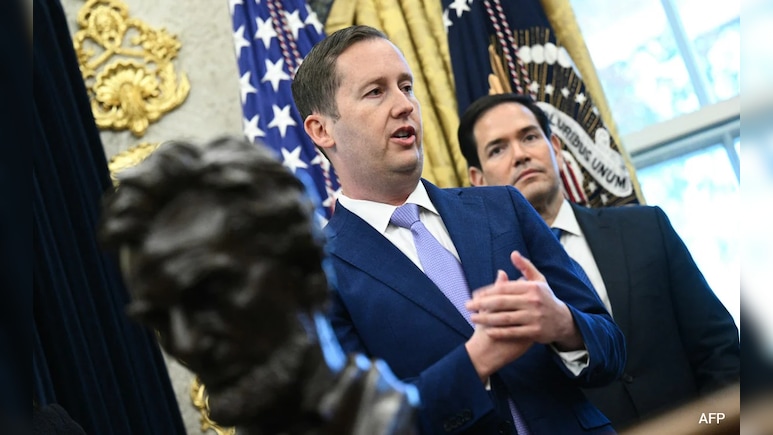
So the much-anticipated seat has now been filled. Sergei Gor, the US Ambassador to India, MAGA ideologue, and self-declared 'close friend' of President Donald Trump, is finally here after his confirmation in August. That's all rather a big basket for an Ambassadorial appointee. There's more. He's also America's Special Envoy to South and Central Asia, which is likely to puzzle the Ministry of External Affairs considerably; it might even puzzle much of the US State Department. A formidable biography for a boy from Tashkent who grew up in Malta and is now, at the young age of 38, at the helm in a region that is changing by the day. The trouble is that much of that change is being driven from Washington.
That Laudatory Speech
His first speech after arriving in Delhi was probably watched and examined from every angle. Some of it was expected, like the over-the-top praise of his President, and a respectful nod to the US Secretary of State. In all fairness, the State Department has been equally fulsome in its own praise of the 'political prowess' of the new appointee. What was somewhat jarring was the emphasis on quoting Secretary of State Marco Rubio in stressing 'reciprocity' as being the byword of the relationship. True, diplomacy is about reciprocity - there are no free lunches anywhere - but this was saying it upfront. At one level, that might be easier than untangling complicated diplomatese. Besides, our Foreign Minister Jaishankar is no less when it comes to candid comments.
The trouble is that the primary focus of reciprocity is likely to be on trade, with the US agriculture sector straining at the leash to push up exports, given the heavy debt and unsustainable subsidies. For India, that's a no-no, mostly due to political reasons. But things may change given the severe climate impact on crops, an area already facing troubles due to low productivity per acre. Nonetheless, as an agricultural nation, there is no doubt that marginal farmers need protection - and the rich a little less flab.
Meanwhile, the good news is that exports to the US went up 22% by end-2025, though this also included existing contracts on items such as shrimps, and even non-tariff products like electronics. The market remained bullish on exports to the US even as Delhi quietly adjusted to new realities, signing six trade agreements in the last few years; three of these were in the last seven months. More are to come. With President Trump now announcing 25% tariffs on any trade with Iran, it's uncertain who will be next, given that friends face an equally bad situation as foes.
All Those Adjectives Mean Little
Then there was Gor's apparent confidence in the 'friendship' between Trump and Prime Minister Modi, which doesn't mean much given how he's treated his own European partners. There were also his bullish references that "no partner is more essential than India" and references to a "most consequential global partnership" of the century - with a "could be" attached to it, unlike the past when it was a given in official documents. Adjectives mean little in an administration prone to throwing words like 'incredible', 'wonderful', et cetera, at every step.
What matters is the reality on the ground. That's what foreign policy mandarins will consider, anyway.
That One Reference
The Ambassador made one notable reference: the inclusion of India into the Pax Silica, a US initiative to improve supply chains for the now vital semiconductor business, the future of Artificial Intelligence. This is the new 'Great Game'. Apart from Japan, Australia, South Korea, the UK, Israel and the Netherlands, new entrants include the UAE and Qatar. That gives the US access to some of the richest sovereign wealth funds - Qatar alone boasts of some $524 billion - and vital power sources for massive data centres that devour electricity.
Beyond the US, Gulf States in January last year signed up for Stargate, the $500 billion data centre initiative announced by OpenAI, SoftBank, and Oracle. India is also in talks for a slice of that pie, with the government already announcing massive investments with major investors. That brings us to the fact that this is a key part of the India-Middle East-Europe corridor (IMEC), so all this hangs together. Connectivity now has multiple facets.
The Overall Relationship
Now consider the whole relationship and its realities. The US is India's largest export destination for both goods and IT services, the largest source of remittances and possibly the largest source of inward foreign investment. While official data shows Singapore and Mauritius as the top spots, everyone knows what that route is about. The US also holds the largest Indian diaspora, which was once a strength for bilateral ties. That might have been turned on its head now, as also the reality that Indian students are the largest segment in US universities, essentially providing the funding for all those big campuses. Remember also that the US has over $40 billion in services sector exports to India. Many of those around Trump, including Edward Lutnick's Cantor Fitzgerald, have a presence in India. It might be worthwhile looking at just who's got what here, and the potential.
Defence's Bumper Years May Reduce
Then there's defence. There's not really a lot going on there. But trends have shifted, with the Navy now being powered by General Electric, rather than Russian/Ukrainian companies, and more MH-60Rs ordered recently. It seems the Navy, at least, is getting ready for that Indo-Pacific role reiterated in the US National Security Strategy. There's also a relatively small order for Javelin and Excalibur missiles. The real potential lies in Reciprocal Defence Procurement. But that has considerable bureaucratic bottlenecks.
The wariness around defence is understandable given the volatility of Trump himself. One aspect is what he says. That's bad enough, including the recent incorrect statements on 68 Apache helicopters ostensibly ordered by India. Then there's what he does. It does seem now from his interview with The New York Times that with Venezuelan President Nicolas Maduro and his wife now in US prisons, his next agenda of Greenland and beyond is likely to roll out, despite the fury of a close ally, Denmark.
The Sum Of It All
This disregard for even allies is a bad portent, given the wide charge of the new Ambassador for 'South and Central Asia'. That includes Pakistan, Bangladesh and Afghanistan. 'Diploming' is going to be tricky. Diplomatic integrity normally demands strict firewalls between countries, especially if they are mutually hostile. Those protocols will come under strain under the highly unusual circumstances of today. For example, Bangladesh is certainly in the eye of US ambitions, and it's unclear whether Indian interests will align with that eventually. Pakistan is being gifted a regional role, apparently for troops in Gaza. But Rawalpindi has managed to evade that adroitly by publicising the visit of senior Hamas leader Naji Zaheer. Now, Israel has refused Pakistani troops.
Add to this any number of contradictory interests, and the permutations and combinations are staggering. No small challenge for a new Ambassador. For India, the critical need is to understand Trump's interests in the region, all of which may not be obvious. His Monroe Doctrine is declared, as in reciprocity on everything, including defence-sharing with all allies, and possibly 'friends'. Less obvious is his stance on China and its linkages with the neighbourhood. All this needs a hard intelligence-driven exercise to connect the dots and then work out a pre-emptive policy. It's not easy. It's almost akin to rolling a dice on a shifting chessboard.
(Dr Tara Kartha is a former Director, National Security Council Secretariat)
Disclaimer: These are the personal opinions of the author

