






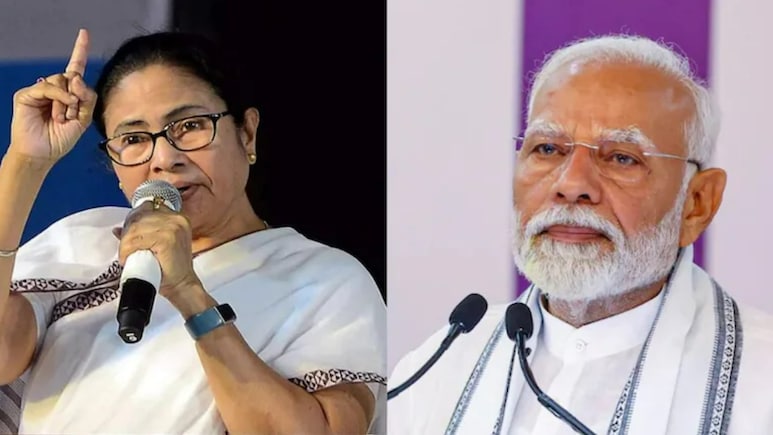
There is an old political saying: offence is often the best form of defence. Perhaps that is exactly the strategy Mamata Banerjee has chosen in the final stretch before the April 29 poll in Bhabanipur.
In this last leg, she appears to have switched to a counter-offensive strategy to the BJP's high-voltage campaigning in her home turf. Here, BJP's Suvendu Adhikari is contesting against her.
A striking example of her new approach came on Saturday in Bhabanipur. While addressing a gathering, she suddenly heard BJP campaign speeches blaring through microphones nearby. Visibly irritated, she reacted sharply, calling it unfortunate politics by the BJP. She said she had taken permission from the police to hold her meeting, yet she was being obstructed from speaking. She described the episode as indecent and unacceptable.
At one point, she even made a phone call and declared that she would move court against what she called the BJP's political misconduct. Eventually, she cut short the event, saying she would return on Sunday and hold another rally there. In effect, it was a challenge, an announcement that she would not be pushed back.
Meanwhile, the BJP camp led by Suvendu Adhikari has offered a counter-narrative. Their argument is that Mamata is complaining now, but when Adhikari held meetings in Bhawanipur, Trinamool workers disrupted them, created disturbances, and tried to prevent BJP speeches from being heard. In that sense, they say, this is tit-for-tat politics.

At this stage, Mamata also understands the social composition of Bhabanipur. Nearly thirty per cent of the electorate consists of non-Bengali voters, i.e., Hindi-speaking communities. Gujaratis, Marwaris, Punjabis and others. It is a deeply cosmopolitan constituency, with a significant young and urban electorate as well. That explains why her campaign here has a multilingual, cosmopolitan tone. In Bhabanipur, she is not limiting herself to Bengali; she is speaking in Hindi and English too. She has deployed Sayani Ghosh prominently as part of this outreach, a younger face who can engage across communities in multiple languages.
Religious inclusion is also part of this strategy. Mamata has been speaking about tolerance while reaching out symbolically across faiths, visiting temples, attending aarti, reciting the Hanuman Chalisa, and even engaging with gurdwaras and Christian institutions. These are not isolated gestures; they are part of a wider message.
But perhaps the most interesting part of her Bhabanipur strategy is something more intimate.
Instead of relying primarily on giant rallies, she has shifted to direct voter contact. She is moving through narrow lanes and bylanes, entering residential housing complexes, meeting residents in individual flats, and creating the feeling that the Chief Minister herself has come to people's doorsteps.
That personal touch matters. She is going house to house, often holding people's hands, appealing to them directly, almost saying, "I hope you will support me; I am asking each of you personally." It is a deeply localised, emotional form of campaigning. She is covering so many narrow alleys and interior pockets that, at times, even the media and camera crews are unable to enter all those spaces. And that, perhaps, is another crucial layer of her strategy.
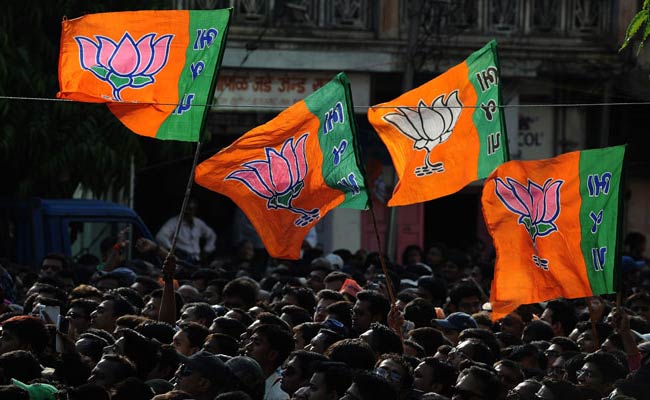
This constituency has witnessed an unusually high-voltage contest. Amit Shah himself has held a roadshow here for Leader of Opposition Suvendu Adhikari, underlining how seriously the Bharatiya Janata Party is treating this battle.
The BJP campaign has been aggressive and openly combative, built around the message that they will remove "goondas" from Bengal and that, having received a mandate in the earlier phase, their arrival in power is inevitable. In that backdrop, Mamata initially appeared somewhat defensive.
Earlier, she had often played the aggressor, projecting the election as a battle between Bengal and Delhi, as if the contest were not simply a state election but a direct political confrontation between her and the Narendra Modi-Amit Shah establishment. In many ways, she looked less like a chief minister and more like an opposition fighter taking on the centre.
Perhaps the BJP recognised the effectiveness of that framing and shifted tactics, focusing more sharply on Bengal itself as the campaign progressed. As a result, Mamata was drawn into responding to allegations and was, for a period, pushed into a defensive posture.
While the BJP is projecting force through spectacle, roadshows, aggressive rhetoric and high-voltage mobilisation, Mamata seems to be countering it with neighbourhood intimacy, symbolic outreach and personal political contact.
One side is fighting through assertion. The other, through proximity. And in Bhabanipur, both strategies are colliding at full intensity.
(The author is Contributing Editor, NDTV)
Disclaimer: These are the personal opinions of the author

