




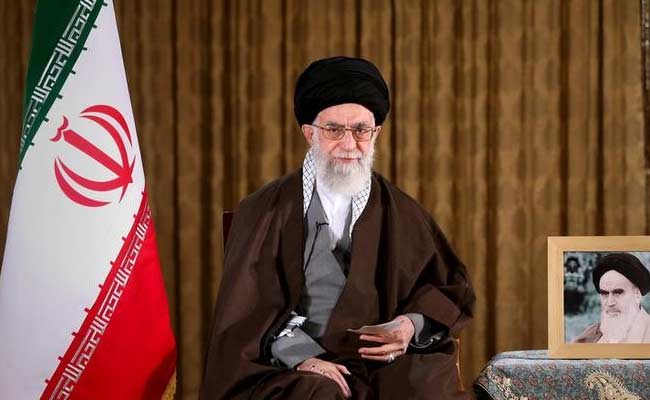
As nationwide violence and reports of mass protests seemingly subside in Iran, the sense of immediate urgency around a direct US intervention appears to have eased a bit. That does not mean the military option has disappeared. As early as Tuesday, White House press secretary Karoline Leavitt said President Donald Trump was keeping all options on the table. Airstrikes, she said, were among them. Diplomacy, she insisted, remained the first option for her boss. This was said at the same time as the president was cancelling meetings with Iranian officials (in his own words), threatening punishment, urging protests to continue and promising help in capital letters on Truth Social.
Nonetheless, the entire Gulf region is bracing itself for chaotic days and weeks ahead. When a US president urges protesters in another country to take over institutions, freezes talks and adopts an opposition slogan as his own, this has to be taken seriously. His slogan, "Make Iran Great Again", should be taken as a declaration that the White House sees itself as an active player inside Iran's internal political crisis, not a distant observer by any means.
Iran's leadership, already on edge, responded immediately. The speaker of Iran's parliament, Mohammad Bagher Qalibaf, warned that if his country is attacked, American military bases, ships and assets across the region would be legitimate targets. He went further, saying Iran would not wait to respond after an initial strike but would act on what it considers objective signs of an imminent threat. Is it bluster aimed at a domestic audience? It is unclear. But it raises the costs of an eventual war in the region.
American Assets In The Region
To understand why the Gulf is so nervous, it is worth spelling out what Iran is pointing at. The US maintains a dense military presence across the region. In Qatar, it has Al Udeid Air Base, the largest American air base in the Middle East and the forward headquarters of US Central Command, critical for air operations across the region. In Bahrain, the US Navy's United States Fifth Fleet is headquartered, overseeing naval forces in the Persian Gulf, Red Sea, Arabian Sea and even parts of the Indian Ocean. Kuwait hosts tens of thousands of US troops and serves as a key logistics and staging hub. Saudi Arabia again hosts US personnel and air defence assets following their redeployment in recent years. The United Arab Emirates provides access to ports and airfields used by US forces, while American warships regularly patrol the Gulf and surrounding waters. These are fixed, visible targets. They are precisely what Iranian officials mean when they say retaliation would not be confined to one place. In case Washington attacks, Tehran will not have to look for targets on the map. They are within Iranian missile range and theoretically prone to being attacked.
It is difficult to read into the latest move by the US and the UK. Both countries are reducing personnel at the Al Udeid air base in Qatar, with officials saying that the partial American pullback was precautionary. Britain has also tightened its posture. It has temporarily closed the British embassy in Tehran, shifting operations outside the country. Are they signs of a military move? Hard to tell.
A Counter-Effect
So, what could possibly happen inside Iran in the event of Trump's direct action? If he authorises strikes, the first effect inside Iran may not result in the collapse of the mullahs' regime. On the contrary, it could result in consolidation. In all likelihood, nationalism will override grievances. The state will move into survival mode. Protesters will be accused of collaboration and treason (over 250 have already been identified and charged, if one believes the Western media). Security forces will claim existential necessity. Space for reform may disappear. This is how authoritarian states behave when attacked, don't they?
If the US strikes Iran, will it bring Western-style democracy closer? The chances are it will push it further away. It will discredit legitimate grievances. It may very well entrench hardliners. It will confirm every suspicion Iranians already have about foreign interference. This is the tragic irony. The louder Washington cheers the protesters, the more Tehran tightens its grip. A symbolic military strike may not achieve its purpose unless the regime is sabotaged from within. We have examples in the region. Sustained pressure on the regime of Syria's Bashar al-Assad, who looked strong with the help of Iran and Russia, until it suddenly collapsed in a heap. He fled to Russia.
No Easy Options
Logistically, the US has plenty of options but no easy ones I am afraid. It has long-range bombers. It has cruise missiles. It could resort to cyber operations and, indeed, a tried and tested method over decades, covert action. All are feasible. Iran is large. Iran is militarised. It is battle-hardened. It has spent decades preparing for precisely this scenario. But today it is at its weakest in decades. I must emphasise that a limited strike would not neutralise Iran's capabilities. Iran's response would likely be like-for-like. A symbolic strike would invite a symbolic response. A sustained campaign would require constant force protection across a region already saturated with US assets.
Every American base in the Gulf would move to high alert. Every ship would become a target. Also, every supply route could potentially be vulnerable. Iran does not need to defeat the US militarily; it cannot. It believes it only needs to raise the cost of engagement. That will be Iran's calculated strategy. It has refined it over years of sanctions, isolation, and conflict.
The regional consequences would be immediate. They are already being felt. The Gulf is tense. The fear is that shipping lanes would be threatened. Insurance costs would spike. There could be chaos in the energy markets. Gulf states would publicly urge restraint while privately preparing for fallout. Militias aligned with Iran, considerably weakened by Israeli attacks, still pose threats. They would not need orders. They exist for this purpose. One strike on a base. One drone attack. One misjudged response. Escalation would become mechanical rather than strategic.
How Russia May Benefit
Beyond the region, the global consequences would be equally profound. Russia would hope to quietly benefit from the resulting chaos. It has already warned the US that its military action could destabilise the world. Russia must be hoping a distracted US would ease pressure on its military campaign in Ukraine. Rhetorically, China would play the stabilising force while exploiting the chaos economically. It might try to accelerate non-dollar energy trade with Iran and reinforce its argument that Washington is the primary source of global instability.
India would once again find itself walking a tightrope. It has long-established relations with Tehran and deepening ties with the US. A US strike and the resulting increase in energy prices would be an unwelcome outcome for India. India would, in all likelihood, not endorse military action, but it would avoid direct confrontation with Washington.
What The Protesters Really Want
Protests inside Iran have the capacity to engulf the region. Any attempt at regime change would make things more difficult for protesters to achieve their goals. Pressure of sanctions for years have crippled the Iranian economy. We must not forget that the protests began in December after the economic hardships became unbearable for the Iranian people. Let them force a regime change from inside rather than drive it from the outside.
And one more thing. President Trump is not unaware of the events of 1979. After the Islamic Revolution that year, the seizure of the US embassy in Tehran and the holding of American diplomats hostage for 444 days turned Iran into a geopolitical hotspot. President Jimmy Carter watched diplomacy collapse, capped by the humiliation of a failed rescue mission in the Iranian desert. The images of blindfolded hostages and burning helicopters became symbols of American impotence. President Carter never recovered politically. He lost his bid for a second term. Of course, we live in a vastly different world now. But that memory still lingers in American decision-making.
No doubt that the protests inside Iran have become inseparable from geopolitics. Diplomacy is increasingly becoming harder and escalation is on the horizon. The forward-looking reality is stark. President Trump can strike Iran. His military is the world's most powerful. What it perhaps still lacks, just as it did four decades ago, is certainty over outcomes. History offers help. Intervention in Iran has never delivered the control or transformation Washington wants. It has delivered instability, resentment and memories that last far longer than any presidency. Remember the events of 2021 in Afghanistan?
(Syed Zubair Ahmed is a London-based senior Indian journalist with three decades of experience with the Western media)
Disclaimer: These are the personal opinions of the author

