






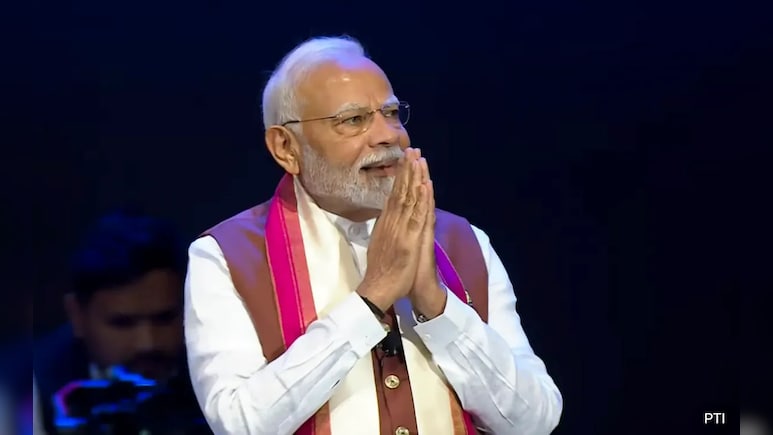
On the morning of June 10, 2026, a new benchmark is etched into the democratic history of India. Prime Minister Narendra Modi completes 4,399 uninterrupted days in office, surpassing Jawaharlal Nehru to become India's longest continuously serving elected Prime Minister. Whatever accolades are bestowed upon him on this historic day, he is likely to mark it as he marks every milestone, by returning to work and focusing on the next national mission. For, PM Narendra Modi's story has never been about power. It has been about purpose: a life dedicated to the service of India and its 140 crore citizens.
For more than a quarter century, first as the head of a state and then of the nation, PM Modi has been guided by a simple conviction: public office is not a privilege to be enjoyed, but a duty to be discharged. The eighteen-hour workdays, relentless travel and rigorous personal discipline that have become part of political folklore all spring from that belief. The significance of this milestone lies not in the number itself. Records are counted in days; leadership is measured in trust.
Three Elections. One Verdict of 140 Crore Indians.
In a democracy, there is no endorsement more authentic than the verdict of ordinary citizens. Headlines change. Narratives rise and fall. Political fashions come and go. The ballot box alone endures. PM Narendra Modi sought the people's mandate in 2014, renewed it in 2019 and secured it again in 2024. Three times, the world's largest democracy entrusted him with its leadership. At a time when incumbents across much of the democratic world from London to Washington have struggled to retain public confidence, that achievement carries significance far beyond electoral arithmetic.
Though Nehru assumed office in 1947, his elected tenure began in 1952 and lasted until 1964. Modi's entire record rests on mandates won at the ballot box. Every one of his 4,399 days in office has been validated by the sovereign will of the people. That is more than a political achievement. It is a rare and sustained expression of public trust, a national verdict, renewed across three elections, on a style of leadership, a model of governance, and a vision of India's future that millions have repeatedly chosen to endorse.
The Economy: From Drift to the Fastest Climb on Earth
A mandate is worth only what is built with it. In 2014, India was the world's eleventh-largest economy. Today, it stands at the threshold of the third, the fastest-growing major economy expanded by close to 90%, while the world managed barely 35. Nearly 25 crore Indians have walked out of poverty, certified by the world's own agencies and not merely by New Delhi, and have turned from claimants on the State into contributors to its rise. The GST, called impossible for a generation, was passed and then simplified. Article 370 was folded into history. And the everyday face of it: new highways and airports, a railway remade, a vegetable seller in a village taking payment on her phone through a homegrown marvel the world now copies.
The Reformer Who Cleared the Path
Above all, he has been a reformer of rare appetite, across every sector at once. He has gone after the deep social and economic ailments that plagued the country for generations, and gone after them methodically, unshackling the potential of the individual Indian. More than 1,500 archaic laws, many of them colonial relics, have been struck off, and some 40,000 needless compliances lifted from the backs of citizens and enterprise. The criminal codes once written by rulers for subjects have given way to laws written by Indians for Indians. The aim runs through it all: easier living for the family, easier business for the enterprise, easier justice for the wronged. A state that once stood in the citizen's path has learned, statute by statute, to step aside.
A Nation Learns to Say, I Can
The deepest change cannot be weighed or counted, for it happened inside the mind of the ordinary Indian. A country that once apologised for itself learned to say, aloud, I can. A startup ecosystem grown from a few hundred ventures to more than 2.3 lakh, throwing up some 24 to 25 lakh jobs, half of them in towns the big cities forgot, a third led by women. Space and drone sectors, once sealed behind a single official door, now teem with thousands of young companies. And on the night Chandrayaan touched the dark south of the Moon, a girl in a small town understood, without being told, that the ceiling she had been promised was never there.
The Last Indian in the Queue
There is one Indian this era set out, above all, to find: the one always left at the very end of the line. He reached her through the largest digital public infrastructure on earth, the trinity of Jan Dhan, Aadhaar and mobile, which put a bank account, an identity and a payment gateway in the poorest hand. With it, the old leakage, where a rupee left Delhi and reached the poor as a few paise, ended; the whole rupee now reaches the hand it was meant for. A free sack of grain through the pandemic, a health card under Ayushman Bharat, a tap in the courtyard, a clean flame, a roof of one's own. To the woman who finally received them, these are not statistics. They are the distance between fear and dignity.
That confidence now travels with the nation abroad. For decades India entered the world asking to be understood; today it walks in carrying proposals. Its G20 turned a club of the rich into a megaphone for the Global South and seated the African Union for good. A country once the world's largest buyer of arms now builds them on its own soil, as self-reliance hardens from slogan into supply chain. And when terror struck, Operation Sindoor replied with the cold precision of a state that has stopped pleading and started deciding. The old powers no longer ask what India will accept. They ask what India proposes.
Before He Led India, He Lived It
To understand the Pradhan Sevak, know the journey that made him. Born in 1950 in a small Gujarat town, as a son who helped at his father's railway platform tea stall before he left school. As a young man he did what few leaders would dare: For years he wandered across India, from the Himalayan shrines to the ashrams of Bengal to the southern coasts, sleeping rough, learning the nation not from books but from her dust and her people. Long before he governed a state, he knew her districts and villages, her faiths and her poor more intimately than almost anyone who has held his office. When such a man speaks of serving 140 crore Indians, he is not reaching for a phrase; he is naming the country he has lived among all his life, and whose pulse he carries like no one else.
The Vow That Never Broke
No government in a vibrant democracy should be beyond scrutiny, and this one has never sought to be. But on the measures it chose to be judged by, the strength of the economy, the dignity of the poor, the ease of everyday life, and India's standing in the world, the years since 2014 will rank among the most consequential in the history of the Republic.
Where Nehru's innings ended in 1964 with a republic still searching for its voice, Modi leads one the world now strains to hear, brick by deliberate brick, he is laying the foundation of a Viksit Bharat. These 4,399 days were never one man's possession. They were a trust, given by the people and held in their name. And the lesson these 4,399 days carry is that in the world's largest democracy, power is not a prize to be possessed but a responsibility to be honoured, and the only way to retain the trust that confers it is to never stop serving the people.
(The author is a Senior Advocate practising in the Supreme Court of India)
Disclaimer: These are the personal opinions of the author

