




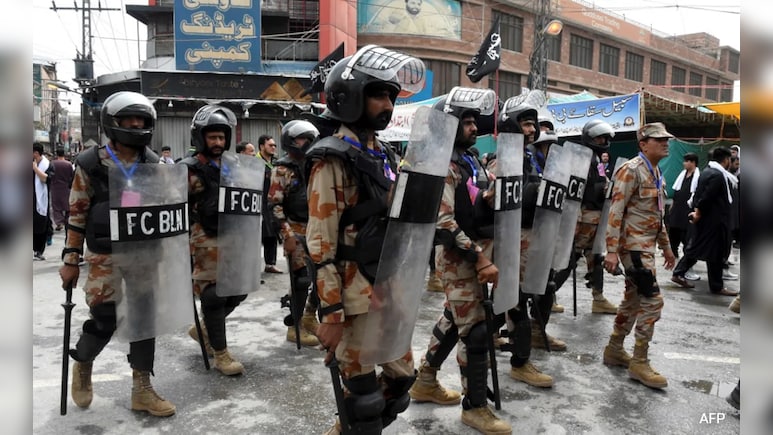
In the early hours of January 31, Baloch freedom fighters belonging to the Balochistan Liberation Army (BLA) launched their biggest, most audacious and spectacular offensive against the Pakistani state. Operation Herof-2 was the second such complex and coordinated attack after Herof-1 in August 2024. In both scale and scope, Herof-2 was bigger and bolder, with insurgents launching over 40 simultaneous attacks in over 12 districts covering the length and breadth of the restive province. According to some estimates, anywhere from 500 to 1,200 guerrillas were involved in the attacks, which targeted big cities and urban centres, including the capital city Quetta and the most secure Quetta Cantonment. Despite the brave face that Pakistan Army and its subordinates in the installed civilian regime are putting up, and the claims of victory being made by the predominantly Punjabi media of Pakistan - which acts as a mouthpiece of the quasi-military-hybrid regime - there is egg on the faces of the self-appointed field marshal and the rest of the security establishment, which was taken by complete surprise.
Shock Treatment
The total collapse of the writ of the state, even if it was for a few hours, has sent shockwaves through the province and the Pakistani state. The fact that the insurgents were able to infiltrate highly secure areas, including the capital city and the cantonment situated there, and were able to attack government offices, security bases and encampments in different cities, has exposed the hollowness of the claims being made by the dubious chief minister and other security officials. Despite official denials, the fact that the situation in Balochistan was fraught and fragile was not a secret. Government officials, ministers, top politicians and even tribal chieftains were unable to travel on highways, even with security. Trains were routinely targeted, and militants used to set up checkpoints on highways, and then melt away before the state could respond. The morale of the local security forces had plummeted. Police officials and civil servants were terrified and unable or unwilling to step out of the safety of their offices. Politically, the alienation of the people from the Pakistani state was at an all-time high. Repressive policies of the security forces, which operated with complete impunity and were given a license to kill, kidnap, forcibly disappear people, invade homes, clamp down upon media and any kind of dissent, only added to the disaffection among the Baloch.
But despite the complete disregard for human, civil, legal and constitutional rights of the people, and total absence of any kind of political outreach, the military-dominated hybrid regime in Islamabad and its local appendage in Quetta were unable to control the situation. Since hybrid military regimes can never accept failure, they must look for scapegoats. It is always easier to blame problems on an external player than admit your own blunders and staggeringly stupid policies. India is, of course, an obvious bogey whenever something goes wrong in Pakistan. The military in Pakistan thinks that labelling the Baloch freedom fighters as 'Fitna tul Hindustan' (subversion by India) can help it get over the problem.
Blaming The Wrong People
Without providing a shred of evidence, the Pakistani authorities and their media mouthpieces (even the private media in Pakistan is nothing if not the Pakistani versions of Pravda and Peoples Daily, only it is controlled by the army and not by any political party) have been quick to allege that India funds the insurgency. By way of evidence, they point to the film Dhurandhar as an admission of India accepting its role in Balochistan. What is more, they use a statement of BLA that it shares a common enemy with India as further evidence. What none of these alleged journalists and analysts (mostly retired Pakistan military personnel) bother to ask themselves is why, if it is so easy for India to indoctrinate people in Balochistan by paying them money, the same tactic hasn't been used in other restive areas like Khyber-Pakhtunkhwa, Pakistan-occupied Kashmir, Sindh and Punjab.
The more the situation in Balochistan deteriorates, the more the Punjabi establishment and their collaborators add new names to the list of usual suspects active in Balochistan. If the delusional Pakistanis are to be believed, Balochistan is the playground not just for India's RAW, but also Israel's Mossad, America's CIA, the UAE intelligence, and, of course, the Afghan or Taliban intelligence service. With US-Iran tensions on the boil, there were many Pakistanis who linked Operation Herof-2 with the larger American game plan to Balkanize Iran. Assisting the Americans in this were, of course, in their view, the Israelis and Indians. The UAE has also been projected as a troublemaker because the Pakistanis think the Emirates want to undermine the dysfunctional Gwadar port, which they think will seriously dent the UAE's ports. Among the grand conspiracy theories that the Pakistanis have conjured up is that countries like India, the US, the UAE and Israel have a common interest in sabotaging the almost defunct China-Pakistan Economic Corridor (CPEC) and are, therefore, working in tandem. Pakistani 'grand strategists' are also convinced that the Americans have been actively sponsoring Azeri, Kurd, Arab and Baloch groups in Iran to split the country. They have convinced themselves that the Americans will bomb Iran and create a chaotic situation in which these groups will be able to separate, leaving behind a rump Persian state.
A Larger Movement?
The southeastern Sistan-Balochistan province of Iran has been disturbed for many years now. The Iranians have managed to keep a lid on the province using brute force. But the predominantly Sunni Baloch province of Sistan-Baluchistan has close links with the Pakistani-controlled Balochistan. While the nature of the struggle in Pakistan-controlled Balochistan and Iranian Sistan-Baluchistan is quite different, both movements gain from each other. Add to this the notoriety of this entire belt as a hub of human, guns and narcotics smuggling, a lot of which takes place with the connivance and complicity of the security forces. Another explosive element in this already deadly mix is the reported American backing for Sunni extremist groups like Jaish-al-Adal, which is based in Pakistan but is carrying out attacks in Iran. The Iranian security forces have occasionally carried out cross-border raids into Pakistani territory in pursuit of these terrorists. For their part, the Pakistanis believe that Iranian territory has been used by Pakistani Baloch insurgent groups to mount attacks inside Pakistan-held Balochistan. Both countries exchanged missile attacks almost two years ago and targeted what they called terrorist bases and camps in each other's territory. In this deadly cocktail has been mixed the Mossad, which is accused of having established a big network in Sistan-Baluchistan.
There is growing trepidation in Pakistan establishment circles that there could be a new great game underway in the region to create a Greater Balochistan comprising Sistan-Baluchistan and Balochistan. This is not just a mineral-rich area, but geographically, a very pivotal area. A Greater Balochistan will alter the geopolitics of the region, straddling not only the entire Gulf region but also providing a base to access Central Asia and keep a watch over troublesome areas in Iran, Afghanistan and a rump Pakistan. In fact, the geographical relevance that Pakistan keeps talking about comes from its control over Balochistan. The Pakistanis are losing sleep at the thought of powerful regional and global players waking up to the importance of Balochistan. Operation Herof 2 and the larger Baloch uprising are, therefore, no longer being seen as a local separatist movement but as part of a larger global conspiracy to cut not just Iran but also Pakistan to size.
(The author is a Senior Fellow at ORF)
Disclaimer: These are the personal opinions of the author

